“So should I just… go over and talk to him?” Grimes asks her friend as she stares at tonight’s guest of honor, Nick Land, the father of accelerationism. “He’s surrounded.”
“How else? Come on,” her friend prods, pushing her forward. “OK,” she exhales, then wades across the room, dodging tech-right scenesters and neoreactionary acolytes. Recognizing her, Land grins back, dispersing the bug-eyed crowd that has swarmed him, and clasps her hands as if greeting a daughter. “It’s you!” he beams.
Yesterday, I had no notion that I’d be witnessing a scene like this. I was at home in New York, lying by my window peering out at snow from the recent blizzard, when my friend Sam Venis, a network state researcher, texted me an invite link. It read “Nick Land Acknowledgement,” an ironic, woke-baiting title, and in its description detailed a private celebration hosted by Wolf Tivy, the founder of the allegedly Peter Thiel-funded Palladium Magazine, welcoming the reclusive philosopher to San Francisco.
“Fuck,” I typed back.
“Should we go?” he asked.
“We have to.”
“Anastasia’s going to be mad. We’re supposed to fly to Puerto Vallarta tomorrow.”
“Bro…”
“Yeah…”
The next morning we got on a flight from Newark, and after checking into our Airbnb in the Sunset District, were that evening in an Uber to a Mediterranean-style mansion in San Francisco’s ritzy Sea Cliff neighborhood. Pulling up, we saw a matte gray Cybertruck parked outside. “Think this is the place?” joked Sam. Approaching, we found two large bouncers managing a small line of people. I feared they might be spooked by my camera, but we were admitted quickly, passing into a paved courtyard with a palatial fountain.

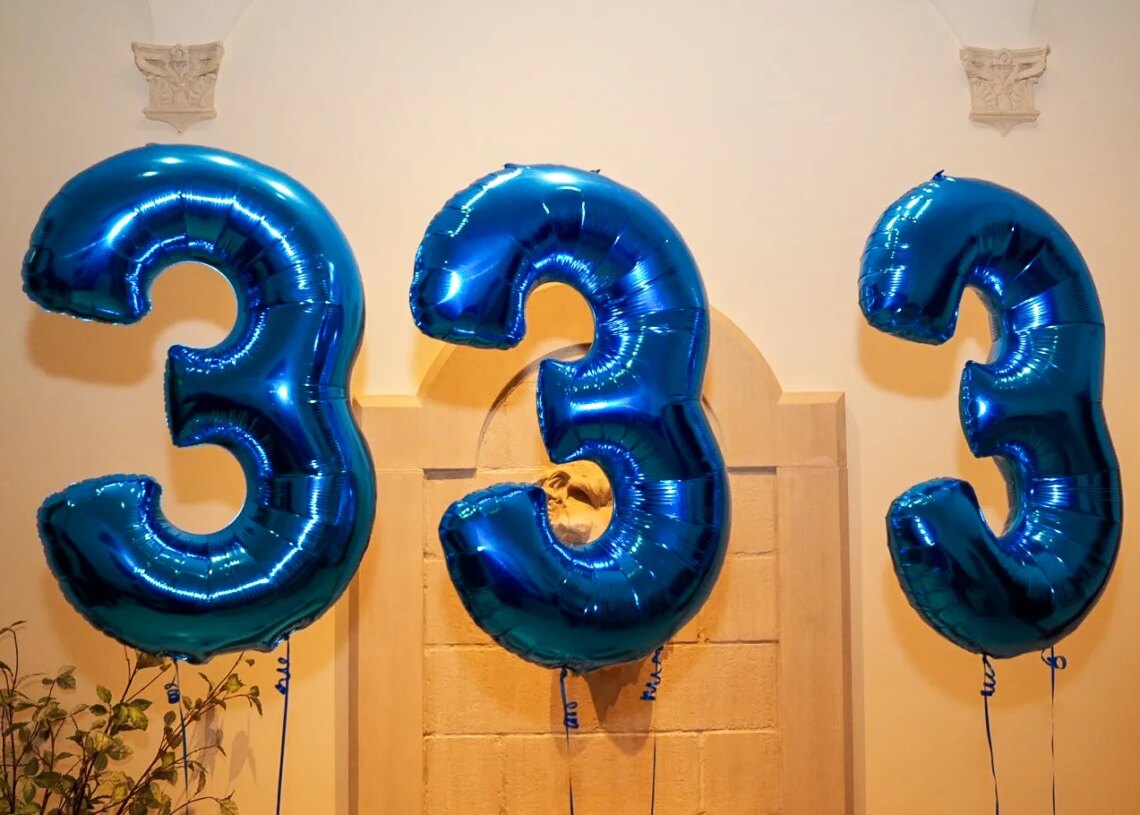
The mansion, I was told, was owned by David Holz, the founder and CEO of Midjourney, the AI image-generation company who in the coming months will “unveil a wide range of ambitious projects under the themes of… beauty and human flourishing.” Yet upon entering, the first thing I saw were three blue balloons, each the shape of the number three. “333” was a symbol often linked with Land and his former Twitter avatar. Drawn from Aleister Crowley and Kenneth Grant’s occult system, it represents Choronzon, the Demon of Dispersion: a chaotic, ego-destroying entity that scatters thought, identity, and structure into incoherence. In Landian thought, it serves as the perfect sigil, signaling that capitalism and technological acceleration are a destabilizing force propelling humanity into irrelevance. A blonde child was tugging on their strings, and had to be told to stop.
To the left of the hallway were stairs to a room with a table of sushi and other assorted snacks. By the host’s request, there was no alcohol or drugs. “Certainly not by Land’s request,” Sam quipped. “Don’t worry man,” I replied. “I snuck us in some Hennessy.” To the right was a massive living room, elegant but sparsely decorated, containing several white couches, a grand piano, and views of the Golden Gate Bridge. I thought it resembled a Bond villain’s lair.
Despite its size, the room was packed with partygoers. I recognized several familiar faces. By the windows stood Dagsen Love, a cherub-cheeked former Dimes Square it-boy, who once told my friend his goal was to DJ his way to Davos. Nearby was Max Novendstern, the co-founder, with Sam Altman, of Worldcoin, a cryptocurrency utilizing iris scans to exchange biometric data for crypto tokens, so as to prove digital identity. On the couch sat Levy 1929, a local e-girl friend and oft-viral comedian. She was relieved to see me. “Thank God,” she said. “I thought I noticed you on the list. It’s so good to have an ally here. A lot of these people are annoying.” And finally, leaning on a wall surrounded by admirers, was Land himself.
From afar, he appeared unassuming, even subdued. Is this really the man, I asked myself, who’s embraced the extinction of the human race? Who’s claimed possession by demons and communed with interdimensional “lemurs,” coined the term “hyperstition,” who left academia after an amphetamine-induced meltdown? Who has predicted the rise of a new kind of post-racial “hyper-racism,” where intelligent elites advance ahead and “genetic refuse” is left behind? Who former CCRU colleague and apprentice-turned-antagonist, the late Mark Fisher, called “our Nietzsche?” He didn’t seem terrifying enough.
“These ideas, once the fringe premonitions of an early internet cyberpunk, have started influencing the policies of the most powerful people on Earth”
Facing him, I felt uneasy, unsure how best to approach. I had first encountered Land’s ideas in another life, while teaching in Shanghai. In the years since, his work—which exalts production ahead of people, dismissing humans as meat puppets waiting to be discarded to make way for the alien intelligence that will become the true protagonist of history—has haunted my days and dreams. After learning we shared a city, I often wondered if we’d ever cross paths. In the intervening years, these ideas, once the fringe premonitions of an early internet cyberpunk, have started influencing the policies of the most powerful people on Earth.
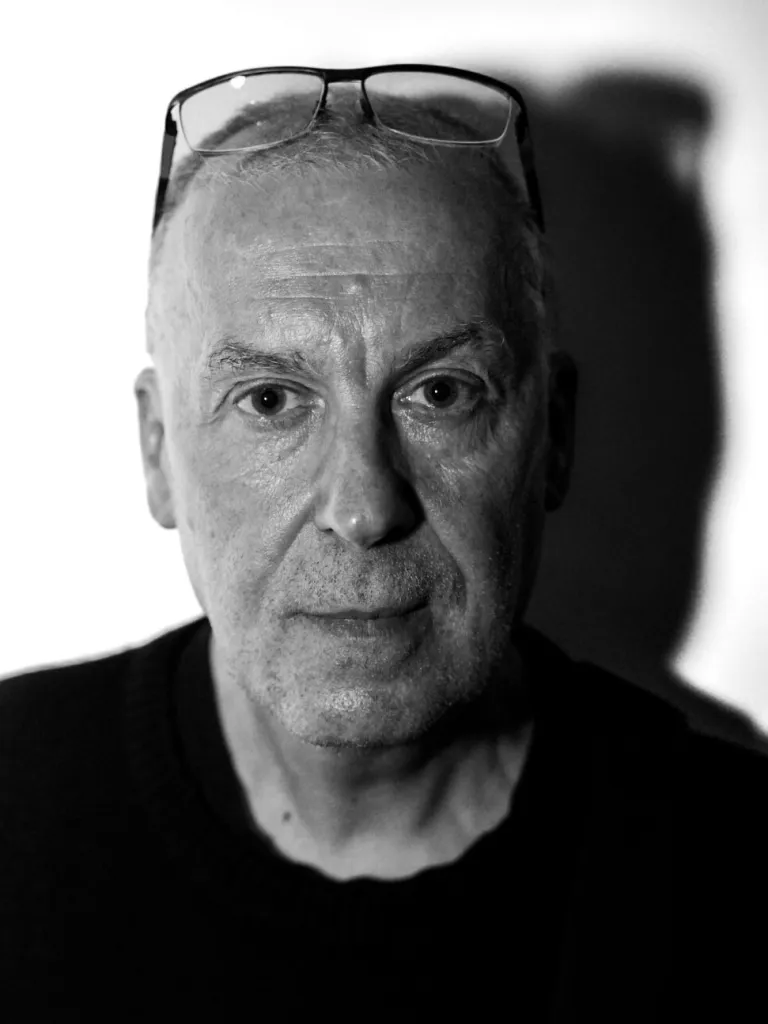
I walk over and introduce myself. “Nice to meet you,” he says, holding my gaze. He’s genial but there’s an intensity to him, and sheepishly, not knowing what else to say, I ask if I can take his picture. I line up my Sony, but whiff on the first shot, dousing his face in harsh flash. Thinking I’ve fucked my chance, I panic, but he agrees to a second try.
Not long after, Tivy takes the stage, announcing that the Q+A will begin shortly, and suggests the attendees take their seats.
I sit next to Levy. “Do you actually like philosophy?” she asks me, yawning.
I shrug my shoulders. “Well, I minored in it.”
“Really? It’s so boring.”
Finally, Tivy brings Land on stage. “San Francisco!” the compere shouts. “It’s been a long time coming, but now, finally, let’s say a proper Nick Land acknowledgement!” The crowd bursts into applause at this repeated joke, while several small children crawl around the guest, happy and giggling. Land, unaffected, takes questions from the audience, speaking densely and extemporaneously about Gnostic Calvinism, simulation theory, the inevitability of human death, the nature of cosmic despair. After about an hour, Tivy turns to the audience, and announces that a surprise guest will be joining proceedings.
Chest puffed and in aviators, Curtis Yarvin, that other would-be rock star of the neoreactionary scene, emerges from the crowd. “For the record, I’m not wearing these because I’m trying to be cool,” he clarifies from the stage in his distinctive monotone. “I’m wearing them because I lost my prescription.”
“Curtis is looking good,” I hear someone whisper. “He must be back on Ozempic.”
It’s the first time that the two men have met. Yarvin emerged first under his blogger pseudonym Mencius Moldbug, critiquing modern democracy as a failed system distributively controlled by a leftist “Cathedral” comprised of media, academia, and the bureaucracy, and proposing a CEO-monarch supplant it and take the reigns of power instead. Land wrote admiringly of Yarvin’s work in his 2012 book, The Dark Enlightenment, and ever since, the two have been grouped together, Land serving as a Kant-type underpinning the movement’s cosmological structure, with Yarvin the reactionary Rousseau articulating their political project.
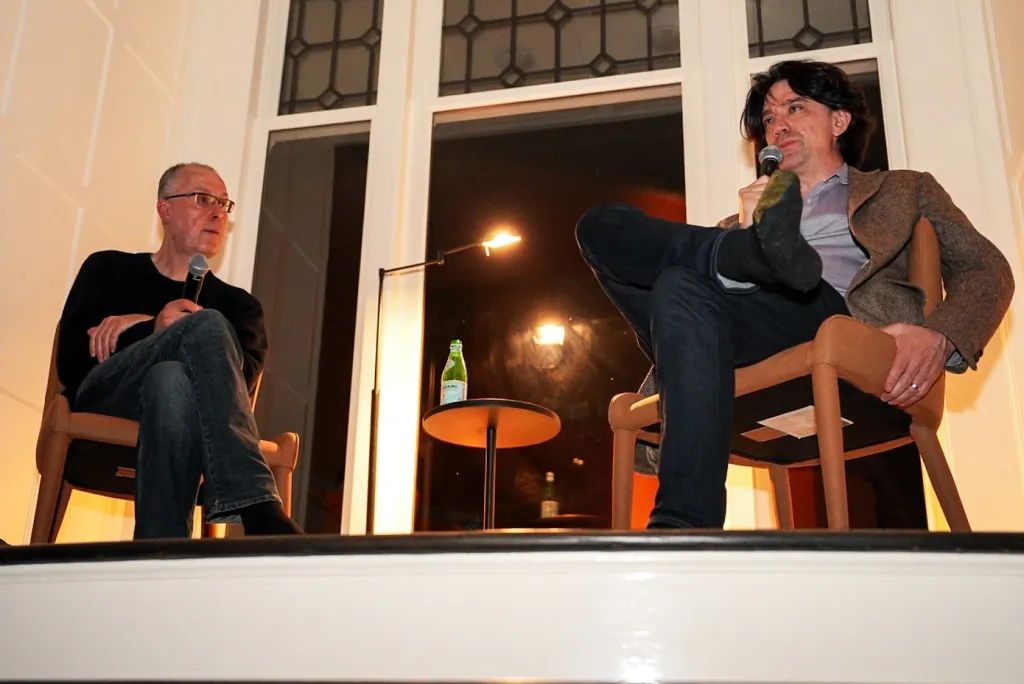
Yarvin, true to his reputation for rambling, does most of the talking, while Land gives short one- or two-sentence answers, or simply nods in quiet affirmation. One questioner asks if the pair still believes, even now, in this time of rightist triumph, that “Cthulhu always swims left,” an old neoreactionary meme contending that society inevitably becomes more progressive over time, a kind of “based” reimagining of Martin Luther King’s famous “arc-of-justice” line. Land simply says no, and that he never said that, while Yarvin launches into a long-winded, discursive answer, explaining the conditions under which it’s both true and false, but clarifying that it’s mostly, usually, true, in an argument that touches upon the late Roman Republic and why it’s really incredible that in 1970s China you had different factions of Red Guards killing people in the streets, just a bloody, undeclared civil war, especially now that China is very depoliticized—in fact, one of the most depoliticized nations in history, they’ve barely any thoughts on politics at all—and that in Rome, after the transition to Empire, elections would be like Monty Python, a pathetic farce, and that it’s all, like, entropy, or a rusted car, or a car that needs to rust more, something like that, but that really, he’s just very, very curious about the Chinese. “What’s your take, Nick?” he turns and asks. “Well… There’s a lot of stuff there…” Land muses. Many in the crowd sigh.
“Why is Curtis like this?” A young man whispers to his girlfriend. “Why can’t he stop talking? We want to hear from Nick!”
“I know,” she replies. “It’s giving Toy Story Woody and Buzz.”
Eventually, the audience grows restless, and their phones come out. Levy’s eyes glaze over. Sensing a loss of energy, Wolf signals that it’s time for one final question, and a torrent of hands shoots up. Sam’s is among them.
“Both of you are on stage because you created the Dark Enlightenment,” he says, pausing as he collects his thoughts. “An ideology which was very potent at a certain moment. Now, though, I’m not sure if that moment has passed, but it’s changed. How, then, do you both feel the concept has evolved, and how do you see it evolving further?”
Unsurprisingly, Yarvin responds first. “The Dark Enlightenment,” he says, “was responding to a set of different utopias—maybe it’s a conservative utopia, maybe it’s a liberal utopia, but it’s all the same teleology, this dream of a place that we’re going, and these progressive movements have, of course, moments of disillusionment, such as with the George Floyd hangover, or with Occupy Wall Street. These people had a millenarian view of the world that failed, and even on the right, there were all these fantasies of, like, restoring the 18th century, and that they were the second Tea Party—never mind that the original Tea Party was basically Antifa—and then their whole dream turned into the shitshow that was January 6th. What we see now is that these visions of the future have become nullified, and rather than history ending in the Fukuyama sense, instead nobody has any clear idea of where we’re going, and that inevitably allows for more interesting, more radical, ideas to spread.”
Land nods. “I agree with a lot of what Curtis said. But really, I still firmly believe that the Unqualified Reservations model of government [a neocameralist system that treats government as a sovereign corporation owned by shareholders] is completely unsurpassed, and it would be absolutely fantastic to have this world shattered into a patchwork of microstates, and to have new modes of geopolitical experimentation open up. But I don’t think, in the short term, anyone is seeing that now.”
After their talk concludes, a group of us, including Sam and Levy, shuffle out into the courtyard to smoke. Sam looks particularly satisfied with himself. “They took my suggestion,” he brags.
“What do you mean?” I ask.
“The Land-Yarvin conversation. That wasn’t on their agenda. I told Wolf they should do it.”
“That was you?” Levy interrupts, angrily glaring at him. “Jesus. You were almost the reason for my suicide note. That was awful.”
“God, everything used to be so much worse, and now look where we are. We’ve got AI! We’ve got crypto! We’ve got power! The siege mentality is over! Woke is dead and gone!”
—Justin Murphy
“I agree,” says a voice from behind us. “I don’t get why they were so solemn.” We turn, and sitting on the fountain smoking a wood pipe is Justin Murphy, host of the Other Life podcast and author of Based Deleuze, which reinterprets the French philosopher’s beliefs as a “reactionary leftism” laced with anti-egalitarian ideas. In 2020, it was Murphy who hosted the first event with Yarvin since his public doxxing and unofficial banishment from Silicon Valley, in many ways shepherding the arrival of the Dark Enlightenment into public discourse.
“They confuse me,” he continues. “They’re always so negative. God, everything used to be so much worse, and now look where we are. We’ve got AI! We’ve got crypto! We’ve got power! The siege mentality is over! Woke is dead and gone! In fact,” he smiles and blows smoke, “Tonight probably marks the end of the ‘dissident’ right.”
“What do you mean by that?” Sam asks.
“Well, what more is there?” He replies. “We’ve done everything.”
I consider what he’s saying, and whether it’s he or I who is living in a bubble.
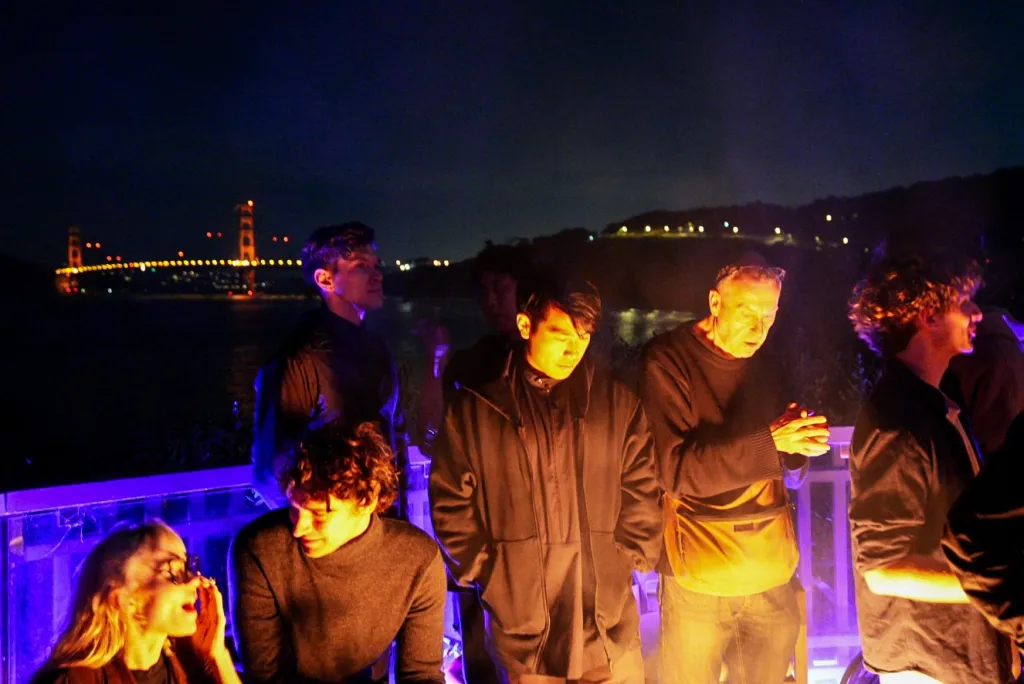
We linger outside talking for a little longer, and upon coming inside, notice that many of the guests have disappeared. A short man with round glasses tells us that they’ve mostly migrated downstairs to the back terrace, where Land and Grimes are having an impromptu conversation and fielding questions. We walk down the stairs to join them, and find the crowd clustered around a cackling fire pit overlooking the Bay.
I take a seat and observe the discussion, taking pictures of the scene. A raven-haired girl comes over and offers me ketamine, boasting she smuggled it in, and soon, the party starts to fade out.
The next day, Sam left to be in Mexico with his girlfriend, and I crossed the Bay to visit my father at my childhood home in Livermore. He was drinking a Coors in his recliner as I lay on our couch, recounting the strange events of the previous night. The hockey was on TV, and San Jose was down late in the third to Colorado. He was shaking his head. He’d never heard of accelerationism, Nick Land, or the Dark Enlightenment. “Yeah, I don’t like this,” he said, sipping his beer. “I believe in the human spirit. We should’ve just frozen technology 20 years ago. That’d have been perfect.”
“That’d have been nice,” I replied.
“Unless… Wait… Did we have flat screens then?”
“I think?” But I couldn’t remember.
“Okay, good, then that’s fine.”
And together we watched the Sharks score one last goal, futile, yet valiant, as they fell 4-2 to the Avalanche.
The post Sunset on the Dark Enlightenment: Inside Nick Land’s San Francisco ‘Arrival Party’ appeared first on VICE.