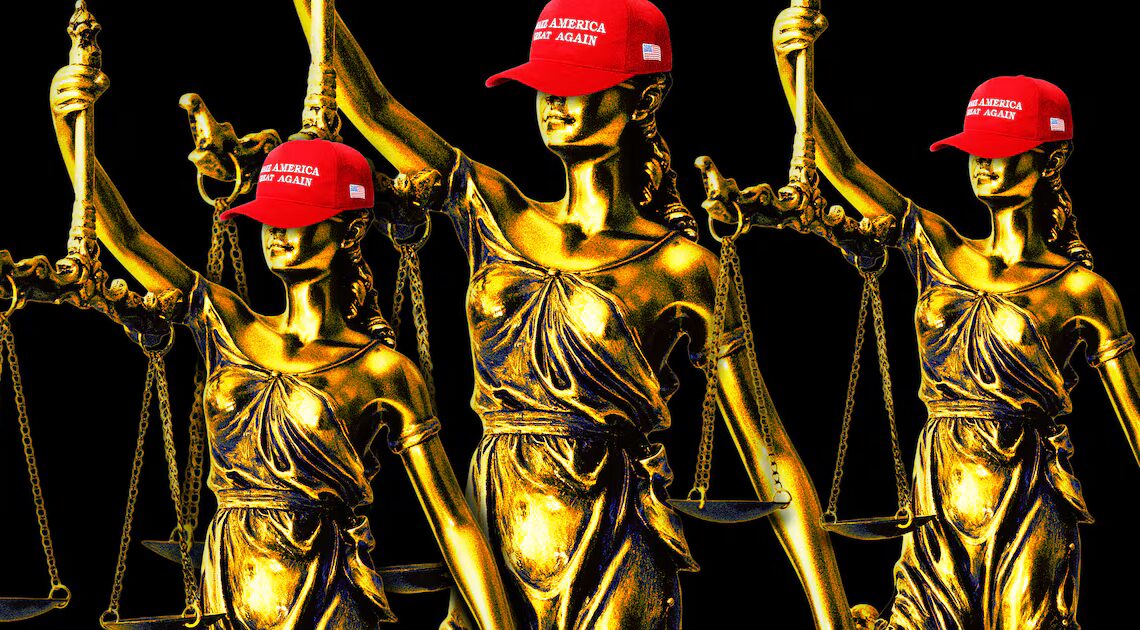
In Donald Trump’s telling, he has to win every election for his own ego. It’s good for America too, he’d argue, but that’s not really the point. (Or the truth.) So to assure his future well-being, he is working to stack the system with judges who will rule for him under the guise of preserving election integrity whenever he or his allies are questioned, and whose very presence—mostly white and mostly male—will resonate with his MAGA base.
Of the 34 individuals Trump nominated for lifetime judicial appointments in the first year of his second term, 26 were male, 31 were white, zero were women of color and zero added professional diversity to the bench— certainly no defense attorneys or non-profit types.
Twenty-six were confirmed.
Beyond their nominations reflecting Trump’s wish to Make America White Again, there is a noticeable unanimity across these candidates in their responses to questions about the 2020 presidential election in their Senate confirmation hearings, as though they’d been coached. (Trump, of course, remains fixated on cementing his alleged victory in 2020, an election he says was rigged.)
When Democratic Senator Richard Blumenthal at a hearing late last year asked three nominees, lawyers nominated to be federal district judges by Donald Trump, whether the Capitol was attacked on January 6, they refused to answer. Each instead parroted a standard remark—that President Biden was certified as the winner, leaving open the question of whether the actual result was in doubt and ensuring they remain in good standing with the president who had nominated them.
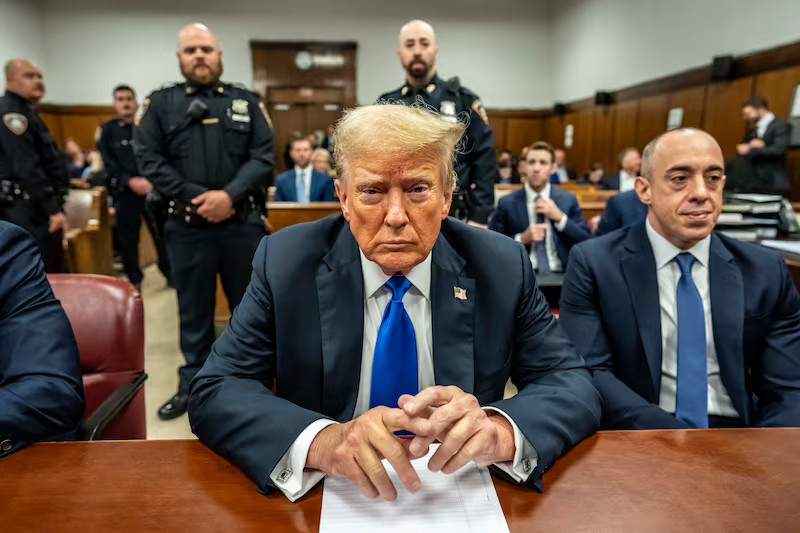
Some have direct ties to Trump, like Emil Bove—formerly the president’s personal attorney. Confirmed to a lifetime appointment on the Third Circuit, Bove tops the list of what the advocacy group Alliance For Justice (AFJ) calls “Trump’s Allegiant: The Lowlights.”
Whatever Trump wants, Bove complies. Having been initially rewarded with a position at the Department of Justice, Bove behaved there like he was above the law. A whistleblower reported that he had encouraged the department to ignore lower court orders to return a plane of immigrants that had been wrongfully deported. Bove later wrote the memo that instructed the Southern District of New York to drop charges against New York Mayor Eric Adams for soliciting bribes and campaign contributions in return for Adams’ cooperation with Trump’s aggressive immigration tactics. When several prosecutors refused to carry out Bove’s order and quit, he stepped in and made personally sure the charges were dropped.
Another particularly notable sycophant is Jennifer Mascott, confirmed to the Third Circuit where she has no ties other than a beach house in Delaware. Her appointment can be chalked up to her outspoken support of unfettered executive power. A thumbnail sketch of her in the AFJ’s report on Trump’s year in judges cites her support for a “King-like executive” having argued in congressional testimony that subjecting a president to criminal prosecution for official acts would be an unacceptable threat to the office. (To be ‘fair,’ this appears to be the position of our current Supreme Court. Maybe Mascott has plans to climb the career ladder further still?)
In his first term as president, Trump went a long way to transforming the judiciary. He got a record number of judges confirmed, and they are young conservatives who will be around for a generation or two. In his second term, the pace has slowed considerably.
On Thursday, he announced four nominations on Truth Social, one for the Virgin Islands, one for the Court of International Trade, one for the district of Montana, and another for the district of South Carolina—a Black woman, Sheria Clarke, who has worked with former GOP Rep. Trey Gowdy, a rabble-rouser when he was in Congress.
These follow four nominations made in January to other district court seats.
Of course, with Trump you never know what’s coming next—it’s still possible that he may prioritize getting more of his people in place before the midterms, and before the avalanche of lawsuits that are likely to be filed if the November election results don’t go his way. Indeed, many of Trump’s new judges are no fans of the 1965 Voting Rights Act, the cornerstone of voting rights that is now subject to right-wing interpretation.
Confirmed to the Ninth Circuit is Eric Tung, for example, a former clerk for SCOTUS Justices Antonin Scalia and Neil Gorsuch and a strong supporter of a theory that would grant state legislatures largely unchecked power to suppress voting rights. He filed a brief in North Carolina’s gerrymandering case saying the state Supreme Court had overstepped in striking down the legislature’s gerrymandered map. A social conservative, he has also criticized feminist groups for what he describes as blurring gender roles and says he believes in “emphasizing family and what it means for a woman to be a good wife or partner.”
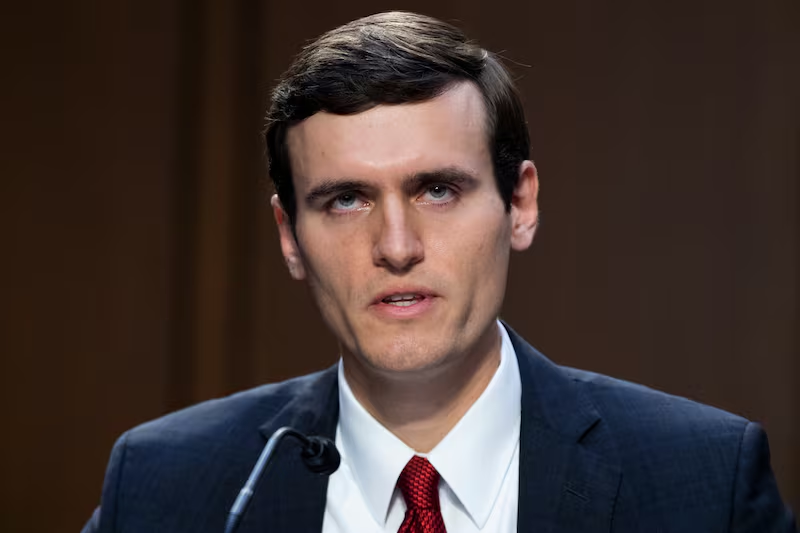
There’s 40-year-old Alabama solicitor general Edmund LaCour, confirmed to a lifetime appointment as a district judge in the northern district of AlabamaLaCour was just two years out of law school when he filed a brief with the Supreme Court in favor of gutting part of the Voting Rights Act; he argued that “race-based remedies to combat racially discriminatory maps were flawed as a constitutional matter.” He has also defended Alabama’s near-total abortion ban and supported a rollback of the Endangered Species Act.
And don’t forget Missouri solicitor general Josh Divine, who in 2010 wrote an opinion piece supporting literacy tests for voting while attending the University of Northern Colorado. “In the Civil Rights Act, literacy tests were banned because they were used as a form of discrimination in that they were only administered to certain groups of people,” he said, “but literacy tests themselves are not a bad thing.”
“When you have so many judges who have a history of undermining voting rights, you’re laying a fertile groundwork to put those rights at risk,” says Christine Chen Zinner, Federal Research and Advocacy Director at the Alliance for Justice.
Trump said he was going to drain the swamp, but he seems more intent on flooding it with reflections of himself, judges who see the country through a frame that values executive power as more than a coequal branch of government. He is setting in place a pipeline that could facilitate Trump-style election denialism and create chaos all the way to the Supreme Court, and beyond.
The post Opinion: Trump’s Sinister Plot to Remake America’s Judiciary appeared first on The Daily Beast.