“A generation ago, midlife might have been a bit of a snore, right? You have your job you’re going to be in for your whole career. You have your house in the suburbs … I don’t think established adulthood is that established anymore,” author Emily Nemens told me from her home in Princeton, N.J., before heading out on a cross-country book tour. “It’s much more pressurized and uncertain.”
This is the foundation of the former Paris Review editor’s sweeping and exquisite sophomore novel, “Clutch,” which features an ensemble cast of five women — all 40, give or take, and longtime friends — who reunite in Palm Springs, each at their own trying crossroads.
Nemens is no stranger to writing group dynamics; her critically acclaimed debut novel, “The Cactus League,” is structured in interlinked stories. She wrote it while juggling a distinguished career at literary quarterlies and making a name for herself as an artist. In the 2010s, her watercolor portraits of U.S. congresswomen went viral for their commentary on political portraiture and the “power suit.” At the time, women made up only 17% of Congress. Her new work also draws on politics — “Clutch” is set in an era shaped by the Dobbs decision and the state of women’s health in America.
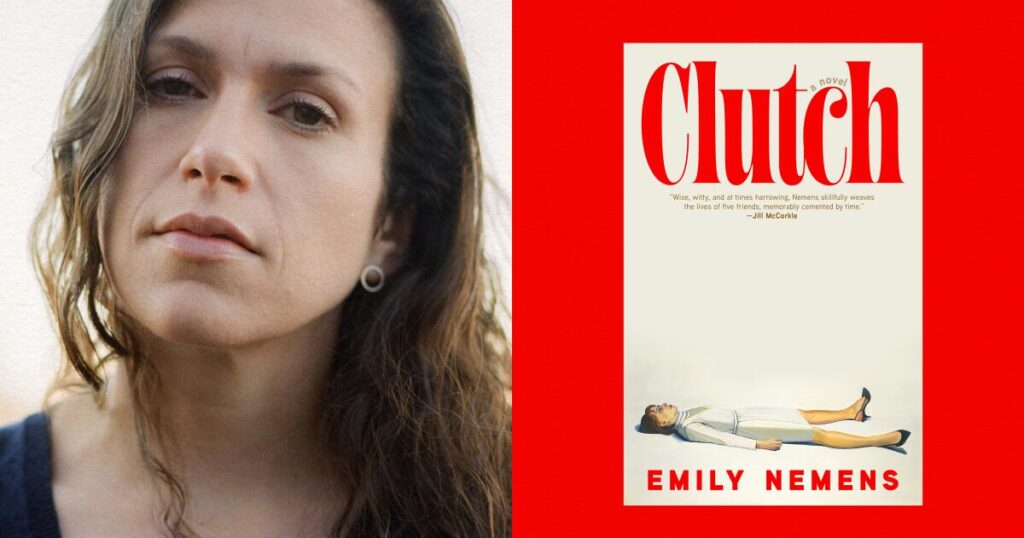
The Times talked to Nemens about favoring friendship on the page, bodily autonomy and her influences including California artist Wayne Thiebaud — whose painting “Supine Woman” is featured on the cover of her novel.
This Q&A was edited for length and clarity.
When did the idea for “Clutch” first come to you?
I went to Palm Springs with my girlfriends. The dynamics, the friction of getting people together who love each other a lot but haven’t seen each other for quite a long time was eventful and felt like something to write about.
On your inspiration for the novel: You’ve previously mentioned Mary McCarthy’s novel “The Group,” which has also been cited as a precursor to “Sex and the City.” How far have we come since “The Group” was published in 1963? How about “Sex and the City” in the late ‘90s? “
McCarthy was writing in the ‘50s and ‘60s about the ‘30s and “The Group” was meant to highlight all the progress women had (and hadn’t) made in this new society, new economy, new technologies, birth controls coming on. There’s a certain amount of new liberation that came purportedly in the ‘30s, purportedly in the ‘60s, purportedly in the ‘90s. I mean, progress is certainly being made. You and I can get birth control and have our own credit cards, but there’s also a lot of things that don’t feel great. A reigning plotline in “Clutch” is about reproductive freedom in Texas in the 2020s and just how devastating that was for so many people who care about bodily autonomy, and that doesn’t feel very different than it did in the 1930s.
“Clutch” puts a cast of millennial girlfriends front and center.
Yeah, I’ve read a lot of books I admire about singular protagonists. A woman rebelling from a marriage or striking out from the role of motherhood or otherwise trying to find meaning. These novels about a singular quest. And I just kept coming up against that and thought: What happens when you try to build the infrastructure of friendships on the page?
We get intimate access to each of these five women — a writer, litigator, ENT physician, an actor turned politician and a consultant turned caretaker. All of them live in various parts of the country, including California, Texas and New York. It must have been hard to balance so many perspectives, plotlines and an omniscient narrator on top of it all.
I broke a lot of rules with that third ping-ponging perspective. Sometimes perspectives shift within a page, within a scene, moving rapidly and gleefully between points of view, and using that omniscient voice to steer us around — that was fun. I was cognizant of balance and understanding the lazy-Susan of it. Making sure I was spinning all the way around the table and touching each piece in each storyline.
Why midlife?
I love a bildungsroman as a novel conceit and as a framing device. But, sometimes, moving beyond that realization of the adult you want to be and actually being that adult is harder and more complicated and maybe more interesting, at least as I am and perceive it right now.
You’ve worked as an editor in some of the literary world’s most prestigious posts, notably at the Paris Review. Do you miss it since pivoting toward your own writing and teaching?
Making magazines was a thrill and a gift and exhausting. In that order. Not every editor is quite as catholic with a little c, as ecumenical, as excited about such a range of writing as I am. I wanted to see not one style of writing, but a broad range of writing that I felt had both ambition and execution.
One of the things that’s hard about being an editor, particularly an acquiring editor, is how often you have to say no. As a teacher now, I never say no. I say “yes.” Instead, I ask: What else can this be doing? That attitude adjustment is glorious.
Back to “Clutch,” what does female friendship mean to you? Do you see your friends’ qualities in these five women?
Female friendship has been such a gift. I don’t have children, I have a really supportive partner and I have this wonderful, creative professional life, but I can’t imagine it without my friends. There are certainly flints of autobiography and different friends in different characters — they’ve read it and liked it, and if they saw themselves, they were pleasant about it.
Tell me about the painting on the cover of the book. It really speaks to what these women are going through.
Getting the rights to the painting was a real coup! It’s called “Supine Woman” by Wayne Thiebaud. It was painted in 1963 — its own little Easter egg is that it came out the same year as “The Group.”
It depicts a woman dressed all in white who is lying on the floor. You’d assume from the pose that she’s sleeping, except her eyes are wide open, and in this frightened or startled expression. To me, it’s indicative of what the women in “Clutch” are going through. This is that moment right after you get knocked down, right before you get up again and that emotional tenor proceeds for a lot of the novel.
Lancaster is a London-based writer of fiction, fashion editorial and screenplays.
The post Millennial women are in midlife and they need to talk about it. A buzzy new novel dives in appeared first on Los Angeles Times.