Good morning. It’s Friday. Today we’ll meet the new Manhattan borough historian. We’ll also get details on the re-raising of the Pride flag outside the Stonewall National Monument.
“Did you know that each of the five boroughs has a borough historian, appointed by the borough president?” The New Yorker magazine once asked. “Well, we didn’t, either, until a reader tipped us off.”
“God knows just what they do,” the reader had scoffed.
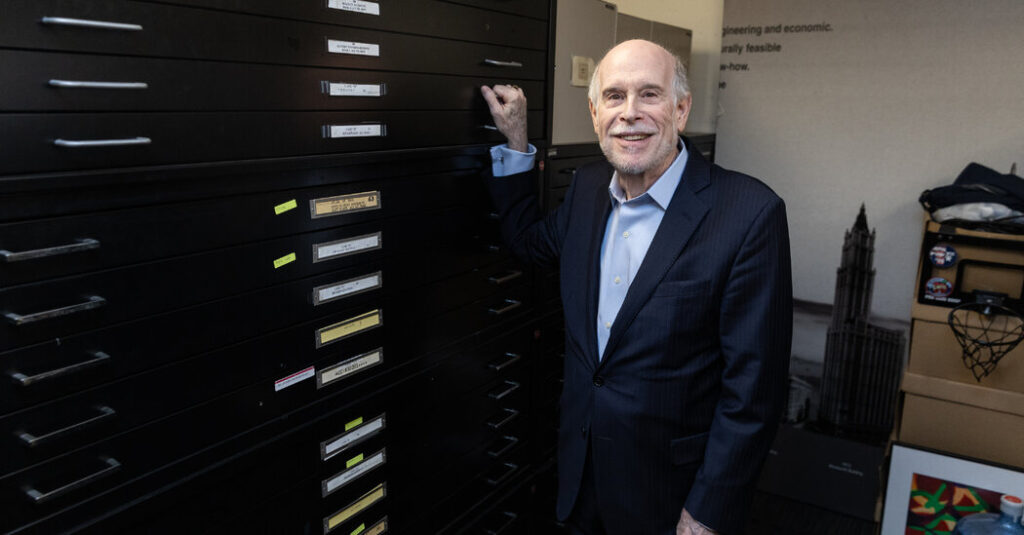
Harold Holzer — the author, co-author or editor of 55 books, most of them about Abraham Lincoln — is about to find out. He has just been appointed the Manhattan borough historian by Brad Hoylman-Sigal, who was sworn in as the Manhattan borough president last month.
Hoylman-Sigal — who said that Holzer brings a “deep understanding of Manhattan’s place in American history” to the job — said there were Manhattan-centric milestones to note in 2026. He mentioned three: the 400th anniversary of Peter Minuit’s purchase of Manhattan for the Dutch; the 250th anniversary of the Declaration of Independence; and the 25th anniversary of the Sept. 11 attacks.
A map of history, good and bad
Holzer said he was looking to create exhibits in the David N. Dinkins Municipal Building in Lower Manhattan, where Hoylman-Sigal’s office is located. Hoylman-Sigal said he wanted to begin a project called “Lincoln in Manhattan,” which Holzer said would include “a tourist map so people will know what stops to make to identify with Lincoln and the Civil War.”
They would include Cooper Union, where Lincoln “made his national political reputation” with a speech when he was stumping for the Republican presidential nomination in a speech eight score and six years ago.
Also on the list would be the site of the Colored Orphan Asylum on Fifth Avenue, which was burned during the draft riots in 1863. The fire, Holzer said, trapped more than 200 Black children in the building until “they followed their minister out.”
The list would include one of the city’s notorious figures, “The mayor who wanted New York to secede from the union so the city would retain trade relations with slave states.” That was Fernando Wood, who served two nonconsecutive terms as mayor and was “the villain of the Spielberg movie ‘Lincoln,’ but by then he was a racist congressman.”
“Another story that is not the finest moment is that Manhattan was occupied by the British for most of the American Revolution,” Holzer said.
Holzer, 77, was born in Brooklyn and grew up in Queens but moved to Manhattan after he and his wife, Edith, married in 1971. “That was a married aspiration, to be in Manhattan,” he said, but there was also a career aspiration: He began as a newspaper reporter and was eventually promoted to editor of The Manhattan Tribune, a weekly newspaper.
Later he was the press secretary to Representative Bella Abzug, worked for the New York State Urban Development Corporation under Gov. Mario Cuomo in the 1980s and was the senior vice president for external affairs at the Metropolitan Museum of Art from 1992 to 2015. Since then, he has been the director of the Roosevelt House Public Policy Institute at Hunter College and will continue in that post while serving in the borough historian’s job, which carries no salary.
So, what do borough historians do?
Manhattan borough historians have approached their work in different ways. One of Holzer’s predecessors, Cal Jones, who was Black, initially passed on the job, saying that African Americans had too often been written out of New York history. He relented after Ruth Messinger, the borough president at the time, said, “Why don’t you write yourself back in?”
His successor, Michael Miscione, championed the story that there had been alligators in the sewers and more recently has promoted “Alligator in the Sewer Day” on Feb. 9, marking a day in which an alligator was actually found in city sewers. Holzer’s immediate predecessor as borough historian was Robert Snyder, a professor of journalism and American studies at Rutgers University-Newark who was appointed by Gale Brewer in 2019. He served through Mark Levine’s term as borough president, which ended on Dec. 31.
Hoylman-Sigal, a Democrat, was among the elected officials who gathered at the Stonewall National Monument on Thursday to condemn a Trump administration directive that prompted the removal of the rainbow Pride flag there.
“That’s a historic site,” Holzer said. “It’s the Lexington and Concord of the L.G.B.T.Q. movement. To remove the symbol of the resistance there is crazy, I think.”
Weather
Sunny conditions will continue today with a high near 36. Expect increasing clouds and a chance of snow showers in the night with a low around 27.
ALTERNATE-SIDE PARKING
Suspended for snow removal.
QUOTE OF THE DAY
“Victim survivors, they need some closure to this.” — Adriana Rodriguez, a spokeswoman for the Roman Catholic Diocese of Brooklyn, which agreed to enter into mediation with more than 1,000 people who say they were sexually abused by priests and lay staff members.
The latest Metro news
-
Mamdani neglects public housing concerns: Mayor Zohran Mamdani’s pledge to hold private landlords accountable overlooks the over 300,000 residents who struggle daily within the New York City Housing Authority system, which he now oversees.
-
Seizure under ICE custody: Leqaa Kordia, a New Jersey woman who has been held at a Texas detention center since March 2025 and has not been charged with a crime, suffered a seizure after she fell and hit her head in the facility. She was arrested during a 2024 protest at Columbia University.
-
Guilty by reason of insanity: A jury found Henry McGowan, the New York man accused of killing his father in Ireland, not guilty by reason of insanity after a four-day trial in Dublin.
-
Fired on his first day: Hours after federal judges appointed Donald Kinsella as a U.S. attorney in upstate New York, he was fired by the White House in the latest clash between the Trump administration and the judiciary.
-
A campaign promise reversed: Mayor Zohran Mamdani’s decision to limit the expansion of a rental voucher program reflects the clash between his ideology and the realities of managing the city.
-
Bread, milk and Oishii strawberries: Happier Grocery in SoHo is part of a trend among food stores that focus on quality, insider knowledge and brand identity.
Pride flag raised again at Stonewall Inn monument
A group of New York elected officials re-raised the Pride flag at the Stonewall National Monument — the symbolic heart of the gay rights movement — in a defiant response to a Trump administration directive that had led to its removal earlier in the week.
But it was not clear how long the Pride flag would remain.
It had been taken down quietly after Department of the Interior issued a directive that said “non-agency” flags could not be flown at National Park Service installations. The park service, which administers a small park at the Stonewall site, said in a statement that “only the U.S. flag and other congressionally or departmentally authorized flags are flown on N.P.S.-managed flagpoles, with limited exceptions.”
The removal of the flag was the latest step in the Trump administration’s assault on diversity initiatives, and was met with outrage in New York. Julie Menin, the City Council speaker — who called Stonewall “a sacred site in this city” — said at a news conference on Thursday that there had been “no discussion” and “no warning” before the flag disappeared.
Officials who gathered in the park, including Brad Hoylman-Sigal, the Manhattan borough president, and Representative Jerrold Nadler, a Manhattan Democrat, first attached their Pride flag using zip ties. It flapped awkwardly against the pole below the American flag, and some people in the crowd shouted “higher!”
Several other people stepped in, removed it and reattached it next to the existing flag, and the crowd cheered.
Mariah Lopez, a transgender activist who helped replace the flag, said its unauthorized return was in keeping with the history of the Stonewall site, which commemorates three days of protests and street clashes between L.G.B.T.Q. activists and the police after a June 1969 police raid on a gay bar, the Stonewall Inn.
METROPOLITAN diary
Bus stop
Dear Diary:
I was walking on 77th Street to catch a bus up Amsterdam Avenue. And just before I got to the corner, I saw a bus sail away.
While I waited for the next one, an older woman joined me.
“We’ve just missed one,” I said. “Eight minutes to go.”
She said she was just taking a rest, not catching a bus.
Her accent was definitely British. Being British myself, I asked what had brought her here, and we began to chat.
I said I had married a fabulous American and had been happy for 56 years.
“I married a really dreadful American,” she said.
— Janet Nelson
Illustrated by Agnes Lee. Tell us your New York story here and read more Metropolitan Diary here.
Glad we could get together here. J.B.
Tara Terranova, Davaughnia Wilson and Ed Shanahan contributed to New York Today. You can reach the team at [email protected].
Sign up here to get this newsletter in your inbox.
James Barron writes the New York Today newsletter, a morning roundup of what’s happening in the city.
The post Manhattan Has Its Own Historian appeared first on New York Times.