Everyone you meet is fighting a battle you know nothing about. And they’re fighting it against their loony neighbor.
Or maybe they might be the loony neighbor — it depends whom you ask. This, at least, is the perspective of “Neighbors,” a dark-comic docuseries on HBO, beginning Friday, that feels uncannily fit to a moment when it seems as if no one in America can get along.
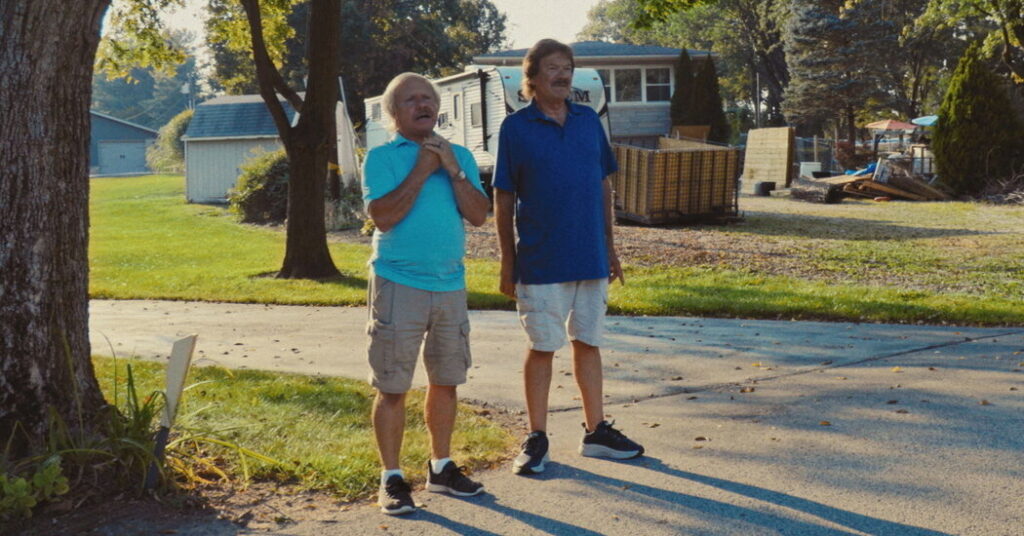
The directors, Harrison Fishman and Dylan Redford, scoured the country to document small-bore conflicts that feel, to their antagonists, all-consuming. In Florida, two women fight over ownership of a narrow strip of grass between their houses. In Montana, neighbors scream at each other over a gate that blocks a road running through one’s property.
They squabble over Halloween decorations and yard-dwelling livestock, over fences and walls. They menace each other with cameras and occasionally more threatening weaponry. They take each other to court and seem to have the police on speed dial. To paraphrase or pervert Churchill, they fight over the beaches, the fields and the streets, and they never surrender.
In the process, they reveal worldviews, anxieties and obsessions. Fishman and Redford take a quasi-comedic approach to the stories, using them to unspool character stories that turn quirky, sad or dark. Subjects reveal their wild past lives, their conspiracist fixations, their OnlyFans pages.
“Neighbors” has a bad tendency to gawk at its subjects; it often uses 360-degree camera effects, for instance, to convey characters’ agitation or decompensation. But it also has a curiosity and a belief, not unlike “How to With John Wilson,” that everyone is potentially interesting and worthy of empathy. Maybe it’s a weird dream to want to raise goats on your lawn or to feed an entire neighborhood’s cats. But it’s still a dream, and it hurts to lose it.
A fight over grass, of course, is never just a fight over grass. It’s about one’s sense of autonomy, security, control, justice and fear, in ways that have unsettling parallels to the weightier intra-American battles we see in the headlines every day.
The conflicts in “Neighbors” are, mostly, not political. But they are entangled with the kind of principles that drive political fights: free expression, property, the private vs. the public, the question of where my rights end and yours begin.
Even in these hyperlocal fights, the trappings of national politics crop up, over and over. A New Jersey man feuding with a neighbor over a Halloween-décor contest also complains about the neighbor’s extravagant display of MAGA signs and flags. A homeowner in Florida posts angrily about “hysterical liberals” fighting for public access to a beach behind his house.
And everywhere, there is the internet: It is battleground, bludgeon and accelerant. At the first sign of conflict, the feuding parties reach for their cameras. (It could be worse. Firearms are also everywhere, though the violence here is usually limited to threats; one woman rustles through her ammo stash while asking the camera crew, “Who’s good with guns?”)
They train spycams on the houses next door, devote YouTube and TikTok accounts to their disputes — providing the show’s makers with ample footage — and clash in the comments sections as well as over the backyard fence. Most everyone in “Neighbors” lives in two places: their physical homes, where they fight claustrophobic battles with the closest person at hand, and their online spaces, where there is no shortage of voices to goad them.
Without nudging the audience (there is no narrative voice-over) “Neighbors” draws a picture of the aftermath of Covid isolation, of online self-radicalization and of festering polarization. The combatants seem to start their confrontations at a 10, then somehow find ways to crank up the dial up from there.
The outcomes in these stories are mostly comic rather than tragic. But the potential for heartbreak, or worse, is always close at hand. Watching “Neighbors” brought to mind not just the recent spate of domestic series about the monster down the road — from “The Burbs” to “The Beast in Me” — but also the run of films like “Civil War” and “Eddington” that suggest Americans are losing the capacity to coexist, and perhaps their marbles too.
I was particularly reminded of last year’s horrifying Netflix documentary “The Perfect Neighbor,” which uses police bodycam footage to tell the story of a white Florida woman who, after months of belligerence toward the families and children on her block over perceived transgressions, shot a Black neighbor to death while claiming self-defense under the state’s “Stand Your Ground” law. (She was later convicted of manslaughter.)
The tale that repeats in all these programs and films is of a people on the edge, with phones and guns in hand. It’s a theme that also resonates with the chilling images in the news, from Minneapolis and elsewhere, that suggest the national crackup previewed on the screen has arrived.
The conflicts between residents and federal forces are, of course, bigger in scope than a fight between subdivision residents (indeed, they often involve neighbors uniting in protest), and the power dynamics are different. But the emotions and images are eerily similar, especially the omnipresence of phones livecasting every side of a standoff.
And something in “Neighbors” feels like a symbol for a larger social dynamic in which self-sorting groups of Americans see other Americans — separated by party or state lines rather than property lines — as enemies to be vanquished.
“Neighbors” is not the sort of show to advance solutions for this kind of big-picture problem. But it does end on a note of small-scale hope. The best and final episode, about Danny, an elderly San Diegan whose neighbors object to his exercising outside in yellow bikini briefs, becomes a bittersweet story about finding one’s people, as he searches for a nudist colony where he can be his true self.
The quest does not go flawlessly, nor does Danny emerge at peace with his skin-averse neighbors. (Eff ’em, he concludes.) But he does make some changes in his life and confronts some truths about himself.
One episode after another, we hear variations on a truism: You can’t choose your neighbors. But sometimes, the series suggests, the neighbor you first need to work things out with is the cantankerous devil who lives in your own head.
James Poniewozik is the chief TV critic for The Times. He writes reviews and essays with an emphasis on television as it reflects a changing culture and politics.
The post ‘Neighbors’ Review: One Battle After Another appeared first on New York Times.