MILAN — It’s the Olympic event that no one wants to see, yet everyone watches with unblinking interest.
When a skier is injured on the course and being attended to by medical personnel, often a helicopter is called in to evacuate the injured racer and take him or her to a hospital.
It happened with downhill racer Lindsey Vonn on Sunday when she suffered a broken left leg in a violent crash. And it happened to her a week earlier, too, when she sustained a torn anterior cruciate ligament in a crash at Crans-Montana, Switzerland.
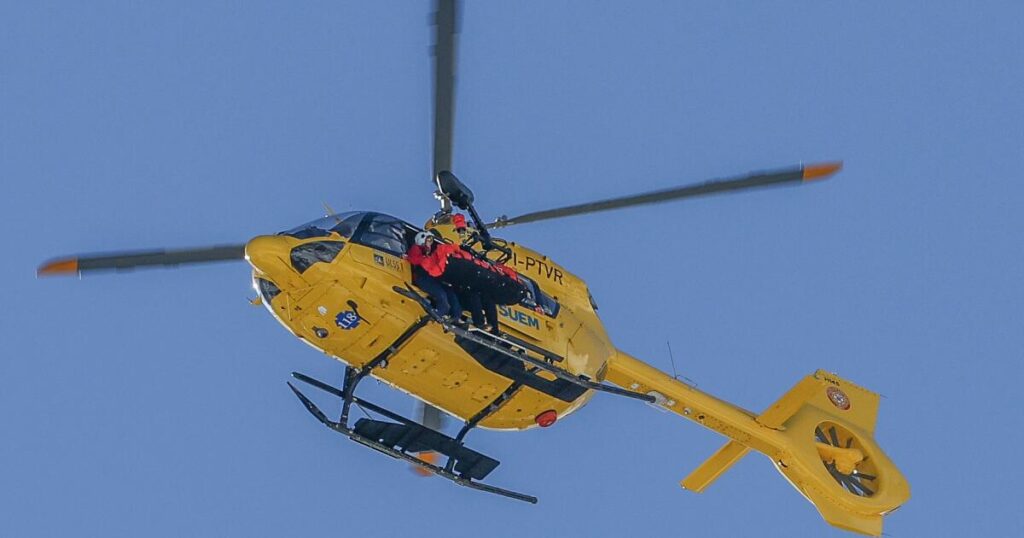
The process is called long-lining, and the skier is typically bundled in a basket that’s lifted by a cable lowered from the chopper. There’s a harnessed medical attendant who rides up with the patient too, and it looks as if the basket is laying across that person’s lap.
From a distance, to those in the finish-line bleachers watching below, it looks terrifying. One of the world’s greatest skiers is dangling over the Dolomites, at least a hundred feet above the trees before she is steadily raised into the helicopter.
Remarked one observer Sunday: “I’d rather just be shoved down the mountain.”
But to seasoned ski racers, already desensitized to pursuits others might find terrifying, it’s all part of the game.
“I think the adrenaline takes over a little bit,” said downhill racer Kajsa Vickhoff Lie of Norway. “You just have to take it easy. You have to trust everyone around you because they know best.”
What’s more, when cocooned in that basket, the injured skier isn’t peering down over the edge.
“You’re looking up,” Lie said. “The only thing you see is the chopper. Sometimes, you’re rotating because it’s a line, and you just see the chopper going around and around.”
In some situations, a skier might already have been administered medication that can dull the senses.
U.S. skier Jackie Miles was preparing for the 2018 Olympics in South Korea when she crashed in Garmisch, Germany, and suffered a devastating knee injury that scuttled her trip to the Games.
“The biggest memory I have is being long-lined to the hospital and just seeing my Olympic dreams kind of go away,” she said. “I could see the finish line as we were flying away.”
So why not put the injured athlete in a sled the way the ski patrol would at a resort, and ski him or her down the remainder of the course?
There are a few reasons. The downhill course is steep and sometimes icy, often more treacherous than a typical slope. A helicopter gets the patient to a hospital much more quickly. And the Olympics are televised, making it important to adhere to a schedule. Safety is paramount, but efficiency and quickness are important as well.
“For me, it was get me out of here because my teammates are waiting at the start to go,” said Olympic skiing legend Picabo Street, now a racing commentator for NBC. “I don’t want to be the reason that they can’t go.”
Street said she never felt a wisp of fear.
“You’re in the hands of some of the most able-bodied human beings on the planet,” she said. “I love helicopters and I love long-lining. ‘Oooh, what a fun ride!’ The circumstances suck, but, yay, it’s a fun ride.”
Three-time Olympian Steve Nyman also crashed at Garmisch and thought he was fine. Then he tried to stand and his knee — limp from three torn ligaments — quickly had him slumping back to the snow.
“A guy ran over to me and said, ‘Oh, get the heli!’” Nyman recalled. “They put you in a nice little tray, tightly packed, and a guy is hanging there right next to you.
“I was looking around when I was up there, like, ‘Wow, this is pretty nice. The German Alps.’”
Former Olympian Stacey Cook banged her head at the Vancouver Olympics and doesn’t have much memory of her subsequent helicopter ride.
Her most vivid memory was a sensory one.
“It was snowing, really bad weather,” she said. “I remember the wind from the propeller. It was like shooting ice pellets at my face. The guy next to me was doing what he could to shield my face, but that’s pretty much all I remember.”
Norway’s Lie once crashed in San Pellegrino, Italy, and suffered a broken leg. Problem was, the medical team didn’t understand what she was saying.
“The medical staff, they didn’t know English, and for me that was catastrophic,” she said. “I said, ‘I broke my leg. You need to take care of that.’ … They were just keeping my head down in case I broke my neck. I told them, ‘You need to unbuckle my boot because I’m in so much pain.’
“After that, they have to know English now because that [communication] is quite important.”
Other than that, it’s quick, it’s efficient and it feels safe.
“Then again,” she said, “you can’t have fear in this job.”
The post Inside the terrifying and efficient world of Olympic ski airlifts appeared first on Los Angeles Times.