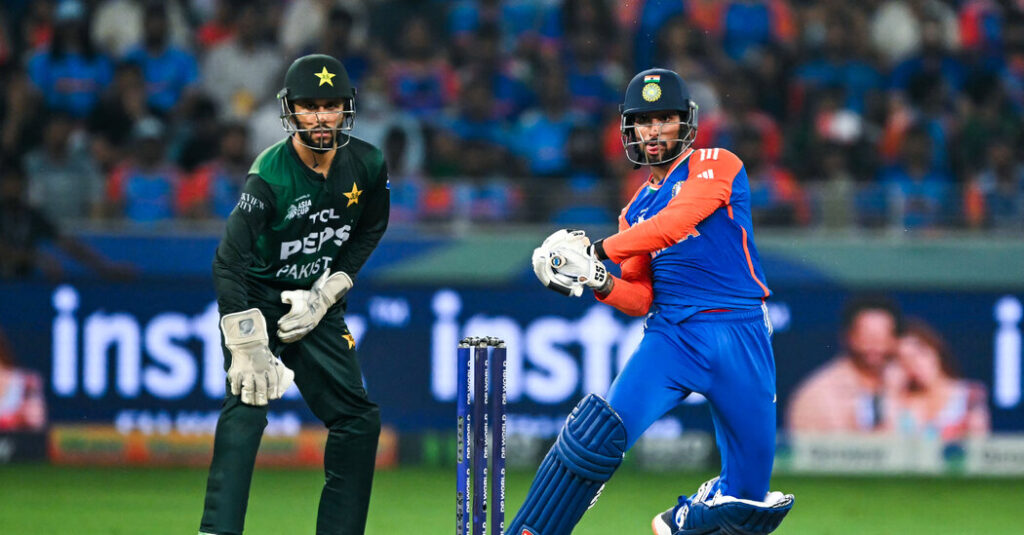
For the legions of cricket fans in India and Pakistan, when their teams face off on Sunday in the T20-format world cup, the money-spinning match with a viewership expected to dwarf the Super Bowl will be about more than just sport. It will be inextricably tied to national pride, or embarrassment.
The India-Pakistan cricket rivalry is rarely free of the baggage of their turbulent, often violent history. But it has been particularly intense recently. After a days-long escalating conflict last year that prompted fears of a full-blown war, there have been few signs of diplomatic hostilities easing.
It was not even clear last week if the match would be played. Pakistan’s government had barred its players from taking the field against India, a boycott it said was to show solidarity with Bangladesh. The Bangladesh team had been thrown out of the world cup after it refused to play in India citing security concerns. After days of negotiations, including at the highest levels of government, Pakistan reversed its decision.
Here’s why this is one of the fiercest, and most financially lucrative, sporting rivalries anywhere in the world:
These tensions date back decades.
The relationship between these neighbors has rarely been smooth since British colonial rule in India ended with a bloody partition and the creation of Pakistan as a Muslim-majority country in 1947. They have since fought several wars, acquired nuclear weapons and come no closer to resolving a bitter dispute over the Himalayan territory of Kashmir.
Attacks by militant groups have been one of the biggest concerns in recent decades. India has long accused Pakistan of supporting groups that have carried out terrorist attacks on its soil, a charge Pakistan denies.
Bilateral cricketing ties have been largely suspended since 2008, when Pakistani militants crossed into India launched a gruesome attack in Mumbai, killing more than 160 people. Pakistan has also accused India of backing militant groups that operate on its soil, which India denies. Last year, a terrorist attack in Indian-administered Kashmir boiled over into the hostilities in May.
While bilateral games are a no-go, Pakistan and India have continued to play each other in international tournaments like the world cup that is underway. These matches are played in third countries — Sri Lanka will host the one on Sunday.
With little improvement in relations recently, there is scarcely expectation of any warm banter between the players on Sunday. When these teams played four months after the war last year, the Indian players refused to shake hands with their Pakistani competitors.
A lot of money is on the line.
Even when ties between the governments are at their worst, there is intense interest among fans in both countries in seeing their teams play each other. And that makes these games immensely lucrative for broadcasters, the cricket authorities in these countries and the sport’s world governing body, the International Cricket Council.
India, the most populous nation in the world, is the undisputed superpower of cricket, and its biggest market. And there is no draw like the matches with Pakistan. The one on Sunday is expected to draw around 325 million viewers, more than double the record of 127.7 million for the Super Bowl.
While assessments vary widely, the reported value of a single match between India and Pakistan at a world cup can reach into the tens of millions of dollars. And commentators have said these financial concerns are big enough to override any nationalist or political pressure in India and Pakistan not to play cricket against each other.
Cricket is sometimes a bridge, too.
For all the talk of their rivalry, sometimes their mutual love of cricket has brought the leaders of India and Pakistan together. Prime ministers and presidents from both countries have used the pretext of a cricket match to hold talks and seek an improvement in their relationship.
In 1987, Zia-ul-Haq, the president of Pakistan, visited India to watch a cricket match and hold talks with Prime Minister Rajiv Gandhi at a time when tensions were rising between the two countries.
In 2005, Pervez Musharraf, Pakistan’s president, visited India and watched a match with Prime Minister Manmohan Singh. And six years later, Prime Minister Yousaf Raza Gilani also met Mr. Singh at a cricket stadium, an overture that came as the two countries tried to find a way to improve relations.
Francesca Regalado is a Times reporter covering breaking news.
The post When Pakistan and India Play Cricket, It’s Never Just a Game appeared first on New York Times.