Remmelt Eldering is 6-foot-7, so when the Canadian speedskating coach climbs under the covers of the twin bed in his room in the Olympic Village in Milan, he can’t fully extend his legs.
The room is too small to host teammates to hang out. Still, Mr. Eldering figures that with an en suite bathroom and plenty of storage space under the bed, it would make a nice dorm room for a college student.
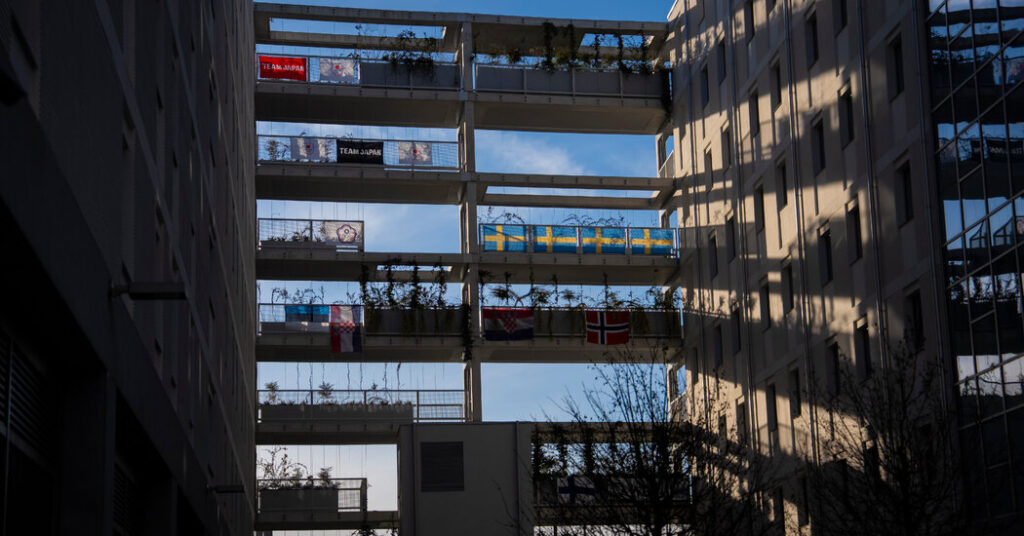
That is, in fact, the post-Olympics plan for the village, a cluster of six pale concrete buildings with 1,175 rooms overlooking train tracks on the city’s southeast. On full-length mirrors in each room, Olympians are invited to write notes to the future occupants in erasable pens.
“From athletes to students, this room has a story to tell,” reads one stenciled message on the mirrors.
Much of the Milan-Cortina Games, which are dispersed across northern Italy, are taking place in existing or temporary venues, partly to minimize the environmental impact. In a few cases, developers have built facilities that are to be repurposed. In Milan, that includes an ice hockey rink that will become a concert arena, and the Olympic Village, which will be revamped as student housing.
For the people of Milan, the village is either a step toward addressing the city’s affordable housing crisis — or a prime example of why officials aren’t serious enough about solving the problems.
The village’s developer, Coima, a Milan-based real estate company, has touted it as a great gift to the city that will provide 6 percent of the beds needed for students. Critics say the converted rooms will be too few to meaningfully address a vast shortage of university housing and too expensive for many students.
With eight universities, Milan has more students than any other city in Italy. Though Italian students tend to live with their parents, an increasing number come to Milan from outside the city, raising the demand for rooms. According to local officials, 70 percent of the city’s 232,000 students are not Milanese. About 17,000 come from abroad, up tenfold since 2010.
Unlike American universities that provide dorm space, Italian colleges tend not to give room and board. Some universities have recently built accommodation and private developers have added rooms tailored to students, but there is still a gaping need. For now, there are just over 16,000 student beds in the city, according to researchers at the Polytechnic University of Milan. The Olympic Village will add 1,700.
Coima said about a quarter of the beds at the village — 450 beds in rooms with two twin beds — would be designated “affordable,” available at $700 a month. Other beds would go for about $1,265 a month in a single room and around $880 for a bed in a two-bed room. Nicole Zancanella, a Coima spokeswoman, said the regular rents would be 25 percent lower than the market average.
Immobiliare, an Italian real estate platform, said in 2025 that the average monthly rent for a single room in Milan was about $870. That makes the regular rent for Coima’s single rooms 45 percent higher than the average, though that includes utilities and access to bike parking, sports fields and study rooms.
Donatella Sciuto, rector of the Polytechnic University of Milan, disagreed with Coima’s definition of affordable. Her university, she said, offers scholarship students a bed for about $300 a month and charges full fee-paying students about $700 a month for a single room.
Many of the Olympic perks are unlikely to survive the transition to student housing.
On a visit to the village recently, national flags festooned the site, and some athletes stowed practice bicycles outside their doors. On a floor for Korean athletes, shelves were stuffed with packets of instant congee — rice porridge — and noodles, as well as jars of peanut butter and chocolate bars.
Elsewhere, skaters and hockey players relaxed in a Samsung-sponsored video game lounge where one Italian figure skater was so engrossed in a car racing game that he declined to answer questions about the rooms. A robot dispensed Olympic pins from a claw machine, and athletes grabbed beers in ski-lodge-style huts.
In the dining rooms, numerous food stations offer the likes of gluten-free focaccia, couscous, roast veal and curry with rice. William Dutton, a speedskating coach for Canada, said he had tried what he thought was pineapple pizza, only to discover that the toppings were slices of potato.
After the Games, many of those trappings will give way to study rooms, kitchens and gyms. Coima said the laundry rooms, which now house just three washers and three dryers each, will include 25 washer-dryers when the buildings are converted. Furniture for the students — desk chairs, folding tables, file cabinets — is stored in the basement for now.
Until next weekend, the site remains the preserve of the Winter Games participants.
Anders Johnson, a skater from Canada, said he was initially puzzled by what he thought were two toilets in his bathroom.
Then he learned one was a bidet. “We were coming up with creative ways to use the other one,” he said.
Josephine de La Bruyère contributed reporting.
Motoko Rich is the Times bureau chief in Rome, where she covers Italy, the Vatican and Greece.
The post Milan Has an Affordable Housing Crisis. Can the Olympic Village Help? appeared first on New York Times.