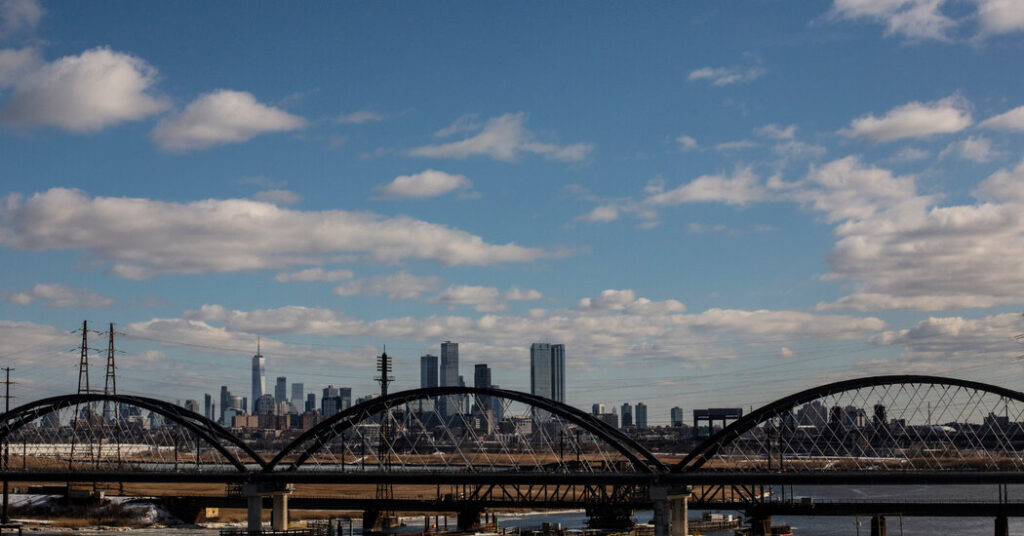
New Jersey commuters who take trains into Manhattan may be in for a long month of travel disruptions as bridge work begins along a key segment of the Northeast Corridor, the busiest passenger rail route in the Western Hemisphere.
On Friday, Amtrak, the national railroad, will begin transferring one track of rail service from the Portal Bridge, a century-old span over the Hackensack River, to a new and taller bridge that will replace it. The project, which Amtrak and NJ Transit described in more detail last month, will cause a reduction in rail service and scheduling changes from Feb. 15 to March 15.
The so-called cutover, in which electrical equipment and other infrastructure will be moved to the new bridge, is expected to have the biggest effect on the rush-hour commutes of passengers on NJ Transit, PATH and other carriers.
While Amtrak owns most of the infrastructure, NJ Transit runs more trains over the bridge. NJ Transit will cut its weekday service over the bridge roughly in half, to 178 trains from 332.
The agencies are bracing for angry customers.
Kris Kolluri, the president and chief executive of NJ Transit, said he understood riders’ frustrations, but that the work was long overdue and would make service more reliable.
“The idea that we’re now at a moment where we can actually open a new track, on a new bridge, is a moment to actually celebrate,” he said.
Laura Mason, the executive vice president for capital delivery at Amtrak, said the inconvenience would be worth it.
“We know the next four weeks might feel very long for riders as they navigate these service reductions, but we’re making a 100-year investment,” she said.
Here’s what to know about the disruptions.
Why is this happening?
New Jersey officials have long sought to replace the 116-year-old Portal Bridge, a swing bridge between Kearny and Secaucus that has been the cause of hourslong train delays and fires that have suspended service.
The moving bridge has often gotten stuck after opening for maritime traffic below, requiring workers to adjust the tracks.
“Imagine, in the 21st century, a person has to go with a sledgehammer and hammer a track back into place,” Mr. Kolluri said.
In 2021, the former governor of New Jersey, Philip D. Murphy, and NJ Transit approved a $1.5 billion contract to build the Portal North Bridge, a 50-foot-high fixed-span bridge that is twice as tall as the original, allowing ships to pass underneath without disrupting train service.
The bridge project, NJ Transit’s most expensive construction contract ever, covers nearly 2.5 miles of the busy Northeast Corridor line and will involve moving Amtrak-owned wires, laying new track and building other infrastructure.
It is the first of two planned cutover projects, with the next phase expected to begin this fall. The new bridge could be fully operational by the end of the year.
The project is part of the broader Gateway Program, the portfolio of infrastructure projects connecting New York and New Jersey that has been the subject of a multibillion-dollar funding fight between President Trump and state officials. But the bridge work, which is already funded, is not expected to be affected by that dispute.
How will it affect riders?
Beginning on Tuesday, NJ Transit passengers who ride the Morris & Essex, Gladstone Branch and Montclair-Boonton lines to New York’s Pennsylvania Station will be diverted on weekdays to Hoboken.
At Hoboken, NJ Transit riders who need to get to Manhattan can use their tickets to transfer for free to the 126 bus to Port Authority Bus Terminal, an NY Waterway ferry to Midtown or the PATH train.
PATH said in a statement on Thursday that there would be increased service during peak travel times, but that customers should expect the Hoboken station to be more crowded.
On weekends, NJ Transit train lines will still go to Penn Station. (Monday is a holiday, so the trains will run to Midtown on a modified schedule.)
Trains on the Northeast Corridor and North Jersey Coast lines will still travel on weekdays to Penn Station, but at a reduced frequency. Riders should check for updated departure times, NJ Transit said.
In anticipation of some riders taking the train fewer days per week, NJ Transit said it would revive on Feb. 15 its Flexpass ticket option, which allows riders to buy 20 one-way tickets at a 15 percent discount. The tickets must be used within a month.
The Port Authority of New York and New Jersey, which operates PATH, has asked customers who use the Hoboken station to work remotely or to try to avoid the morning rush from 7 a.m. to 10 a.m. on weekdays.
Other carriers may also be delayed. There will be fewer weekday Amtrak-operated trains on the Acela, Northeast Regional and Keystone lines.
Keystone, for instance, will cut its number of weekday trains between Philadelphia and New York City to 10 from 24, according to a joint presentation by Amtrak and NJ Transit.
What else should riders know?
The service changes come after a series of frustrations for riders on the busy rail corridor.
During the morning rush on Monday, NJ Transit and Amtrak riders traveling in and out of Penn Station in Manhattan faced long delays because of downed overhead wires operated by Amtrak. Delays continued the next morning.
Mr. Kolluri of NJ Transit apologized for the delays and said they were the latest evidence of the urgent need to upgrade the route’s aging infrastructure, including the Portal Bridge.
“If there is ever an Exhibit A for why we need this improvement, it’s what you saw on Monday,” he said.
NJ Transit has also raised fares in recent years. In 2024, it instituted a systemwide fare increase of 15 percent, followed by a 3 percent jump in 2025.
Mr. Kolluri said the increases were necessary to help fund long-deferred projects to improve service. The agency said it would begin this year to replace some of its aging train stock, some of which has been in operation since the 1970s.
Stefanos Chen is a Times reporter covering New York City’s transit system.
The post New Jersey Bridge Project Could Snarl Rail Traffic for a Month appeared first on New York Times.