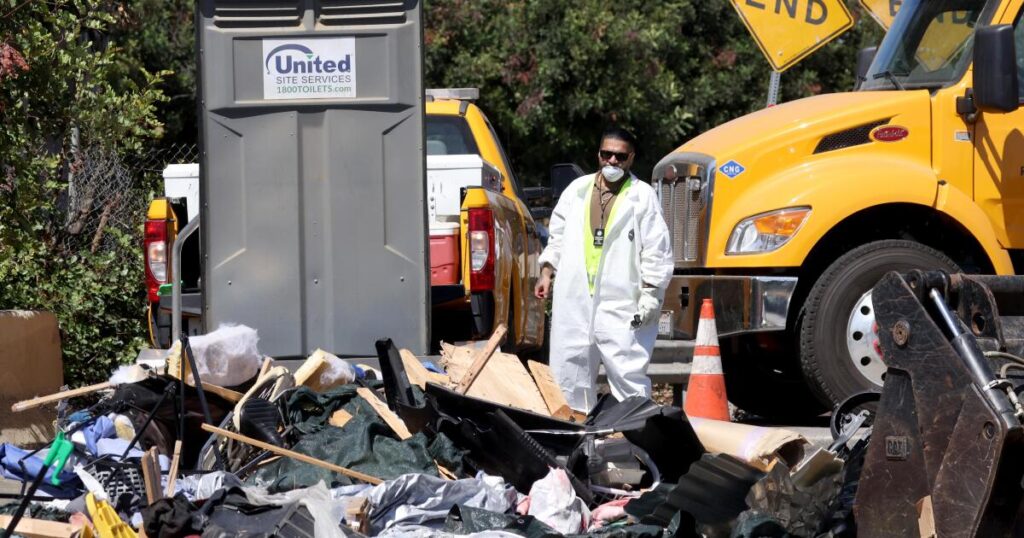
A federal judge has found that the city of Los Angeles violated the constitutional rights of homeless people by seizing and destroying their personal property during cleanups.
The ruling filed late Wednesday by U.S. District Judge Dale S. Fisher ended a seven-year-old case against the city without a trial. The decision hinged on Fisher’s finding that the city had altered records of the cleanups after the case was filed to make it appear that care was taken to separate personal property from trash or hazardous material.
She rejected the city’s argument that any flaws were the result of “error-filled record keeping during the pandemic.”
“The timing of the City’s modifications and fabrications is strong circumstantial evidence of bad faith, especially when considered alongside the types of modifications made to produced documents, including changing words to characterize items as biohazards, describing property as surrendered or dangerous, and adding narratives of procedures,” Fisher wrote.
In a neutral forensic analysis she ordered, Fisher wrote that the examiner found records in 90% of 144 cleanups were “either modified or fabricated after the City was put on notice” of its obligation to preserve documents.
She had been waiting on that final examination to make her ruling.
The ruling denied the city’s proposal that the court could merely exclude the altered records as evidence, finding the evidence so tainted that a fair trial would not be possible.
“This means that the court has accepted all of the facts alleged in the case as true without a trial, effectively granting a win for the plaintiffs,” lead plaintiffs’ attorney Shayla Myers of the Legal Aid Foundation of Los Angeles said at a news conference Thursday.
The ruling did not specify what the city must do to comply with the law. Fisher ordered the parties to file briefs by March 15 on proposed relief.
Myers said the plaintiffs are seeking monetary damages and an injunction requiring the city to provide homeless people the opportunity to contest the seizure of their property and recover seized items.
In an October status report, Myers outlined potential terms for an injunction setting conditions for property seizure. Among them, sanitation workers would have to give 24-hour notice and describe the property to be seized and the basis for the seizure.
The city would then have to store the property for at least 90 days and provide the owner an itemized list of the seized belongings and information on how to retrieve it.
For the destruction of hazardous property, it would establish a standard of “a substantial likelihood of causing significant harm” that is reasonably expected to occur immediately.”
The case, Garcia vs. City of Los Angeles, was filed in 2019 on behalf of seven homeless people and KTown For All, a volunteer organization that provides direct assistance and advocacy for homeless people. The homeless plaintiffs allege that the city violated their rights by destroying their belongings in camp cleanups in 2018 and 2019.
One of the plaintiffs has since died, Myers said.
The complaint alleges that the city’s practice of seizing and disposing of property violates the 4th Amendment’s protection against illegal search and seizure and the 14th Amendment’s guarantee of due process.
It described property used by lead plaintiff Janet Garcia for her work as a domestic cleaner being seized and destroyed when she was not present. Other plaintiffs weren’t given time to collect personal items before they were seized, it alleged.
Ktown for All was harmed by having to expend resources replenishing the seized items, it alleged.
“For years, our members have been hearing and telling the same stories all across this city,” the group’s volunteer president, Sherin Varghese, said Thursday.
“They took my ID. They took my medication. They took my tent. They took all my clothes and blankets. They took my parents’ ashes,” Varghese said. “They took the bike I take to work. They made fun of me while they tore my life apart and threw it into a trash truck.”
In her ruling, Fisher chastised the city for abuses in the discovery process and defiance of court orders, which “prolonged this case for years, delaying the resolution of issues obviously of great public interest and interfering with the Court’s need to manage its docket.”
Early in the case, Fischer issued a preliminary injunction barring the city from enforcing the municipal code that prohibits bulky items in public places or on the streets. Because of that ruling, the plaintiffs would have essentially already won their case involving any property taken under the bulky item law, but the city would have retained a defense for items taken under a health standard, Myers said.
Fischer subsequently held the city in contempt after the plaintiffs’ attorney introduced evidence that city workers continued to post signs in some locations prohibiting bulky items.
The case dragged on for years in disputes over discovery, through which the plaintiffs found records that had been altered.
According to court filings, the city responded to the plaintiffs’ discovery request by converting printouts of the original Microsoft Word files of health hazard assessment reports into PDFs. The process eliminated the date stamps that recorded when the originals were created and last modified. When the original of one of those records was attached to an email obtained in discovery, Myers found that it had been extensively revised before the PDF conversion.
Manually comparing originals with the PDFs, Myers’ team found more than 100 revisions in some documents. Among them, “bulky” was changed to “ADA violation,” a reference to the Americans With Disabilities Act, and “Property left behind by encampment” was changed to “Contaminated Items Surrendered or Left Behind by Resident.”
In 2022, Fisher ordered the neutral forensic examination of alleged doctoring of the city records.
Based on a preliminary report, she found in 2024 that the city had tampered with records, but she withheld a final ruling until the examination was complete.
The post L.A. liable for destroying homeless people’s property, federal judge rules appeared first on Los Angeles Times.