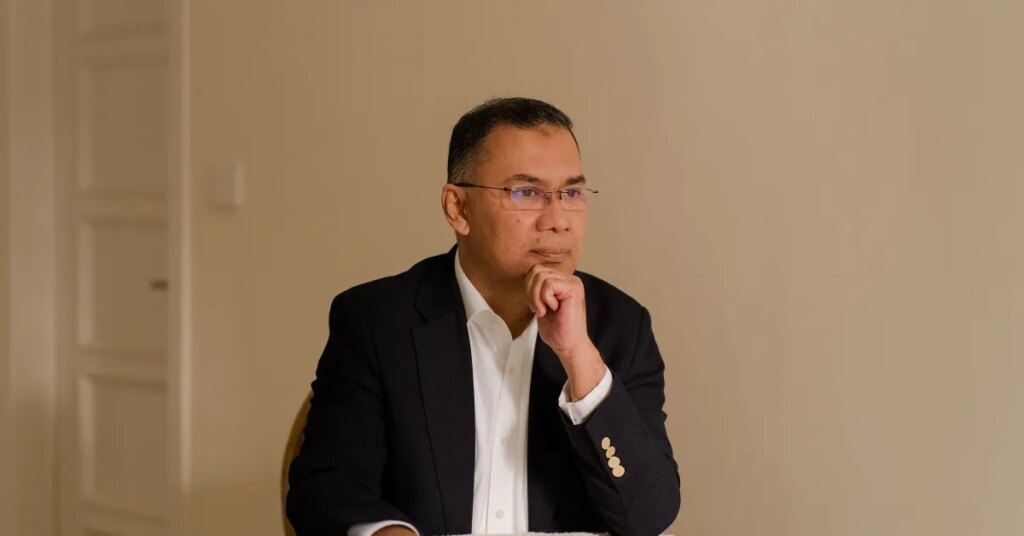
Tarique Rahman had spent 17 years in exile before returning to Bangladesh on Christmas Day. Just seven weeks later, he looks set to become the South Asian nation’s new Prime Minister.
Polling indicates that Rahman’s Bangladesh Nationalist Party (BNP) is set to win an outright majority of around 185 seats in the 300-member legislature in Thursday’s general election, which is the first since the ouster of autocratic former Prime Minister Sheikh Hasina on Aug. 5, 2024.
[time-brightcove not-tgx=”true”]
TIME sat down with Rahman in early January as he laid out his plans for rebooting South Asia’s second biggest economy and healing social divisions. Asked what his first priorities would be, Rahman replied: “ensuring rule of law. The second one is to bring back financial discipline. The third will be to try to unify the country. Whatever political programs we have, whatever policies we take, if we cannot unify the country, it won’t be possible to take the country forward.”
Here are five takeaways from TIME’s exclusive interview with Bangladesh’s new leader.
Healing the nation
Up to 1,400 people were killed in the July 2024 revolution that toppled Hasina in addition to some 3,500 extrajudicially disappeared during the last 15 years of her despotic reign. Those wounds remain very raw, and Rahman will have to rebuild trust in institutions that were totally politicized by Hasina’s Awami League party, including the military, courts, civil service, and security services.
Violence targeting the Awami League and religious minorities broke out swiftly after the BNP-led coalition last took power in 2001, and Rahman—who has preached a message of unity and forsworn retribution since returning to the nation of 175 million—will have to work tirelessly to keep the peace.
“Vengeance will not bring [anything] back,” he says. “Rather, if we can control it, if we can keep everyone united, keep the country united, that might get us something good.”
Fixing the economy
Bangladesh was the Asia-Pacific’s fastest growing economy during Hasina’s last stint in power, with GDP rising from $71 billion in 2006 to $460 billion in 2022. But soaring costs, inequality, and youth unemployment saw resentment grow against her Awami League, which was banned from taking part in Thursday’s election.
Bangladesh’s woes have not improved much since Hasina’s ouster, with high inflation and a weak taka currency combining to erode real incomes for ordinary households. Some 2 million young Bangladeshis enter the workforce each year, though youth unemployment already stands at 13.5%. Declining foreign reserves have led to import restrictions that undermine energy supplies and the vital manufacturing industry.
With over 40 million Bangladeshis living in extreme poverty, one of the BNP’s flagship policies was monthly cash to women and the unemployed via a “Family Card,” although questions remain about how it will be funded.
Rahman also wants to boost connectivity to unleash the potential of young entrepreneurs to embrace the digital economy, while liberalizing the banking sector to allow them better access to international markets. In addition, he wants to upskill the roughly 1 million Bangladeshi migrant workers currently toiling overseas to allow them to seek better-paid jobs. “We can train them with languages and the other things they need to know,” he says.
Resetting relations with India and the U.S.
Bangladesh’s reliance on exports means improving relations with both regional superpower India and the top purchaser of Bangladeshi goods, the U.S., will take precedence. Ties with New Delhi soured following the toppling of Hasina, who was very close to Indian Prime Minister Narendra Modi. In a sign of how bitter relations have sunk, in January star Bangladeshi cricketer Mustafizur Rahman had his Indian Premier League contract abruptly canceled, prompting Dhaka to ban broadcasts of the league in retaliation.
Still, there are indications that India is pragmatically prepared to work with the BNP, with Rahman meeting with Indian External Affairs Minister S. Jaishankar in late December. However, many points of contention remain, including over Teesta River, with the BNP campaigning on signing the 1997 U.N. Water Convention to “claim a fair share of water.”
Rahman says many of the treaties between India and Bangladesh under Hasina contain “imbalances” that must be rectified to properly reset bilateral relations. “Of course, we are neighbors,” says Rahman. “Bangladesh’s interest, guarding the interest of our people, comes first, then we will try to take relations further.”
The Trump Administration, meanwhile, has also been critical of the interim government, whose leader, Nobel laureate Muhammad Yunus, is known to be a close friend of Hillary Clinton. While Trump initially imposed “reciprocal” tariffs of 37% on Bangladesh, Dhaka managed to negotiate that down to 20%, and earlier this week down again to 19% in exchange for Bangladesh opening its markets to a wider range of American goods. In addition, certain clothing and textile goods produced with American cotton and man-made textiles can enter the U.S. tariff-free.
It’s progress ,but Rahman has eyes on reducing the nation’s trade deficit to negotiate a further tariff reprieve—potentially by purchasing Boeing airplanes and U.S. energy infrastructure. “We can help each other,” Rahman said of Trump.
Managing rising Islamism
Other than the BNP, the other main beneficiary of Thursday’s election is the Bangladesh’s main Islamist party, Jamaat e-Islami, which has had its Hasina-era ban rescinded and looks on course to win the second most seats.
While Jamaat has the goal of Shari‘a law in its party constitution, it moderated its more radical rhetoric, focusing on social welfare and rebranding itself as “anti-fascist.” However, critics say a leopard can’t change its spots and misogynic comments from the party’s leader, Shafiqur Rahman, including denying the existence of marital rape, has made rights activists very nervous.
The fact that the BNP—which previously had an electoral alliance with Jamaat—appears to have won an outright majority means the Islamists’ clout will be restricted. But Jamaat will remain a significant force in the country going forward, and Rahman says it’s incumbent on all parties to work together toward a common good.
“It’s not only responsible of the BNP, but all the political parties in the country who believe in democracy, who believe in the voting rights of the people,” says Rahman. “We need to work together and unite so that we do not go back to before Aug. 5. We must go forward so that people can have the political rights.”
What of the students?
The revolution that toppled Hasina began with student-led protests against employment quotas for regime loyalists, though soon metastasized into an all-out revolt against state repression. Students remained at the forefront of the movement and were a key constituent of the interim government. However, the fact that the National Citizen Party (NCP) formed by student leaders entered into an alliance with Jamaat alienated many female and minority members.
From the heady days post-revolution, the student movement splintered, and the electoral dominance of the traditional parties has left many young people disillusioned—not least since women stood at the vanguard of the July revolution yet were largely sidelined in the reform process.
“I do believe there is hope for a genuine political alternative in Bangladesh,” says Tasnim Jara, a former NCP leader who quit and stood, unsuccessfully, as an independent in the Dhaka-9 constituency. “But it will not emerge overnight. It will come from citizens with professional integrity entering politics, staying principled under pressure, and building trust slowly at the local level. If that succeeds even in one constituency, it shows that the old guard is not the only future available to us.”
Rahman, for his part, says he is determined to honor the memory of those who gave everything for democracy: “We have a very, very strong responsibility to those people who lost their lives.”
The post What Bangladesh’s New Leader Tarique Rahman Means for South Asia and the World appeared first on TIME.