Funding for the Department of Homeland Security is set to lapse early Saturday morning, barring a breakthrough in negotiations, with no clear sign of when it may be revived.
The looming shutdown of the sprawling department is the result of a bitter impasse over the Trump administration’s immigration crackdown in cities including Minneapolis, where two U.S. citizens were fatally shot by federal agents last month. Democrats do not want to fund the department unless Congress imposes rules requiring immigration officers to identify themselves during operations, remove their masks and obtain judicial warrants to make arrests on private property. Republicans have rejected those demands as overly burdensome.
But a lapse in funding is not expected to bring the department’s immigration enforcement operations to a screeching halt. And the department is also home to several agencies unrelated to immigration, including the Coast Guard and FEMA, that will be affected.
During last fall’s record-long federal shutdown, more than 90 percent of the department’s employees were required to work. The department has not updated its public guidance for funding lapses since then, but it is expected to handle a D.H.S.-focused shutdown similarly.
“D.H.S. essential missions and functions will continue as they do during every shutdown,” the department said in a statement. “However, during a shutdown, many employees will be forced to work without pay, putting strain on the frontline defenders of our nation.”
Here’s how a shutdown could affect some of the department’s most visible activities.
Immigration Enforcement: ICE and Customs and Border Protection
The agencies at the heart of the dispute over D.H.S. funding would almost certainly be among the least affected by a department shutdown. Immigration and Customs Enforcement, which employs about 22,000 officers, and Customs and Border Protection, which employs over 60,000 officials, perform work seen as essential to public safety, and employees can therefore be legally required to work, even without pay. (Under a 2019 law, they — like others employed directly by the federal government — are entitled to back pay once funding resumes.)
ICE in particular has an extra cushion: Last summer, Congress drastically expanded its operating budget as part of a sweeping domestic policy bill with an extra $75 billion, resources it can use to ride out a lapse in funding.
Airport Security: The Transportation Security Administration
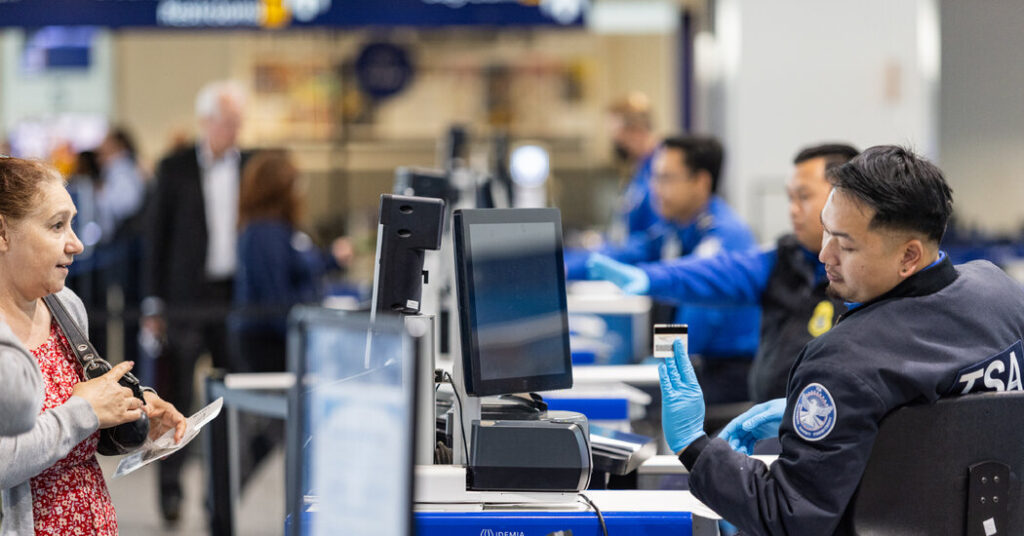
About 95 percent of the Transportation Security Administration’s roughly 60,000 employees are required to report to work through a shutdown without being paid, according to the agency’s acting administrator, Ha Nguyen McNeill.
Still, during the fall’s shutdown, that open-ended requirement proved untenable to many workers, who found it difficult to ride out what became a 43-day shutdown without taking side jobs. T.S.A. saw a spike in resignations after that shutdown, Ms. McNeill told lawmakers this week, while she noted that the agency was trying to increase hiring before the World Cup later this year.
Staffing shortages did cause screening delays at Houston’s two airports during the later weeks of shutdown after employees had missed multiple paychecks.
The Homeland Security secretary, Kristi Noem, awarded $10,000 bonuses to some T.S.A. officials after the shutdown ended for going “above and beyond.” It is not clear if the potential for another windfall — though Ms. Noem has not promised one — will keep more T.S.A. employees reporting to work through another shutdown.
Disaster Response: Federal Emergency Management Agency
Disasters pay no heed to federal funding lapses, and for that reason, nearly 85 percent of Federal Emergency Management Agency employees are expected to work without pay through any shutdown, based on how the agency handled last fall’s lapse in funding.
FEMA’s disaster relief fund has enough money to carry out its current and anticipated emergency response activities, according to Gregg Phillips, the associate administrator for the agency’s Office of Response and Recovery. But if a catastrophic disaster were to occur during a Homeland Security Department shutdown, the fund “would be seriously strained,” he told lawmakers on Wednesday.
FEMA would find it difficult to reimburse states for disaster relief operations quickly, Mr. Phillips said. Those delays could in turn slow recovery efforts, he added.
Immigration Benefits: U.S. Citizenship and Immigration Services
U.S. Citizenship and Immigration Services, the agency that processes green cards, naturalization and other benefit applications, is largely funded by fees it charges applicants, so most operations would typically continue during a shutdown. During the last shutdown, a vast majority of the agency’s roughly 22,000 employees continued working.
Some programs do receive appropriated funds, including E-Verify, which allows employers to check their employees’ eligibility to work in the country. During the last shutdown, the program was temporarily suspended. In a statement on Thursday, Matthew Tragesser, an agency spokesman, said the administration would “take decisive action to keep E-Verify open during a shutdown.”
Coast Guard
Though the Coast Guard is part of the Homeland Security Department, it operates like any other branch of the military when it comes to government shutdowns: Uniformed personnel must keep coming to work, even though most of them will not be paid until after the shutdown is over.
Vice Admiral Thomas Allan, the acting vice commandant of the Coast Guard, has warned that a prolonged shutdown would erode mission readiness and hurt morale. Certain training for pilots, aircrews and boat crews would stop, Mr. Allan said. Aircraft and boats could also degrade as scheduled maintenance is deferred, he added.
Cybersecurity Operations: Cybersecurity and Infrastructure Security Agency
Most employees at the Cybersecurity and Infrastructure Security Agency, which helps protect the country’s election system, power grids and water utilities, would be furloughed during a shutdown. The agency would require 888 of its 2,341 employees to continue working, many of them without pay. Although the agency would continue operations that are “essential to protecting life and property,” it would delay strategic planning and development of cybersecurity guidance.
Secret Service
About 94 percent of the Secret Service’s work force of more than 8,000 would stay on the job, many without pay, during a shutdown. Matthew C. Quinn, the deputy director of the agency, said on Wednesday that agents would continue to protect the president and vice president, along with their families. They would also continue to protect former presidents and their spouses, in addition to visiting heads of state and other top government officials. Still, Mr. Quinn warned about fading morale “as bills come due.”
He also said critical agency priorities would be delayed, such as efforts to hire or train agents and officers.
Karoun Demirjian is a breaking news reporter for The Times.
The post The Homeland Security Shutdown Could Affect ICE, Travelers and the Coast Guard appeared first on New York Times.