Before we get to discussing China, let’s get caught up:
-
The Trump administration on Thursday erased the scientific finding that requires the government to regulate the pollution that is dangerously heating the planet.
-
Read more on what the repeal of the “endangerment finding” means here.
Chinas clean energy future
In a series of articles published last year, my colleagues and I charted the remarkable rise of clean energy in China, and the degree to which the United States is falling behind in the race to adopt low-carbon technologies like solar power and electric vehicles. Importantly, these products are often less expensive and provide greater convenience than fossil fuel technologies.
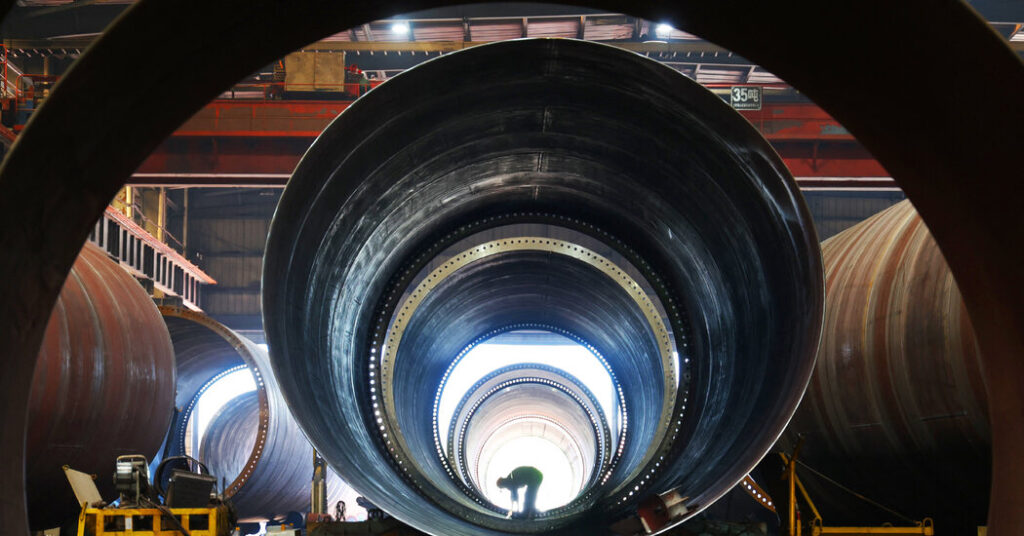
We explored the extraordinary scale of Chinese solar farms, including one that covers some 162 square miles, and its construction of thousands of miles of ultrahigh-voltage transmission lines.
We examined how China was exporting cheap solar panels and electric vehicles around the globe, reshaping economies from South Africa to Brazil. And we looked at China’s rapid advances in emerging fields including fusion, self-driving cars and rare earths.
With each passing week, the headlines reinforce the central idea of this series.
At the same time, China has not slowed its global efforts. Canada last month agreed to lower tariffs on some Chinese vehicles, opening the door to popular electric cars from automakers like BYD. Chinese state media this week reported that researchers had developed a lithium battery that can retain its electrical charge in extreme cold.
Clean energy technologies, including solar and electric vehicles, were responsible for more than a third of China’s economic growth last year, generating some $2.1 trillion in economic activity, according to an analysis by Carbon Brief.
To get a sense of how fast things are moving, I called my colleague Keith Bradsher, who is based in Beijing.
“China is way ahead of the rest of the world,” he told me. “Not just in installing a lot of renewable energy and new transportation technologies, but also in scoring research breakthroughs.”
The U.S. turns back the clock
The contrast between Beijing and Washington is stark.
The Chinese government has been a patient supporter of the country’s clean technologies for decades now — its policies governing rare earths, which are essential components in everything from electric cars to supersonic jets, date back some six decades. U.S. policy, by contrast, has been all over the place.
After four years during which the Biden administration worked to nurture the wind, solar, battery and electric vehicle industries, the Trump administration is now doing precisely the opposite.
And just as China is accelerating its shift to clean energy, the Trump administration continues to find new ways to penalize renewables and promote fossil fuels like coal, oil and gas.
Just yesterday, the White House ordered the Pentagon to buy more electricity generated from coal, the dirtiest fossil fuel. (China remains the world’s largest user of coal, but is working to decrease its usage. Overall, Chinese carbon dioxide emissions have been flat or falling for 21 months now.)
Last month, the Energy department canceled $30 billion in loans for clean energy projects. And as Brad Plumer and Rebecca Elliott reported this month, the White House and its allies are delaying approvals for wind and solar projects on both federal land and private property, creating what one renewable energy group called a “blockade” that is stalling hundreds of developments nationwide.
“The U.S. is really turning its back on a lot of 21st century energy and transportation technologies,” Bradsher told me.
Couple all that with the Trump administration’s attacks on the offshore wind industry, its sweeping efforts to roll back environmental regulations, its expanded support for fossil fuels, and its cuts to scientific research, and a picture emerges of the world’s two biggest economies diverging on the central issue of how to power the future.
What’s more, Bradsher told me, the playing field is expanding with each passing month, as China’s policies have begun leading to a cycle of ever more innovation.
“China has a vast research effort to develop new inventions from rare earths, even as the U.S. has almost abandoned basic chemistry.,” Bradsher said.
Shaping the world
As the United States doubles down on domestic fossil fuels, China continues to extend its influence around the globe.
Last year, Chinese exports of electric vehicles hit a record $70 billion, and China’s carmakers saw sales in more than 150 countries and territories. And in the first half of 2025, Chinese exports of solar cells jumped sharply, even as exports of finished panels stagnated because of oversupply.
“We’re shifting away from an oil-powered world to a much less expensive solar-powered world,” Bradsher said. “And every other country is buying more and more of their electricity in effect from China, because China has a near-monopoly on solar panels. And that’s all that anybody wants to buy now in much of the developing world, because it’s a cheaper way to get your electricity than anything else.”
I asked Bradsher, who has covered China for 24 years, what it was like living in a country where these technologies were commonplace.
“China’s high-speed rail, and ultramodern subways and growing numbers of self-driving electric cars often make me feel like I’m living in the future,” he said.
Climate law
For months, tear gas wafted into their homes. Now, they’re suing ICE.
Federal agents have fired so much tear gas near Mindy King’s apartment in Portland, Ore., that she and her 13-year-old son bought gas masks to wear inside. Her neighbor, Diane Moreno, has gone to urgent care, twice, with tightness in her chest and bloody discharge from her nose.
The problem, they say, is an Immigration and Customs Enforcement office less than 100 feet away from their homes. For months, ICE agents have sporadically used tear gas against protesters outside the facility.
Now, she and other residents at their affordable housing complex are suing the Trump administration, making a novel legal accusation. The U.S. government is knowingly releasing poison gas into the homes of its own citizens, they allege in their lawsuit. The chemicals bind to walls, carpets, clothing, furniture and even children’s toys, they say, creating a toxic environment. — Hiroko Tabuchi
Quote of the day
“The 19th century called, and it wants its fuel source back. The Trump administration is using our tax dollars to prop up the nation’s dirtiest, least-efficient power plants.”
That’s from Manish Bapna, president of the Natural Resources Defense Council, who was responding to President Trump’s latest attempts to kick-start the declining United States coal industry. Brad Plumer reports that Trump on Wednesday directed the Pentagon to start buying more electricity from coal-burning power plants.
At the event, more than a dozen coal executives and miners in hard hats presented Trump with a trophy that said “Undisputed Champion of Beautiful Clean Coal.” The award came from the Washington Coal Club, an obscure group with financial ties to the coal mining industry.
One last thing
States weigh bills to allow you to make your own electricity
Exactly six months ago, I wrote an edition of this newsletter about the state of Utah passing a law to allow residents to install plug-in solar systems on their balconies and rooftops without special permission.
These systems, which cost around $2,000 and plug straight into a wall socket, can produce enough power to offset the energy consumption of a few appliances. The law was inspired by balkonkraftwerke, or balcony power plants, which have taken off in Germany, where well over a million have been installed.
But thanks to a regulatory wrinkle, and a lack of third-party safety certification, balcony solar has not taken off in the U.S.
Things may be changing quickly. As of this week, lawmakers in 24 states have announced similar legislation, inspiring hope among solar enthusiasts that at least some of the bills will pass. Proponents hope the momentum sends a signal to plug-in solar companies that the U.S. is open for business. An influx of competition would theoretically cause prices to fall. In Germany, the systems start at around 300 euros, or about $355, and can be purchased online.
As Raymond Ward, a Republican state representative in Utah, told me, the simplicity of plug-in solar has helped lead to a groundswell of interest in the technology.
“People are like, ‘Oh, I can just buy that and plug it in?’” he said. “‘Oh yes, I want one of those.’ And then they’re turning to their representatives to say, ‘Why can’t I have it here? What needs to change?’”
More climate news from around the web:
-
The Washington Post reports that the last three years of accelerating global warming have perplexed climate scientists.
-
Heatmap News argues that Toyota’s newly announced Highlander electric vehicle, a three-row SUV, “signals a sea change for the world’s largest automaker.”
Read past editions of the newsletter here.
If you’re enjoying what you’re reading, please consider recommending it to others. They can sign up here.
Follow The New York Times on Instagram, Threads, Facebook and TikTok at @nytimes.
Reach us at [email protected]. We read every message, and reply to many!
David Gelles reports on climate change and leads The Times’s Climate Forward newsletter and events series.
The post Why Living in China Is Like ‘Living in the Future’ appeared first on New York Times.