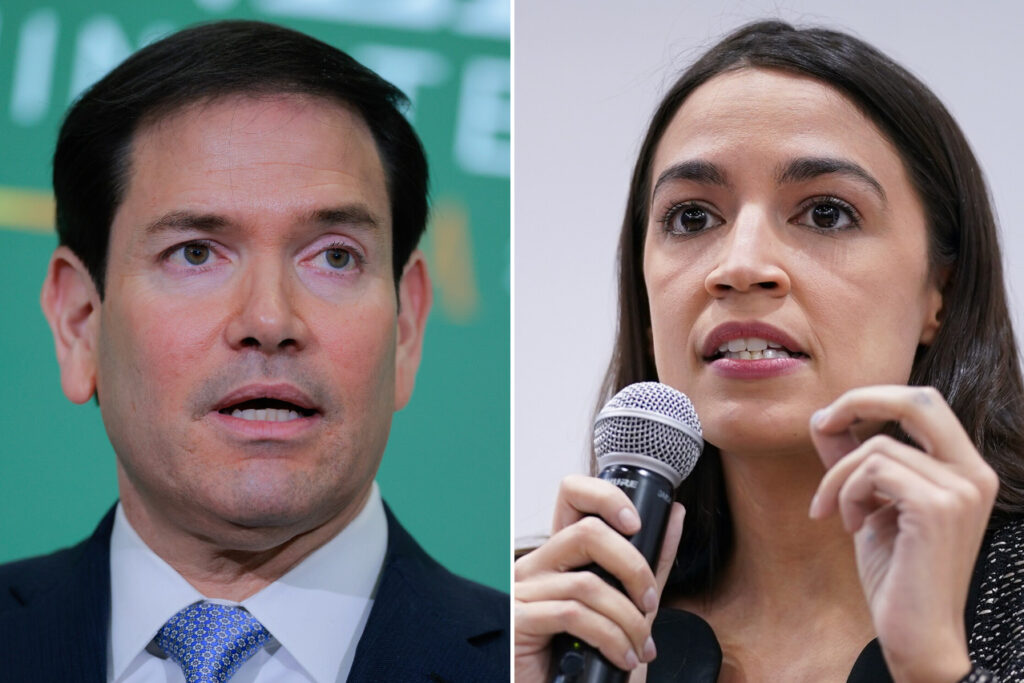
Secretary of State Marco Rubio and Rep. Alexandria Ocasio-Cortez (D-New York) are poised to deliver clashing visions of U.S. global leadership during a key European security summit this week where leaders will endeavor to address the world’s most pressing crises.
At the Munich Security Conference, the potential 2028 presidential candidates are expected to challenge Europe’s ruling class in their own way as the Democratic and Republican establishments struggle to convince U.S. voters of their party’s value on the world stage.
Rubio, who heads the U.S. delegation traveling to Germany, is widely seen as the “good cop” in the Trump administration’s ever-widening conflict with Europe over defense spending, Greenland, internet censorship and immigration policy.
Unlike Vice President JD Vance, who stunned the conference last year with his accusations of Europe’s civilizational demise, Rubio is expected to focus on more familiar criticisms related to the continent’s overreliance on U.S. military support.
Ocasio-Cortez, meanwhile, is expected to decry the influence of billionaires and corporate interests on international policies she views as hostile to the working class.
“She brings an understanding of the way that oligarchy and corruption are part of the problem in our foreign policy and have been for a long time,” said Matt Duss, an informal adviser to the congresswoman and executive vice president of the Center for International Policy.
The elite conference, which invited 50 leaders from around the world, is famous for promoting the vision of a Western “rules-based” global order that has come under increasing criticism from politicians on the right and the left as outdated if not illusory.
“The consensus surrounding a rules-based order has been collapsing under their feet, and they’re only getting the memo now,” said Duss, who noted Ocasio-Cortez’s long-standing view that the deepening influence of wealthy interests on government is a driver of right-wing populism that threatens Western democracy.
“This is an opportunity to hear from a progressive leader who represents a perspective not often heard at the Munich Security Conference,” he added.
Duss’s role advising Ocasio-Cortez’s debut in Munich has also raised expectations that she will speak forcefully on the Israeli-Palestinian conflict, a longtime focus of Duss’s, said Jeremy Shapiro, research director at the European Council on Foreign Relations.
“It’s obviously a progressive cause, and in Europe she’ll find a receptive audience to a somewhat more pro-Palestinian approach than you find in the American mainstream,” Shapiro said.
Since 2024, Ocasio-Cortez has condemned what she calls Israel’s “genocide” in Gaza, a term supported by many genocide scholarsbut avoided by some high-profile prospective 2028 Democratic presidential candidates, such as California Gov. Gavin Newsom or Pennsylvania Gov. Josh Shapiro.
Rubio, as the highest-ranking U.S. official in Munich, will be defending Trump administration policies that have rattled America’s friends and foes, including a raft of punitive tariffs, high-wire talks aimed at ending the war in Ukraine, and on-again, off-again provocations to “own Greenland” and make Canada the “51st state” of the United States.
Rubio’s keynote speech to the conference is scheduled for Saturday, while Ocasio-Cortez is due to speak at a town hall Friday and on another panel later in the evening, her office said.
Ahead of the conference, Munich’s organizers published a report declaring a fundamental break in the U.S. post-World War II strategy that rested on multilateral institutions, economic integration, and support for human rights and democracy. The Trump administration is actively undermining each pillar, it says.
“The most powerful of those who take the axe to existing rules and institutions is US President Donald Trump,” the report says. “Yet, it is unclear whether demolition is really clearing the ground for policies that will ultimately serve the people.”
“Instead, transactional deals may well replace principled cooperation, private interests may increasingly trump public ones, and regions may become dominated by great powers rather than governed by international rules and norms,” the report warns.
The State Department did not immediately respond to a request for comment.
The Trump administration has made clear the feelings of transatlantic disappointment are mutual. In its latest National Security Strategy, the administration urged Europe to “stand on its own feet” and take “primary responsibility for its own defense.”
The document condemned Europe’s migration policies “that are transforming the continent,” its “cratering birth rates” and “censorship of free speech and suppression of political opposition.”
European officials have made clear they are not interested in such lectures from the United States, which has been revoking visas of college students critical of Israel and is experiencing a record low fertility rate.
“The attempts by the Trump administration to accuse Europeans of suppressing free speech are met with justified incredulity in Europe,” said Jeff Rathke, president of the American-German Institute and a former State Department official. “The way that they respond to individual incidents can differ, but the notion that there is some massive suppression of free speech in places like Germany is just not backed up by the facts.”
The post Ocasio-Cortez, Rubio to offer dueling visions of world order in Munich appeared first on Washington Post.