Large swaths of the Department of Homeland Security are set to shut down Saturday unless lawmakers strike a last-minute deal to fund the agency, with Democrats threatening to oppose any legislation that does not include new restrictions they are seeking regarding federal immigration agents.
Democrats demanded a long list of changes to DHS after federal immigration agents killed Alex Pretti last month in Minneapolis, including tighter rules on warrants and a ban on agents wearing face masks. President Donald Trump appears to be open to some of them, but Democrats rejected the White House’s latest proposal Thursday, raising the odds of a partial government shutdown.
“They have not addressed most of our major concerns at all,” Sen. Patty Murray (Washington), the top Democrat on the Senate Appropriations Committee, told reporters.
The White House sent Democrats the proposal Wednesday night, according to a person familiar with the matter, who spoke on the condition of anonymity to discuss ongoing negotiations. But Senate Democrats swiftly dismissed it as insufficient. Asked whether Democrats could reach an agreement with the White House, Sen. Tim Kaine (D-Virginia) said “not today.”
Republicans have accused Democrats of being unreasonable. They have asked Democrats to support a short-term funding extension for DHS while negotiations continue — though Senate Majority Leader John Thune (R-South Dakota) warned that Democrats would have to make concessions of their own.
“Democrats are never going to get their full wish list,” Thune said Thursday on the Senate floor. “That’s not the way this works.”
Democrats have ruled out voting for any funding extension if they do not reach an agreement with the White House.
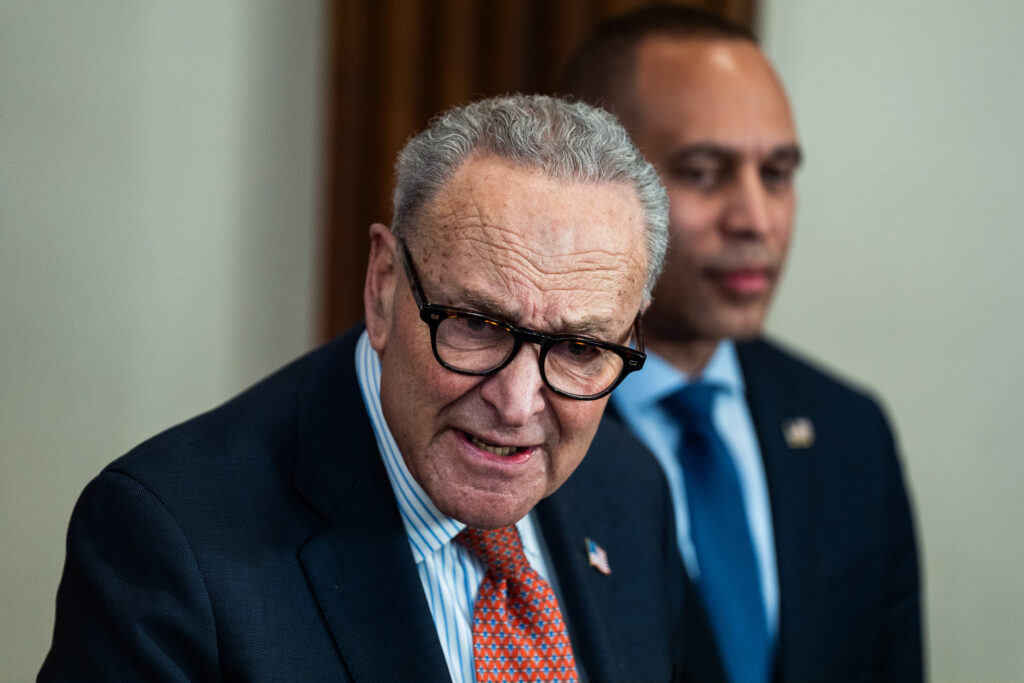
“Democrats have been very clear: We will not support an extension of the status quo,” Senate Minority Leader Charles E. Schumer (D-New York) said Thursday on the Senate floor.
The stalemate means much of DHS will shut down after the end of the day on Friday absent an unexpected breakthrough in negotiations. Many lawmakers are planning to leave Thursday to travel to the Munich Security Conference, putting further pressure on negotiations, although leadership could try to keep them in Washington if a deal appears within reach.
The House would also need to pass any last-minute deal to fund the department. Republicans have a perilously narrow majority in the chamber, and House Minority Leader Hakeem Jeffries (D-New York) said Thursday that the White House proposal was not enough to win House Democrats’ votes.
“Funding for ICE and the Department of Homeland Security should not move forward in the absence of dramatic changes that are bold, meaningful and transformational,” Jeffries told reporters.
A funding lapse would trigger the third full or partial federal government shutdown in barely three months. The government shuttered for 43 days in the fall amid a standoff between the two parties over expiring Affordable Care Act subsidies; that was followed by a shutdown of much of the government for several days that ended last week.
This shutdown would affect only DHS — but it would not shutter Immigration and Customs Enforcement or Customs and Border Protection, because Republicans sent those agencies tens of billions of dollars in additional funding last year that would allow them to continue to operate.
Instead, the brunt of a shutdown would fall on the Transportation Security Administration, the Federal Emergency Management Agency, the Coast Guard and other agencies within DHS. It would affect about 13 percent of the federal civilian workforce, most of whom would be forced to work without pay, according to data from DHS and the Office of Personnel Management.
Republicans have emphasized the potential impact on agencies unrelated to the administration’s immigration efforts if DHS funding lapses.
“The pain will be felt by the men and women of TSA, who will once again work to keep our airways safe without a paycheck,” Rep. Mark Amodei (R-Nevada), who chairs the Appropriations subcommittee on homeland security, said Wednesday. “There will be uncertainty for our Coast Guard men and women — who have no choice but to show up for work. … It will reduce the amount of funding in the Disaster Relief Fund — just weeks after massive winter storms affected wide swaths of the country.”
Democrats said the administration’s announcement Thursday that it would end its surge of federal immigration agents in Minnesota was not enough to earn Democrats’ support.
“The announcement that the surge is over in Minneapolis changes in no way the tactics that are used there and across the country,” Sen. Richard Blumenthal (D-Connecticut) told reporters. “There needs to be a complete overhaul of this department.”
The Senate is expected to vote Thursday on taking up legislation to fund the agency through Sept. 30, but Democrats have said almost unanimously that they will oppose any bill to fund DHS without new restrictions on immigration agents.
Sen. Catherine Cortez Masto (D-Nevada), who broke with her party during last year’s shutdown and voted for a Republican funding bill, said Tuesday that she would not do so this time.
“We are asking our colleagues and the White House to work with us,” Cortez Masto told reporters. “It’s common sense. Work with us. Unfortunately, we are not seeing that.”
The restrictions demanded by Democrats include requiring federal immigration agents to wear identification and body cameras and barring them from operating near schools, medical facilities, churches, polling places, child care facilities and courts. They also want to ensure that states and local jurisdictions can investigate and prosecute potential crimes committed by agents and excessive use of force, among other demands.
Republicans have criticized many of the Democrats’ demands, arguing that they would needlessly hamstring agents. Thune has said he expects the White House to make its own demands, including new protections for federal immigration agents and measures cracking down on cities that limit cooperation with federal immigration authorities, sometimes known as “sanctuary cities.”
Still, Thune said he thought that negotiations between the White House and Democrats were making progress and that a deal was still possible with more time.
“There’s been clear movement there, which to me suggests that discussions ought to continue,” Thune told reporters Thursday. “And I hope the Democrats feel the same way.”
Emily Davies and Maegan Vazquez contributed to this report.
The post Partial government shutdown looms as ICE negotiations hit stalemate appeared first on Washington Post.