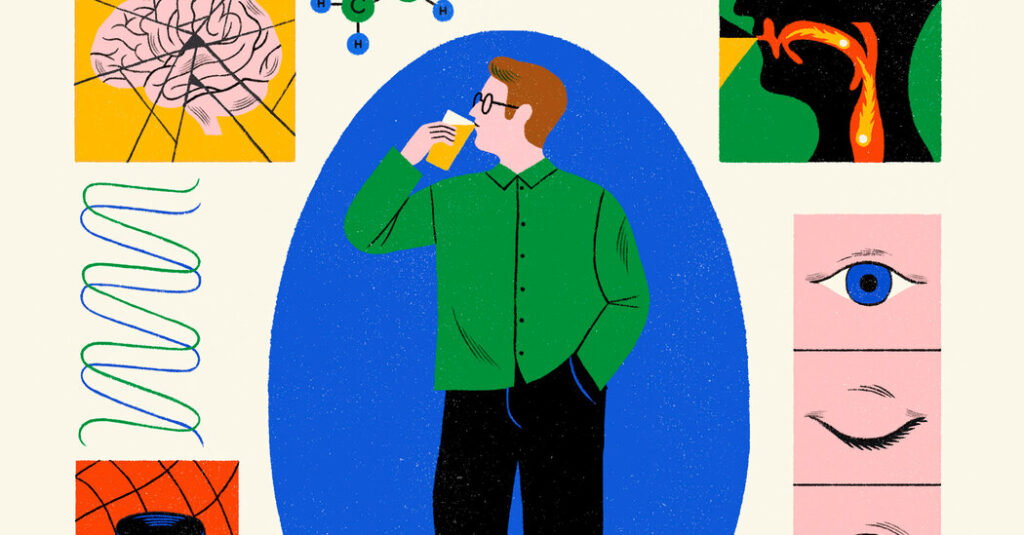
Dry January has come and gone, but Americans’ relationship with drinking is undergoing a more lasting change. According to one recent poll, just 54 percent of U.S. adults said they consume alcohol, the smallest percentage in nearly 90 years of data collection. That may be because more people are taking alcohol’s negative health consequences seriously.
Drinking alcohol can have profound effects on the brain and body. In the moment, some of those effects can be pleasurable. But in the long term, especially when it’s consumed in large quantities, alcohol can cause serious health harms.
Here’s an inside look at what alcohol does to the body, both while you’re drinking and over time.
In the Brain
Alcohol has a rapid effect in the brain, causing people to feel more relaxed and sociable.
Over the long term, alcohol use is associated with changes in brain structure. Some studies have found that middle-aged and older adults who average even one drink a day tend to have slightly less brain volume than people who don’t drink. And the more alcohol someone consumes, the more the brain shrinks. Experts don’t know exactly why that is, but one theory is that alcohol alters the brain’s immune system, ramping up inflammation, which can damage neurons.
In the Mouth and Neck
The tissues that are most at risk from drinking tend to be the ones that come into direct contact with alcohol, including in the mouth and neck.
Drinking alcohol increases the risk of four types of cancer in the mouth and upper digestive tract: oral, pharyngeal (throat), laryngeal (voice box) and esophageal. The mouth, throat and esophagus are particularly vulnerable since those tissues have some of the greatest exposure to acetaldehyde. According to one analysis, the risk of mouth and throat cancers increases by 13 percent and the risk of esophageal cancer by 26 percent with just one drink per day. For people who have five or more drinks a day, the risk of all three cancers is roughly four times higher.
In the Heart and Chest
A few decades ago, scientists thought alcohol might benefit heart health. But that perspective has changed among some experts in recent years as more research has come to light.
Alcohol’s relationship to heart attack and stroke is more complicated. Heavy drinking (three or more drinks per day) is associated with a higher risk of both. But when it comes to light to moderate drinking (two drinks a day or less), the research is mixed. A few studies suggest a small increased risk of heart attack and stroke starting at one drink a day, but several others report that people who drink in moderation actually have a reduced risk, compared with people who don’t drink at all.
In the Gut
Like the mouth and throat, the stomach and intestines come into direct contact with alcohol and acetaldehyde, making them particularly susceptible to damage.
Tissues in the gastrointestinal tract are also prone to alcohol-related cancer. One recent study found that people who consistently averaged two or more drinks per day had a 25 percent increased risk of developing colorectal cancer compared with people who averaged less than one weekly drink.
In the Liver
The liver may be the organ most vulnerable to damage from drinking, and alcohol-related liver disease is the leading cause of death from excessive drinking.
According to one estimate, 90 percent of people who consume more than four drinks per day have fat deposits on their liver, and 30 percent of people who regularly have three or more drinks a day will develop cirrhosis. The fat deposits, inflammation and early fibrosis can be reversed, but advanced liver cirrhosis is permanent.
Like in other parts of the body, heavy drinking also increases the risk of cancer in the liver, because of the DNA damage caused by acetaldehyde.
•
The facts are sobering, but take note: Experts say that the odds of experiencing health harms from drinking are relatively low if you average one drink a day or less.
The risks go up at eight to 14 weekly drinks, but whether those heightened risks result in an illness often depends on people’s genetics and pre-existing conditions. And if you currently drink heavily, research shows that some of the damage can be reversed if you stop or cut back.
Sources
Dr. Krishna Aragam, the director of cardiovascular genomics at the Cleveland Clinic; Veronika Fedirko, a professor of epidemiology at the University of Texas MD Anderson Cancer Center; Thomas Kash, a professor of pharmacology at the University of North Carolina at Chapel Hill; Dr. Frances Lee, an assistant professor in the division of liver diseases at the Icahn School of Medicine at Mount Sinai; Dr. Gregory Marcus, a professor of cardiology at the University of California, San Francisco; Dr. Robert Messing, a professor of neurology at the University of Texas at Austin; Anya Topiwala, a senior clinical researcher in psychiatry at the University of Oxford; and Vasilis Vasiliou, a professor of environmental health sciences at Yale University.
Produced by Deanna Donegan, Claire Merchlinsky, and Meghan Morris
Dana G. Smith is a Times reporter covering personal health, particularly aging and brain health.
The post What Alcohol Does to the Body appeared first on New York Times.