Gustavo Dudamel has wanted to bring Beethoven’s “Egmont” to the Los Angeles Philharmonic for years. As his 17-year-tenure as the orchestra’s music and artistic director comes to an end, he has decided that now is the time.
Beethoven’s incidental music for Goethe’s play “Egmont” will come to the Philharmonic this Thursday through Sunday, with new text by Jeremy O. Harris (“Slave Play”) and narration by Cate Blanchett (who played a conductor in “Tár”) as Count Egmont, the Dutch nobleman who led the resistance to Spanish rule in the Netherlands in the 16th century.
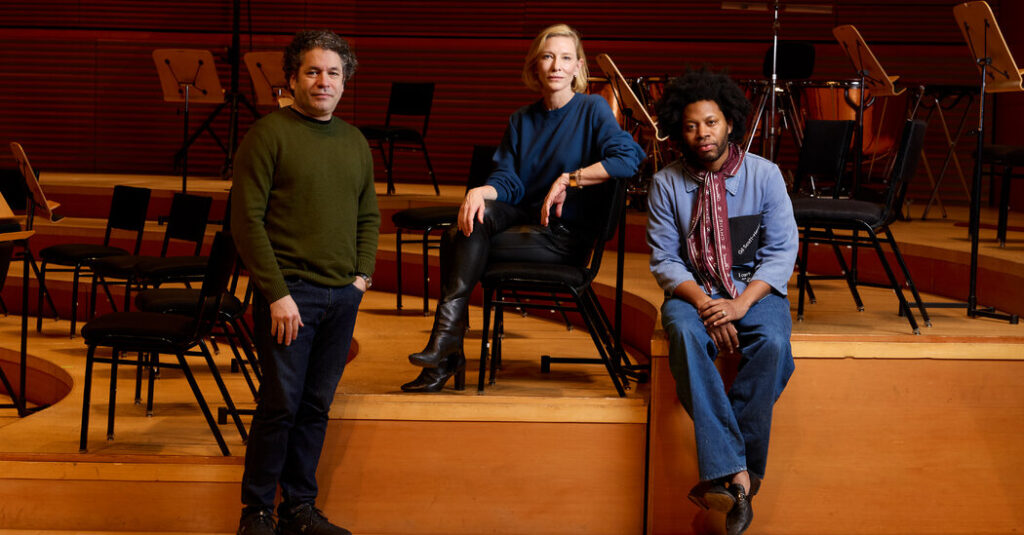
Between rehearsals on a recent afternoon, Dudamel, Blanchett and Harris gathered at Walt Disney Concert Hall to discuss what drew them to this project, a valedictory piece of Dudamel’s farewell before he becomes the New York Philharmonic’s music and artistic director this fall. Here are edited excerpts from the conversation.
Jeremy will join us in a moment. But first, tell me how you know each other. Were you friends before the movie “Tár?”
CATE BLANCHETT We met when Gustavo kindly did a Q&A for “Tár” at the Academy Museum for Vanity Fair.
GUSTAVO DUDAMEL The film was amazing.
BLANCHETT It wasn’t a film about conducting, yet there was conducting in it.
DUDAMEL The meaning of what we — I imagine it’s the same for acting as conducting.
BLANCHETT I don’t know, it’s still a collective endeavor, isn’t it? I mean, people talk about monologues, or they prize individual achievement. But in the end, you cannot do it unless you have an ensemble. You cannot do it, unless you have an orchestra or singers.
Welcome, Jeremy. Let’s start with: How did this collaboration happen?
JEREMY O. HARRIS I’m the luckiest email recipient in the world. I received an email from Cate and I was like, what?
DUDAMEL It was because of Cate. We were talking about what to do, how to do this. I was doing a version in Berlin with a Goethe text, a version narrated by Bruno Ganz in the 1990s. We used that text but changed little things. In the conversation with Cate, we said we have to bring this to our times. Cate brought up the idea of Jeremy.
Cate, what made you think of Jeremy?
BLANCHETT (turning to Harris) There’s a naked urgency about the way you write. You write with such soul, and your spirit and your intellect are so electrified in your words. And I just felt that it would speak to this, when you were writing, it could speak to the moment more than anybody else that I could think of.
HARRIS They were amazing collaborators. I’ve been a big admirer of classical music for a long time, but I think that like many people, I have this intimidation of a philharmonic, an opera, these things that I had no way in. But I’ve always wanted to work with her, so there was no way I would say no.
The thought of writing something for this audience felt like I had to do a lot homework. Gustavo made that anxiety go away immediately by saying: “Give me everything, and I’ll conduct it. I’ll shape it.” And that gave me a lot of freedom, and I was really grateful that there were no constraints on my imagination.
Are there constraints in writing the text to music like this? Does the text follow the music, or is it the other way around?
BLANCHETT It’s much more fluid. You know, because there are these suspended moments. We’ll see what happens, but there are some really strong, contemporary tectonic resonances in what Jeremy’s written. So it might need more air around them.
How much did you try to modernize this story?
HARRIS I read the story of Egmont, I read the play, and then the text usually used with the incidental music. I read it 20 times. I played Gustavo’s Berlin performance in the background and just started writing. It came out of me like vomit. I just let my hands move and prayed they wouldn’t hate it.
But the thing that I took from everything I read about Egmont is that there was no necessity to make it like wildly contemporary because it is wildly contemporary. It’s about the Inquisition. The things going through the minds of the people, the things they were celebrating about Egmont’s life and the Eighty Years’ War that came after that, are the things that we’re talking about now as we try celebrate the people who are standing up and fighting. There’s so many reasons to rage. There are so many things that put me in the 15th century, the 16th century, 17th century.
What kind of reaction did you get when you sent it to your collaborators?
HARRIS The first text I got back was from Cate, and it was so overwhelming I threw my phone down. My fiancé was like, “What’s going on?” I was like, “Oh my God, oh my God, oh my God.” And he had read it already. He was like, “Everyone’s going to love this.” I was like, “No, they won’t.”
BLANCHETT My first response was a profound relief. I was just so relieved. That you had thought it, that you had written it, and that we would get to say it. And I felt that the words matched the power of the music.
What has it been like rehearsing this together for the first time?
HARRIS (to Dudamel) You vibrate — every part of your body vibrates — when you’re up there. It’s really amazing to watch.
BLANCHETT You could feel that this was the first time you had ever lead the Overture, just watching you. It was like your every sinew in your arms.
DUDAMEL It’s such powerful music. It’s incredible because I played, as a child, the overture many times. I was 12 years old, 13, 14, and it’s still, you know, when I’m playing that, it’s like completely new. It’s like I’m always in love with the piece. It’s very passionate, it has all the elements, and with the text, it enhances everything.
When you planned this a while ago, did you have any sense about what this time might be like politically, about any parallels between the original play and this moment?
BLANCHETT (to Dudamel) You began to speak to the orchestra about it, and it made me think that the creative act begins with instinct, but it also begins with intuition. So you must have strong intuition that somehow this would be right moment for this: that you wanted to do something in your last season that’s really special. There must have been a deeper intuition that you knew that it had enough space, and enough metaphorical space, because it’s so difficult to speak directly to this moment because it is so overwhelming.
DUDAMEL That’s true, but you know it’s crazy because, I don’t know which analogy you use, but it’s like a river. Everything comes very naturally. I didn’t plan this because already the piece brings some values that are very important: justice, freedom, love, selflessness. I love Mahler and Stravinsky, but for me, the greatest is Beethoven. His way of thinking. He was a crazy man, but he wanted to speak about these values through the Missa Solemnis, the Ninth Symphony. To understand the music, you have to bring context — text. This music was done for a play. If you play it without the text, it doesn’t connect as well.
Adam Nagourney is the classical music and dance reporter for The Times.
The post Beethoven’s ‘Egmont,’ by Way of Cate Blanchett and Jeremy O. Harris appeared first on New York Times.