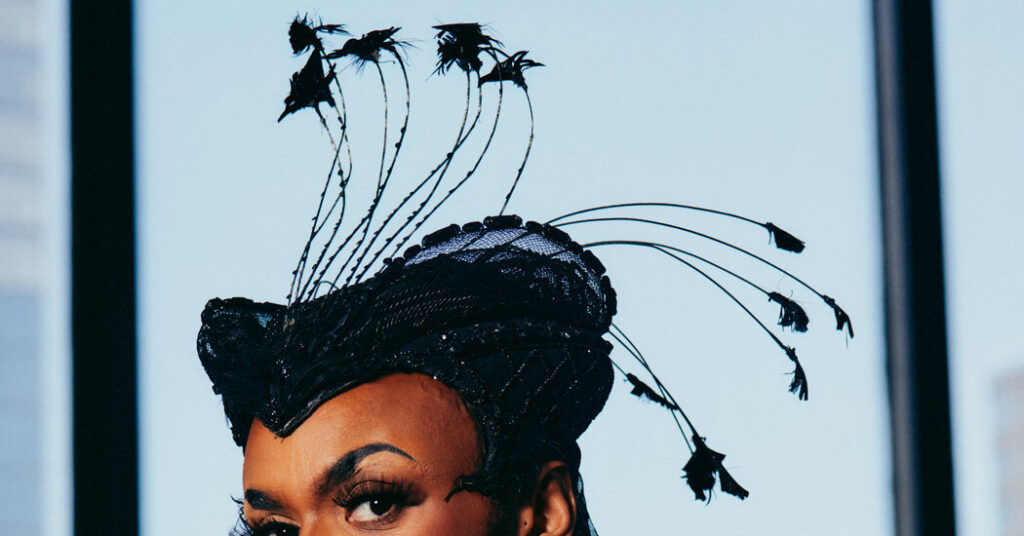
The last time Carabosse ripped through the kingdom in New York City Ballet’s production of “The Sleeping Beauty,” Taylor Stanley made a casting request. Could the role, a wicked fairy out for revenge, be played by a male-identifying dancer? In other words, by Stanley?
The answer was no.
That was in 2023. With the ballet scheduled for winter 2026, Stanley, who uses he/they pronouns, asked again — and again was told no. He took matters into his own hands, an uncharacteristic move for a dancer known offstage for his gentle demeanor. “In very Carabosse fashion, it stirred up a fire in me,” Stanley said. “So I went straight to the source. I went to Peter.”
Peter Martins, the company’s former director, choreographed the production. Martins said yes.
Martins’s Carabosse is a glamorous — but definitely still evil — figure: After crashing Princess Aurora’s christening, the fairy turns spiteful, casting a spell: The young princess will prick her finger and die. The Lilac Fairy softens the curse; instead of dying, Aurora will sleep for 100 years.
Stanley said he had admired past interpretations of Carabosse at City Ballet (there are four debuts in the part this season). But felt he could bring something different to the role, which has been played by men at other companies.
Martins, Stanley said, was surprised that he wanted to do it. But “he was lovely about it,” Stanley said. “He said, ‘Well, you’re going to have to wear heels.’”
Stanley had already done so as Drosselmeier, the mysterious, magical godfather in “George Balanchine’s The Nutcracker.” Character roles aren’t so common at City Ballet, but Stanley, increasingly, has found himself drawn to them. (He also performed as the eccentric Dr. Coppélius in “Coppélia,” which returns this spring.)
“It surprised me how much I connected with character roles,” Stanley said. “And the ones I’ve done here, Drosselmeier and Coppélius, have felt like invitations to explore queerness. They were steppingstones, which led me to Carabosse. Drosselmeier is like a dandy. And Coppélius is sensitive, sweet, sad — wholesome, but also misunderstood.”
Carabosse isn’t a cookie-cutter role, said Kathleen Tracey, a City Ballet repertory director who has worked closely with Stanley. “I have seen the gamut of fiery anger to more subtle and more conniving to just a strong presence,” she said.
With Stanley, she added, “You see such thought and creativity, and you see this character harmonizing spontaneity as well as calculation.”
Stanley, 34, is not just the first male identifying dancer to play the role at City Ballet; he is also mixed race, queer and nonbinary. The scholar Kimberlé Crenshaw and her idea of intersectionality have been on his mind lately. “I’m at this crossroads of different facets of myself playing a character who is on the margins,” Stanley said.
Stanley, who is scheduled to perform the role on Feb. 14, 18 and 21, spoke in a recent video interview about how, among other subjects, the role gives him a sense of purpose. “It feels really huge,” Stanley said. “When I found out that I was to be cast, I sobbed.”
What follows are edited excerpts from that conversation.
Do you know why you took such initiative to get this role?
I had to for my own sense of purpose and my own growth. I have always been like, I could do this and I could feel good about the way that I’m doing it. So I had to really fight and kind of in Carabosse form make a little bit of — not a scene — but just make my presence known.
I have noticed recently that you have been taking a stand on social media about politics and pushed for canceling a performance during the recent snowstorm. Has Carabosse played into that?
She’s kind of informed me that my silence is a bit outdated and in order to step into this role, I need to become aware of my meekness when it comes to speaking up. In previous times, I might have just stood back, watched the conversations go back and forth and not really done anything.
It struck me as a new Taylor.
Something is shifting. Rehearsing Carabosse is a vessel through which I can channel those inner changes so that they don’t just stay locked.
How do you think about the gender cross?
I’ve been going back and forth thinking, is this drag? Is this not drag? I don’t know if I have the answer to that. With Carabosse, I am portraying a woman with female energy. There’s a part of me that also feels and connects to that female energy. I don’t feel like a man playing a woman.
What do you feel like?
I really don’t feel like either man or woman as my gender. And it’s still taking me time to find that outer expression in my daily life, which is another voice that churns in my head. Like you don’t look nonbinary enough or you don’t look like a woman enough.
So this is also an opportunity for me to cross a bridge where I gave myself permission to step into this role and play this part. How can I take that confidence outside of the ballet, outside of the stage and not put on a character, but feel comfortable and empowered by this very feminine energy that I’m still trying to nurture?
What are you thinking about in terms of your gestures?
Carabosse is always leading with her posture. She’s never sunken. She’s never apologetic. And she has this amazing beaded dress on, and I have to show every inch of me off. I think just imagining myself as tall and giving myself length with every movement and resisting this kind of apologetic nature that is very much a habit for me. Saying sorry all the time and being embarrassed about things very quickly and not always being sure of myself.
She just erases all of that, and with that comes this tall, long, gorgeous, effeminate being. She’s conniving and she’s devious. And that equates to evil. It’s a weird line to walk.
How do you walk that line as Carabosse?
She is not like any of the other fairies. I see her as wanting to belong even though it’s contained in rage. The first thing she says is: “You didn’t invite me. Why?”
Carabosse thinks she’s the most regal thing. She is the queen in her mind. So she’s broken inside but she’s obviously hiding that brokenness by seeking revenge, seeking power, seeking control. I’m playing a villain in a ballet, but also what constitutes a villain? What constitutes the victim?
How do you approach that side of the role?
I’m drawing from my own experiences and feelings of otherness, of being marginalized. It’s knowing that worth and making sure that that’s a constant now in my life over the way that I am perceived. That is also maybe what Carabosse is teaching me: that really no one else’s opinion matters except for mine because I know that my power is within me.
And that’s when the beauty of Carabosse kind of comes out, you know? She’s just pure fierceness and beauty. Have I accepted that power and that beauty and that respect for myself?
It’s so personal and artistic at once.
Yeah. Hopefully this can be another door that is open for people who are standing in the wings being like, “Oh my God, I know I could do that role,” or “I wonder what it would feel like to.” I think it in general pushes the needle a little in a direction that I hope we can continue going in as a ballet industry and institution.
Gia Kourlas is the dance critic for The Times. She writes reviews, essays and feature articles and works on a range of stories.
The post Playing an Evil Fairy, a Dancer Makes His Presence Known appeared first on New York Times.