END OF DAYS: Ruby Ridge, the Apocalypse, and the Unmaking of America, by Chris Jennings
Of the gantlet of widely televised crises that have become synonymous with the 1990s — Waco, Oklahoma City, the O.J. trial — the siege at Ruby Ridge is arguably the haziest in public memory.
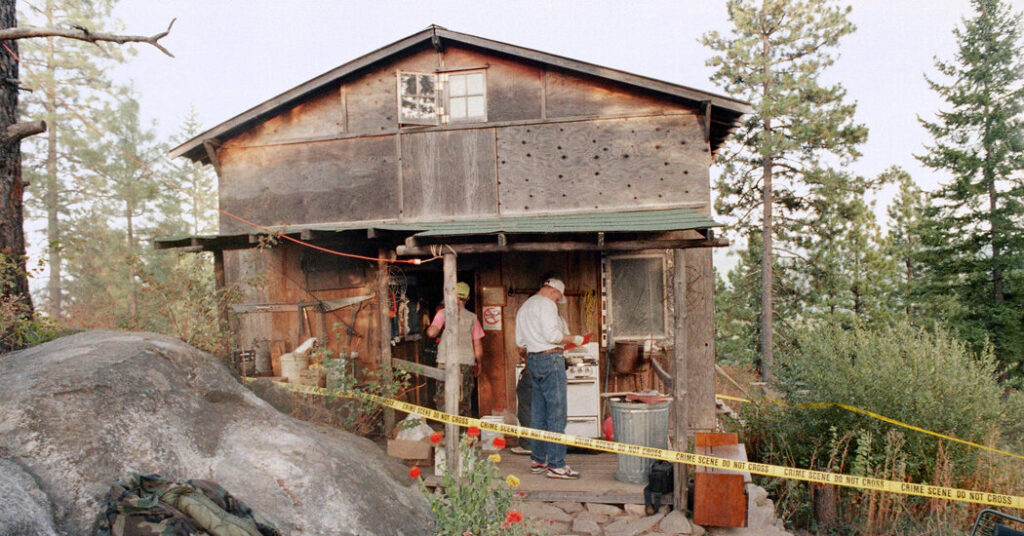
In late August 1992, federal agents in Idaho surrounded the mountain cabin of Randy Weaver, a Christian survivalist who had failed to appear in court on a gun charge. Weaver and his family, who were heavily armed (including the children), believed they were living through the biblical End of Days and subscribed to the antisemitic conspiracy that the government was run by a shadow group called ZOG (Zionist Occupied Government). They barricaded themselves in their house and refused negotiation attempts for over a week. By the time they surrendered, Weaver’s son; his wife, Vicki; and his dog had been killed, and one U.S. marshal had been fatally shot.
That is, at any rate, the most abbreviated version of the story. “The facts of the Ruby Ridge affair, when maximally compressed, make no sense,” Chris Jennings writes in “End of Days,” a riveting and thoroughly researched chronicle of the 11-day standoff that attempts both the decompression and sense-making that has long eluded accounts of the event. How did an unemployed man who’d committed a petty crime manage to summon a multimillion-dollar response from the U.S. government involving snipers, helicopters and commando teams?
And how did Randy and Vicki Weaver, two middle-class Midwesterners raised in the 1950s under more moderate expressions of faith (Vicki was brought up in a congregation of the Reorganized Latter-day Saints; Randy’s family was vaguely Presbyterian), become Christian survivalists and white nationalists?
Jennings traces Randy and Vicki’s spiritual evolution to the midcentury rise of the Christian Identity movement and, later, the Aryan Nations. These ideologies, rooted in racism and apocalyptic fundamentalism, had taken off in the rural Midwest of the 1970s and ’80s, a period of economic hardship exacerbated by Cold War trade battles.
While the Weavers remained largely inoculated from direct financial harm — Vicki worked as a secretary at Sears and Randy just barely held onto a job at John Deere — a steady diet of Ayn Rand, far-right magazines and theological mail-order cassettes primed the couple to inhale the strains of conspiracy and extremism that flowed from their harder hit neighbors.
Vicki, who was the brains and will of the family, developed a fervent sense of devotion that leaned heavily on the obscure mandates of Deuteronomic law. She refused to eat pork, secluded herself in a menstruation shed each month when she was “unclean” and took the command against graven images so literally that she refused to allow people to photograph her children.
As economic shock and apocalyptic obsession swirled together, families like the Weavers came to see themselves as the pawns of distant, abstract forces. General distrust of the government spread, as did prophecies of a “New World Order” ruled by Jewish bankers who wanted to advance communism as a prelude to the apocalypse.
There is another kind of prophecy that feels relevant here: the self-fulfilling kind. One of the central ironies of the Weaver family is that their mistrust of the government and their belief that they were living through a period of world-shattering chaos are precisely what triggered the siege. Randy refused to surrender to the authorities when they came looking for him because he and Vicki believed they were “servants” of the New World Order. And the siege lasted far longer than it might have because the family could not possibly trust the F.B.I. agents who promised them safety and fair treatment. As the prosecutor in Randy’s eventual trial would say of the defendant’s knotty logic, “If there was no persecution, the core of their religion would have been false, a fallacy.”
Jennings, the author of a history of utopianism in America, writes with vividness and precision, and occasionally soars into a panoramic lyricism reminiscent of Truman Capote’s “In Cold Blood” (“Compared to the uplands of North Idaho, the green, mellow expanse of the American Middle West seems an unlikely place for premonitions of apocalypse to creep into the human heart”).
He is also very good at pointing out the many ironies of the story, like the fact that the Weavers’ theological racism flowered in North Idaho, “a place where nonwhites and Jews were almost an entirely theoretical proposition.” Or the paradox that their antisemitism coincided with their attempts to live, essentially, in perfect observance of the Torah.
While the book does not sympathize with the Weavers, it does make an earnest and un-self-conscious effort to understand their motives and beliefs. It also takes stock of all the mistakes that the F.B.I. and U.S. marshals made during the siege: taking Randy’s theological bluster too seriously; revising their rules of engagement in a way that was clearly illegal; shooting the family dog, Striker, in order to silence his barks as they prepared an ambush, which only intensified public support for the Weavers. “Whatever Americans think about anti-government fanatics,” Jennings writes, “everyone agrees on the fundamental innocence of Labradors.”
These missteps would prove decisive. The siege ended with deaths on both sides, and though Randy Weaver was charged with murder and conspiracy, he was acquitted on all counts, apart from his original failure to appear in court. The surviving family members later sued the federal government, settling for $3.1 million in damages.
Part of Jennings’s thesis is that Ruby Ridge, and the throngs of protesters who gathered down the mountain to support the Weavers, foreshadowed our current politics — especially the conspiratorial bend of Americans who believe, for example, that the government is run by a secret cabal of pedophiles and Satan worshipers. “Three decades on, Ruby Ridge looks more like the start of something than its finale,” he writes.
It’s a thesis that is a tad conspiratorial itself, finding complex patterns that connect past to present, and like most conspiracies, it is at times utterly convincing and at others grasping at straws. Jennings insists that the Weaver saga portended “a slow-moving ontological crackup,” the splintering of consensus reality that characterizes our current moment — a claim that could surely apply to any number of controversies and crises from the late 20th century.
What the book demonstrates most clearly is the irrepressible human need for meaning, which extends far beyond the kiln of conspiracy and inspires virtually all narrative impulses. Jennings is acutely conscious of this primal craving — and of the unfortunate fact that it often leads a single person, family or event to become “a metonym for some larger phenomenon,” as he puts it in the epilogue. He is aware, too, of his complicity in this universal inclination: “The preceding pages,” he writes, “are one more contribution to that misfortune.”
END OF DAYS: Ruby Ridge, the Apocalypse, and the Unmaking of America | By Chris Jennings | Little, Brown | 377 pp. | $30
The post Ruby Ridge Was a Mess. Did It Foretell Our Modern World? appeared first on New York Times.