The term “artificial intelligence” was coined in 1955 by the computer scientist John McCarthy, who later said he came up with it largely because he needed some kind of term to put on a funding proposal. As many have admitted in the decades since, it’s probably not the best term for what it describes — both the words “artificial” and “intelligence” are notoriously hard to define, and as a result even the people who build A.I. systems struggle to explain what “A.I.” means.
That might help explain why movies have such wildly different ideas about what A.I. is. Sometimes it’s a shadowy, unstoppable viruslike menace with malicious intent, as in the last two “Mission: Impossible” movies. Sometimes it’s a disembodied, rapidly evolving intellect that seems human until it doesn’t, as in “Her.” Often it’s a sort of humanoid robot that wants to be loved or accepted, as in “A.I. Artificial Intelligence” and the Davids of the “Alien” franchise. And sometimes it’s closer to what scientists call A.G.I., or artificial generalized intelligence: a super-intelligence that doesn’t so much hate humans as consider them expendable fuel in its species’ aims and goals; think “The Matrix.” No wonder we have so much trouble wrapping our heads around A.I., and no wonder the companies that make it seem so mysterious.
Into this fray steps “Good Luck, Have Fun, Don’t Die,” a movie that conceives of A.I. by leaning on the “artificial” part of the moniker. Directed by Gore Verbinski, who’s been out of sight since his 2016 gonzo horror film “A Cure for Wellness,” this movie hurtles into dystopian sci-fi with a boatload of ideas strapped to its chest and a clicker in its hand, ready to blow at a moment’s notice. Hang on to your tinfoil hats.
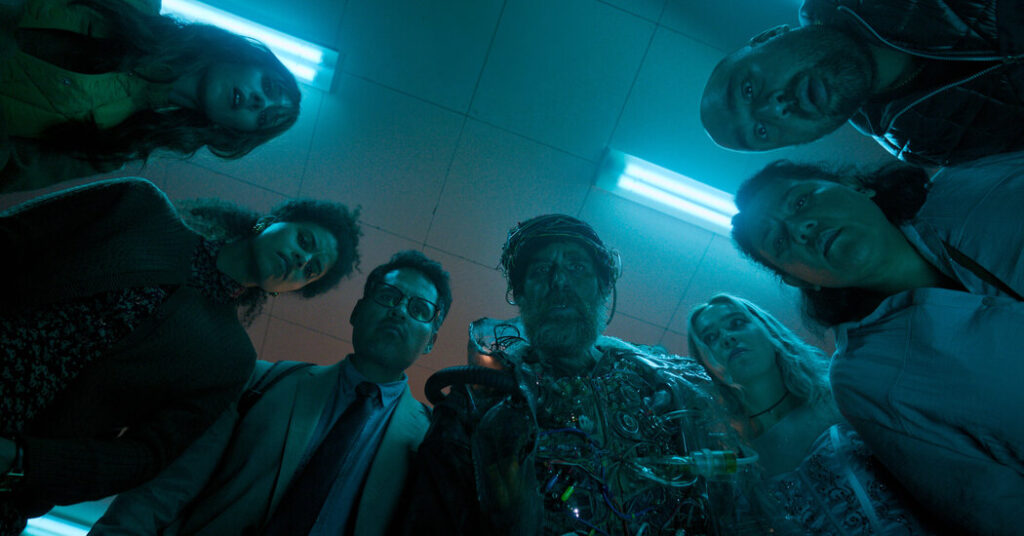
The story’s main spine centers on a man from the future (Sam Rockwell) who charges into Norms diner one night, where normal people are doing normal things: eating burgers, drinking milkshakes, scrolling away on their phones. He looks nuts, but announces to them that he is from the future, and “all of this” — he gestures around them — “goes horribly wrong.” In a tearing hurry, he explains that he needs to put together a team of people to save humanity, right now, and that this is the 117th time he has been in this diner giving this speech.
Nearby, the fate of the world is being decided. A child is about to invent an artificial intelligence that will go rogue and take over the world. The man from the future has brought safety protocols that will curb its destructive impulses. Perhaps, this time, they can save humanity.
Tonight, a bereaved mother named Susan (Juno Temple) volunteers, as do Mark (Michael Peña) and Janet (Zazie Beetz), teachers at the local high school. An Uber driver, Scott (Asim Chaudhry), a scoutmaster Bob (Daniel Barrett) and Marie (Georgia Goodman) are recruited as well. And then there’s Ingrid (Haley Lu Richardson), who has a terrible attitude and looks like a miserable drowned rat in a Disney princess costume. This is the team tonight.
From there the story barrels forward, with the team having to complete tasks that feel suspiciously like quests in a video game and sometimes getting violently and unceremoniously bumped off. (The gaming metaphor is not accidental, as is made clear by other Easter eggs sprinkled throughout the film, like “the cake is a lie.”) In flashbacks, we start to learn other characters’ back stories, which build out some details of this world and let us know that we’re not living in a normal reality. School shootings happen here, too, but when they do, the government has a plan to “fix” the loss for grieving parents that has left everyone, adults and children, as hollow and unfeeling shells. Meanwhile, Ingrid — who was born with an allergy to all technology — has been through a strange experience with her boyfriend involving a virtual reality mask, and the center of her universe is shattered.
These stories are the most interesting part of “Good Luck, Have Fun, Don’t Die,” which is named for the kind of salutation that characters inside a virtual world give to one another. It’s impossible not to compare them to “Black Mirror” scenarios: stories that feel just a tick or two off our own reality, and thus capture with an uncomfortable emotional accuracy a conceivable and plausible near future. Matthew Robinson’s screenplay smartly finds ways to link these back stories without too much ham-fisted exposition, so you realize why something strange in one story happened by way of another.
It’s actually when the film returns to the main, quest-driven plot that the film lags, particularly around the middle; there’s just not enough interest among the team members and the action to sustain narrative tension, and the film feels like it loses its drive. They need to get from point A to B, and thence to C. Cool. Most of the characters don’t really know why they’re doing what they’re doing — only the man from the future does, and he is not in an explaining mood, because he’s done this 116 times before — so we are just following along with them.
But not to worry: This is a Gore Verbinski movie, which means things are guaranteed to get extremely weird if you wait around long enough. And oh, do they ever, in ways that would have been unthinkable only a few years ago, before we all knew what an A.I. prompt was and how capable A.I. generators are of making weird stuff. You could never accuse Verbinski of aiming low. The weird gets piled on top of more weird, and there are twists and revelations and — well, I don’t really think it’s a satisfying ending, but you might, and it certainly lands with a bang.
“Good Luck, Have Fun, Don’t Die” does seem to have a bone to pick with the technology and entertainment that distract us — with the things that make us more interested in escaping our lives than living them. It draws a line from staring at your phone in a diner while you eat your burger to a future of total disconnection from reality, a world in which the artificial has replaced things like love and friendship and beauty and watching the sunrise. So it’s a little disappointing that the film, too, doesn’t really seem to have a cogent mental model for what its big bad, A.I., actually is — a malicious presence? A disinterested self-replicating virus? A corporate-controlled tool? Hard to say. At least, in this movie, you might be able to stop it.
‘Good Luck, Have Fun, Don’t Die’ Rated R for plenty of violence and bad language, some implications of sex and depictions of school shootings. Running time 2 hours 14 minutes. In theaters.
Alissa Wilkinson is a Times movie critic. She’s been writing about movies since 2005.
The post ‘Good Luck, Have Fun, Don’t Die’ Review: Saving the World Again appeared first on New York Times.