The British historian, art critic and TV presenter Simon Schama counts among his many fascinations the paintings of Rembrandt, the history of the Jews, and the human relationship with the natural world. During the Covid-19 pandemic, his thoughts turned frequently to the link between endangered animals and human illness, and how interspecies interactions can bring us perilously close to extinction.
He explored these connections in his 2023 book, “Foreign Bodies: Pandemics, Vaccines and the Health of Nations.” Martine Gosselink, the director of the Mauritshuis museum in The Hague, read an excerpt from the book, and it nearly brought her to tears. So she invited Schama to curate an exhibition at the Mauritshuis, exploring some of the book’s complexities.
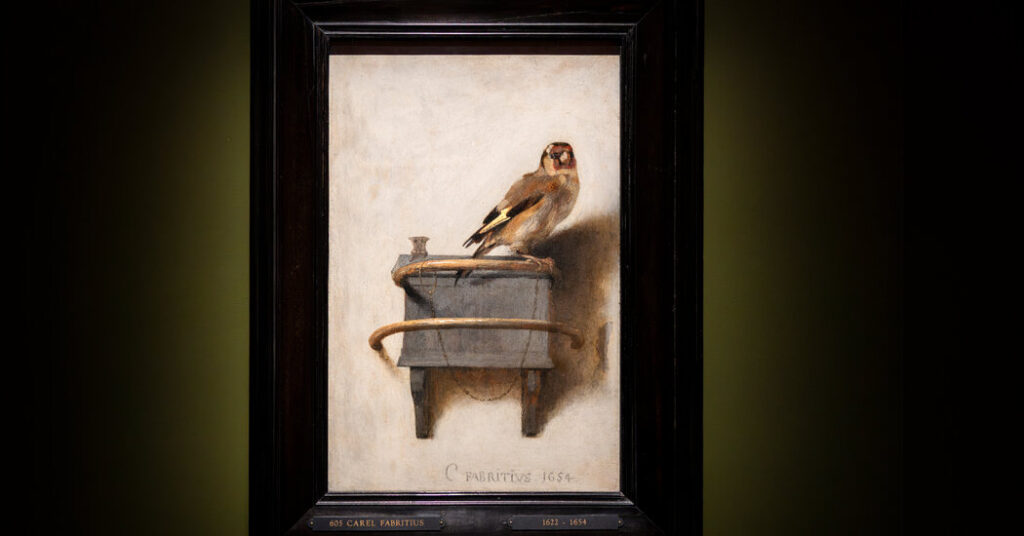
As a point of departure, they decided to take “The Goldfinch,” Carel Fabritius’s delicate 1654 painting of a songbird, which tricks the eye into thinking that the life-size bird is real. That depiction of a finch perched on a metal bar is one of the Mauritshuis’ highlights, and the subject of centuries of public fascination and creative inspiration: It was deeply admired by Johannes Vermeer, and is the titular subject of the Pulitzer-Prize winning novel by Donna Tartt.
Part of the painting’s appeal is its dramatic history. It was one of the few paintings found in the artist’s destroyed studio after Fabritius was killed, at age 32, in a large gunpowder explosion, known as the Delft Thunderclap, in the Dutch city of Delft in 1654.
He was one of dozens of people killed in the blast, yet the little finch emerged unscathed. We were left with only a small glimpse of Fabritius’s prodigious talent and promise.
Schama, an expert in Dutch old masters paintings, recognized in “The Goldfinch” not only elements of great painterly skill, but also resonant Christian iconography, suggesting both resurrection and immortality. Meditating further on the little finch brought him into new realms of Egyptology, ancient mythology and contemporary art.
Schama has been fascinated with birds since he was a boy, he said, and in recent years he and his wife have become avid bird watchers in the Hudson River Valley of New York, where they live.
In the exhibition, “Birds: Curated by ‘The Goldfinch’ and Simon Schama,” which opens Thursday and runs through June 7, Schama brings together many strands of his reflections on these feathered friends in his associative and philosophical way. He explained some of his thinking this week in an interview, which has been condensed and edited for clarity.
When the Mauritshuis director approached you about curating this exhibition, was the idea to specifically build a show around the “The Goldfinch?” Or was it something broader?
The starting point was birds, but the question was about “The Goldfinch”: What can we do around this powerful gem? Fabritius painted it the same year that he died, and there are small abrasions and scouring marks in the surface that suggest the painting was made not long before the city and the painter blew up.
I wanted to look at the relationship between humans and birds because, since deep antiquity and onwards, we’ve always imagined the afterlife to be up there rather than down there. Creatures that fly are, in some sense, the intermediaries — they take us airborne. Since I was a kid, I always wondered, “Why is the Holy Ghost a bird?” and not a lion, or a horse, or something else? It is because it occupies both spaces and therefore is a sign of the remade world.
So I started with this mad sprawl of instincts and intuitions and then pruned it all down.
Fabritius’s “Goldfinch” is tethered to its perch by a nearly invisible chain. It appears very still, although goldfinches are some of the most restive songbirds. Some scholars see the chained bird representing a tension between beauty and cruelty, and a metaphor for a captured soul. How do you see it?
He was a genius, Fabritius. He was the greatest of Rembrandt’s students. Everyone at the time would have known the biblical story of the splatter of blood when the bird alights on Jesus’ crown of thorns on the road to Calvary. They would have known that “The Goldfinch” directed them to the Bible and to Christ’s sacrifice.
At the same time, Fabritius would have seen goldfinches in cages, or on perches, as amusements. So he has a double amusement: The first is that you see it and you think it’s a live bird, because originally it was unframed. It’s a consolatory trip to the Bible plus a demonstration of the infinite, magical sorcery of illusionistic art. And the bird is looking at you.
There are some grim images in the show, like a Rembrandt painting of dead peacocks, or a dead swan by Jan Weenix. In your catalog essay, you write, “As far as art is concerned, birds keep close company with death.” Tell me about that connection.
If you think about Poe’s “The Raven” and Coleridge’s “The Rime of the Ancient Mariner,” it’s all about how the death of a bird triggers the death of everyone else. There’s this extraordinary sense that because birds belong in another realm, you damage them at your peril.
Billions of birds have been lost since 1970, and something like 90 percent of the bird loss has been in 12 species: sparrows, finches, woodpeckers, junkers, very common populations. The goldfinch is not extinct, but all finches are in very bad shape.
There’s such a wide variety of works in the show, including Leonardo da Vinci’s sketches of birds’ wings, a Picasso dove — but also sculpture, taxidermy and a video installation. It’s almost like a cabinet of curiosities.
Yes, well there’s death, death, death — but I wanted it to be fun as well: a kind of “Wunderkammer.”
The earliest instincts about the wonders of the natural world fall between Plato and Aristotle. For Aristotle, who was a zoologist, the infinite variety and diversity of nature was its own thing — it was a creative cornucopia. For Plato, if you gathered things from all over the world, there would be a mad “Eureka” moment when the secret of divine creation would magically illuminate itself.
I wanted the exhibition to be like that. But in the middle of it, people will have to stop and have a meditative moment, where they will think about what birds have meant to us since antiquity and the terrible collapse as a barometer of our whole relationship to life on the planet.
You had ideas about what you wanted to include from the beginning, but while you were putting the show together, did you have any “Eureka” moments of your own or discover anything you didn’t expect?
It’s a tiny thing at the beginning of the show, a Ba from Egypt, which is often translated as “soul bird.” I thought that was beautifully poetic.
The bigger “Eureka” moment was that almost all of art is a denial of mortality — an attempt to fix a face, or a landscape, or a story, a mythology. It’s an attempt to deny mortality. We want to be not just consoled, but resist our ephemerality in the world — and that’s so distinctly the case with these little creatures.
As part of your cornucopia, you display all kinds of plumage, including feathered headdresses from Brazil and Ecuador, a folding fan made of bright pink ostrich feathers and a gown with organza wings by the Dutch fashion designer Iris van Herpen. What is our attraction to wearing feathers?
The notion that we want to be birds, and that we can try to become birds by covering ourselves with feathers, is global; it’s universal. It goes from mad fashion capitalism — I really wanted to get Björk’s swan dress — through to the very fundamental sense that we just want to get as feathery as we possibly can. Iris van Herpen’s gown has a wonderful kinetic sense, giving our body motion, and the possibility of feeling a little bit airborne.
The two artworks that bracket the exhibition are “The Goldfinch” and Constantin Brancusi’s “Bird in Space,” which is a sculpture of a feather, made of polished brass, from the Peggy Guggenheim collection. Why did you want to end with that one?
The sculpture became the focus of the “Is it Art?” trial in 1927 and 1928, after U.S. customs charged an import tax on the sculpture because they did not recognize it as an artwork.
In 1927, Marcel Duchamp brought an identical version of this sculpture to the U.S. as a courier for Brancusi, and he had to pay an import tax, because they called it a “household utensil.” Brancusi was outraged, and he insisted on bringing the suit. It became a way to say that art can make an idea material and visible.
Apparently — and I don’t know if this is true — Peggy Guggenheim was desperate to get it. So they had a brief affair in Paris, and he finally sold it to her as the Germans were advancing.
It creates the sensation of a rushing flight. The limestone plinth is very important. He was very into the paradox of “How do you make a sense of movement from a solid base?” If you’ve ever been to his studio, you know that he was very self-conscious about being a peasant and having grown up in the world of stone and greenery.
So it’s something that comes out of his own history and something deeply universal. You lose the flight of the bird, and you lose the song of the bird, and you lose the world, really.
The post Looking at ‘The Goldfinch,’ and Thinking About Extinction appeared first on New York Times.