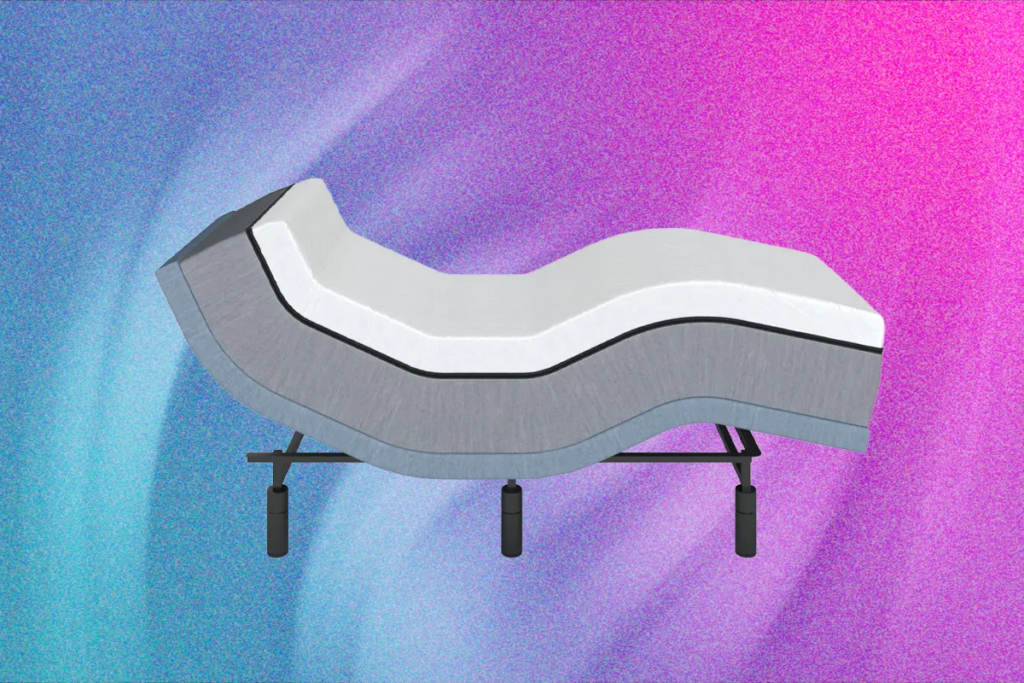
I didn’t come to zero-gravity sleeping out of need. It was more of a “why not?” My Bedgear adjustable bed frame, which I’ve owned for years, has a “zero gravity” preset. I’d used it occasionally to watch TV but had never actually slept in that position.
Today, sleep has become less about simply getting through the night and more about getting it right. We track it, score it, optimize it—increasingly, posture has come into the conversation. It fits in with alignment quietly becoming a wellness fixation, from ergonomic office chairs that promise to save our spines to Pilates and yoga classes built around neutral pelvis alignment and the much-discussed pelvic floor problem. The message is clear: How you hold your body matters, and that extends to how your bed holds it while you sleep.
One night, as I was researching sleep studies for work, I came across a NASA-published paper describing a “neutral body posture” that astronauts naturally assume in microgravity, which is often cited as an ideal position for rest. Upon further digging, “That’s what it’s for,” I thought, eyeing the ZG button on my bed’s remote.
So I decided to give it a real trial: One full week of sleeping in zero-gravity mode. On night one, I climbed into bed, pressed the button, and prepared for what I thought would be a life-changing night’s sleep. Well … it wasn’t. Here’s what went down.
What Is Zero-Gravity Sleeping?
Zero-gravity sleeping is a reclined position where your head and upper body are elevated at about a 40-degree angle, while your knees are bent and raised slightly above the heart. The goal is to distribute body weight more evenly and reduce pressure on the spine.
The term comes from aerospace research. In microgravity, astronauts naturally drift into what NASA calls a neutral body posture: a relaxed, slightly flexed position in which the spine maintains its natural curves and the limbs float up without any effort. It’s a posture that NASA researchers repeatedly observed during shuttle missions, and the one the body seems to choose when gravity isn’t forcing it to lie flat.
That research didn’t stay confined to spaceflight. Over time, the idea of neutral body posture bled into ergonomics and consumer products, mainly adjustable chairs, recliners, and eventually beds. Manufacturers began borrowing the term “zero gravity” to describe preset positions that elevate the head and legs in an attempt to mimic that stress-reducing alignment.
On earth, zero gravity mode isn’t about feeling weightless so much as feeling supported using gentle elevation to nudge your body and legs into a more relaxed alignment. This distinction matters. “Most claims about sleep benefits tend to be exaggerated in the marketing world,” says Erin Flynn-Evans, director of the Fatigue Countermeasures Laboratory at NASA Ames Research Center. “What really matters is whether such claims can stand up to scientific scrutiny.” NASA’s research simply documents posture in space—not how people should sleep on Earth.
Benefits of Zero-Gravity Sleeping
Semantics aside, the claims around zero-gravity sleeping are compelling. “Short-term, people notice less tossing and turning and deeper comfort. Long-term, it supports spinal alignment, reduces inflammation, and helps the nervous system shift into true rest and repair,” says Annie Schlecht, a sleep consultant and occupational therapist who also practices craniosacral therapy.
According to Schlecht, the gentle elevation can ease specific issues like lower back pain, sciatica, hip and joint discomfort, arthritis, and leg swelling. Keeping the upper body slightly raised can also benefit people with reflux, snoring, or mild breathing issues by keeping the airway more open.
How to Sleep in Zero Gravity
If you want to try zero-gravity sleeping, the most straightforward way is with an adjustable bed frame that is able to lift both the head and the legs. Press a button, and let the bed do the work. Of course, adjustable frames aren’t cheap or even standard. You can get pretty close by using pillows: Use a wedge pillow or stacked pillows to elevate your upper body and place another pillow underneath your knees to lift your legs.
“The biggest mistake is overdoing it,” Schlecht says. “Too much elevation, especially at the head, can strain the neck and disrupt breathing.” She also cautions that changing your sleep position won’t compensate for a bad sleep space. “Alignment helps, but it can’t override too much light exposure, heat, or noise pollution.”
She recommends starting with small adjustments. Give yourself enough knee elevation to relieve your lower back, then gradually lift your head while keeping your airway open. And make sure your neck is supported: “Your spine should feel long and neutral,” she says. “And give your body a few nights to adapt.”
How I Measured
Almost every night, I wear a Garmin Lily 2 smartwatch to bed. It generates a nightly sleep score, which I don’t usually obsess over. I tend to adjust my sleep habits based on how I feel, but for the sake of this experiment, I wanted some data to back up my findings.
The Garmin Lily 2 automatically tracks sleep as you’re wearing it, calculating a sleep score using data from your heart rate, heart rate variability, respiration rate, and body movement throughout the night. It estimates time spent in each sleep stage, how often I wake up, and how restless I am. All of this info gets condensed into the sleep score, a single number from 0 to 100 that appears in the Garmin Connect app each morning.
For seven consecutive nights, I slept in the zero-gravity position and recorded my sleep score. I didn’t change anything else about my routine: same bedtime, same wake-up times, same presleep habits. The only variable was the position of my bed, which I adjusted when I was ready to fall asleep.
This wasn’t a controlled study, and wearable sleep data has its limits, but I tend to be a good, consistent sleeper, so any noticeable changes in my sleep patterns stand out.
The Results
Before digging into the numbers, it’s worth discussing how the week actually felt. Sleep data can be telling, but when something isn’t working, your body usually figures it out first.
How I Felt
For me, sleeping in zero gravity was pretty uncomfortable from start to finish. The position felt unnatural, like my body was being held in place instead of allowed to melt into my mattress. I’m used to shifting positions throughout the night with no disruption, but in zero gravity mode, every small movement felt strenuous. Each time I needed to adjust my position or flip over, I fully woke up.
I also couldn’t quite figure out the pillow situation. Adding pillows under my head strained my neck, so I ditched them altogether. But this didn’t help, either; without the support, my neck felt tense each morning. And don’t get me started on my back, which crackled like bubble wrap each day I rolled out of bed.
The overall sensation was that I couldn’t fully let go. Instead of sinking into sleep, I felt locked into a posture that didn’t allow my body to naturally flow through its sleep stages throughout the night.
The Data
My sleep scores over the course of the week told a similar story: This position wasn’t working for me. I started strong with a score of 84 (good) on day 1, which gave me some hope. But things went downhill quickly: Day 2 dropped to 57 (poor), day 3 ticked up slightly to 61 (fair) and day 4 hit rock bottom at 43 (poor).
Days 5 and 6 gave me two rebounded scores of 80 (good), which was encouraging, and I thought my body might finally be adjusting to sleeping in zero gravity, despite feeling stiff in the mornings. But day 7 crashed back down to 58, ending the experiment on a disappointing note.
My average sleep score across the seven days was 66, below the 2024 average sleep score for Garmin users, which is 71. More telling than the average, though, was the volatility. The inconsistency suggested that while the position may have worked sometimes, it never settled into anything consistent.
Schlecht’s words echoed in my mind as I reviewed my results: “If your body doesn’t relax in the position, it’s not the right fit.” My body had made its verdict clear.
That inconsistency may not be surprising. “Movement during sleep is normal,” Flynn-Evans says. “By changing positions, we naturally reduce pressure on different parts of the body through the night.” Forcing the body into a single posture could actually create new discomfort rather than relieve it.
Despite the science behind the neutral body posture and the promised benefits, zero-gravity sleeping wasn’t for me. As Flynn-Evans put it: “When it comes to sleep, it’s usually the boring stuff that works.” This means a consistent bedtime, a dark and quiet room, and fewer distractions before bed.
If you need me, I’ll be in my preferred sleeping position, firmly planted face-down on a flat mattress.
The post Many Adjustable Bed Frames Have a “Zero Gravity” Feature. I Tried It for a Week appeared first on Wired.