Mayor Zohran Mamdani has spent much of his early weeks in office focused on New York City’s bad landlords, pledging to hold them accountable for dilapidated apartments. But he has said little about the largest landlord of all: the New York City Housing Authority, which runs the city’s vast public housing system and which he now oversees.
More than 300,000 New Yorkers live in public housing and regularly grapple with sudden leaks, broken elevators, frigid apartments and sprouting mold. The system has been in crisis for years, and the cost of backlogged repairs has soared to nearly $80 billion.
“I’m disappointed that he has not been talking about public housing,” said Kimberly Elliott, president of the Astoria Houses Resident Association in Queens, who lives in Mr. Mamdani’s former state assembly district.
Ms. Elliott was one of more than a dozen public housing leaders who wrote a letter to Mr. Mamdani’s team in December, expressing frustration that residents did not have a stronger voice in his transition and requesting a conversation. They have not heard back.
Mr. Mamdani understands the pressing challenges NYCHA is facing. As a state assemblyman, his district included Queensbridge Houses, the nation’s largest public housing complex, where he attended community events.
But as he ran for mayor and won with a message focused on the high cost of living, Mr. Mamdani did not outline a detailed vision for public housing, a lifeline for many of the city’s low-income residents.
Instead, he has focused on a proposal to freeze rents on the city’s nearly one million rent-stabilized apartments. And he has highlighted the misdeeds of private developers, criticizing a landlord in Brooklyn in his first day in office and announcing a series of “rental rip-off” hearings to be held during his first 100 days.
Mr. Mamdani is expected to release a comprehensive housing plan in the coming months. Jessica Katz, the city’s chief housing officer under former Mayor Eric Adams, said that she had a “high level of confidence” in Mr. Mamdani’s team and in NYCHA leaders.
“I’m very hopeful to see NYCHA front and center in a Mamdani housing plan,” she said. “As many have said, a budget is a moral document.”
The City’s Worst Landlord
When Jumaane Williams, the public advocate, released his annual list of the city’s worst landlords late last month, he saved his harshest criticism for NYCHA. He said the authority was the worst offender, with more than 600,000 open work orders for repairs.
“They’re in a category all by themselves,” said Mr. Williams, a progressive ally of Mr. Mamdani.
The mayor oversees NYCHA, which relies on a mix of federal, state and city funding. It has more than 170,000 apartments across 330 developments. Many were built in the 1950s and conditions inside them have become dire.
In 2019, the authority was placed under the oversight of a federal monitor to try to force improvements, and there has been some progress, including lower response times to complaints about pests and other issues. Its current chief executive, Lisa Bova-Hiatt, was appointed by Mr. Adams in 2023.
Mr. Mamdani appeared last week with Ms. Bova-Hiatt and Leila Bozorg, his deputy mayor for housing, at the Beach 41st Street Houses in Queens to announce funding for heat pumps for more reliable heating and cooling. The mayor said he was committed to addressing the persistent problems in NYCHA housing.
“New Yorkers, they hear a lot of talk; what they want to see is action,” Mr. Mamdani said.
He declined to say if he would stick to his campaign promise to double the city’s capital funding for NYCHA, which is about $1.2 billion annually.
A disused community room nearby was in shambles: Leaks had burst through the ceiling, leaving large pools of water on the floor and scraps of paint hanging from above.
Eugenia Gibson, president of the development’s tenant group, said she was “hopeful” about Mr. Mamdani’s plans, though she wished he had talked more about NYCHA during his campaign. With inconsistent heat and hot water, she said, residents have been boiling water for baths and using their stoves to keep warm.
“Nobody should have to come in the apartment and open your mouth and see the smoke coming out of your mouth,” she said.
Ms. Bozorg said in an interview that Mr. Mamdani’s administration viewed improving NYCHA as part its broader efforts to ensure that “people have safe, affordable, healthy homes to live in.” NYCHA has made some upgrades in recent years, she said, but “we hear from residents still every day that it’s not enough.”
She added, “We want to be making significant investments in NYCHA and in NYCHA’s residents, given the scale of challenges that they face.”
Bridget Marachlian, president of the Bland Houses Tenant Association in Queens, also signed the December letter from tenant leaders and said she wanted to talk to the mayor about safety concerns.
“In many buildings, doors don’t work and locks are broken,” she said. “When that happens, people who don’t live in the building are able to come in and hang out.”
She moved to the complex more than a decade ago when she lost everything in a fire. Now she is on edge after a homeless man was charged with starting a fatal fire at a NYCHA development in the Bronx last month. In 2022, her development went more than six months without gas.
Still, she has not considered moving.
“Where am I going to?” she said. “All the rents are $3,000 or $4,000 for a shoe box. We have no choice.”
‘He hasn’t forgotten us’
In June, during the mayor’s race, Mr. Mamdani visited a NYCHA building in the Soundview neighborhood of the Bronx to hear from residents.
Their most pressing concern was a sputtering boiler in the basement of the building, at 1471 Watson Avenue, that failed to keep their apartments warm. There were many other problems, too: widespread leaks, broken kitchen tiles that had not been fixed and warped windows lined with mold.
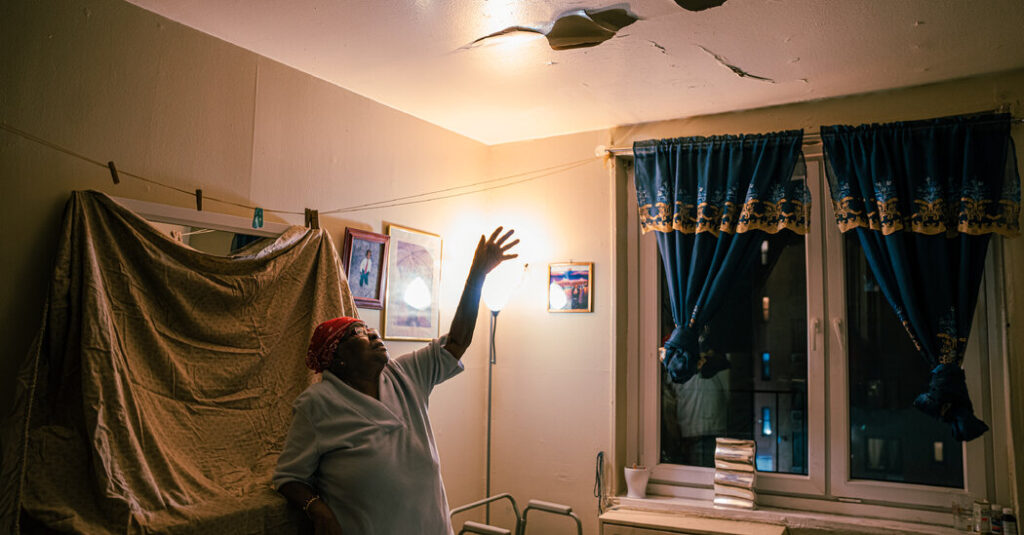
On a recent night when the temperature outside dropped to 15 degrees, Gladis Fanfan, 86, and her husband, Rafael, 92, shivered in their apartment, stuffing sheets into the edges of the window to keep the wind out. In another apartment, a leak had caused a large funnel to form on the ceiling, dripping into three buckets below.
Their neighbor Angela Norales, 88, winced as she looked up at a new leak above her bed. The ceiling was filed with cracks from past patch-ups. She covered her furniture and waited for repairs.
“They were supposed to be here this morning, but nobody showed up,” she said.
The Rev. Carmen Hernandez, the president of the resident council, has been pushing for repairs for years and signed the letter to Mr. Mamdani’s team. NYCHA was setting up a mobile boiler outside as a temporary solution.
She had endorsed Mr. Mamdani for mayor and posted a photo with him on social media, urging her neighbors to support him. And she took note when he mentioned public housing in his victory speech in November, pledging to “work tirelessly to make lights shine again in the hallways of NYCHA developments where they have long flickered.”
“That really touched me,” she said. “He hasn’t forgotten us. We have to give him time.”
The Future of Public Housing
New York City’s public housing system is at a major crossroads. State and city officials have sought to bring in private companies to make improvements, stirring both relief and anger among residents.
In the Chelsea neighborhood of Manhattan, the city is moving to demolish NYCHA buildings in a partnership with the private developer Related Companies. The people who live in the roughly 2,000 apartments there would be moved into new buildings on the same land, while nearly 1,000 subsidized units and 2,400 market-rate apartments would be added.
But some residents have fiercely opposed the plan, expressing concerns about relocating and changes to the area’s character.
The Chelsea project has advanced under a program called Permanent Affordability Commitment Together, or PACT. Mr. Adams had championed another option, called the Public Housing Preservation Trust, which involves leasing NYCHA buildings to a newly created public benefit corporation.
Residents must vote to join either program. When Mr. Mamdani was asked about programs like PACT during the campaign, he said he wanted a “more democratic process,” and noted that “views on these programs have differed greatly development to development.”
Mr. Mamdani has not weighed in on the Chelsea redevelopment, which has been moving through the courts. Ms. Bozorg said in the interview that his administration supported the plan and called it “innovative.”
“We would like to see the project move forward so that residents can actually receive brand-new apartments,” she said. “But we want to reset and make sure that residents are feeling heard, that their issues and questions are actually being addressed.”
NYCHA could also be vulnerable to federal funding cuts under President Trump, who has sought to slash funding for housing programs that help poor people. About two-thirds of NYCHA’s revenue comes from the federal government.
At his recent event at the Beach 41st Street Houses, Mr. Mamdani said that the city could not expect significant federal funding to pay for major renovations at NYCHA.
“What that requires us to do is look at every avenue we have as a city and as a state to start to confront this ourselves,” he said, noting that the new heat pumps were part of a promising public-private partnership.
When asked about tools like PACT and the trust, Ms. Bozorg said in the interview that the city must take an “all-hands approach” while “ensuring that the public interest and NYCHA’s interests are really protected when we enter into these public-private partnerships.”
Corinne Haynes, president of the tenants’ group at Queensbridge Houses, said residents of her development wanted major investments in new plumbing and gas lines — without using PACT or the trust, which she worries could lead to excessive rent increases. She said the mayor’s plan to double the NYCHA capital budget was not enough.
“That’s a drop in the bucket,” she said.
Jeffery C. Mays contributed reporting.
Emma G. Fitzsimmons is a public policy correspondent for The Times, covering New York City.
The post Mamdani Is Targeting Bad Landlords. What About Public Housing? appeared first on New York Times.