If you were standing on the surface of Comet 41P/Tuttle-Giacobini-Kresák nine years ago as it was getting closer to the sun, you might have been in for a shock. First, each day on the comet would have gotten drastically shorter over a period of weeks, until the object’s rotation stopped dead — and then started going backward.
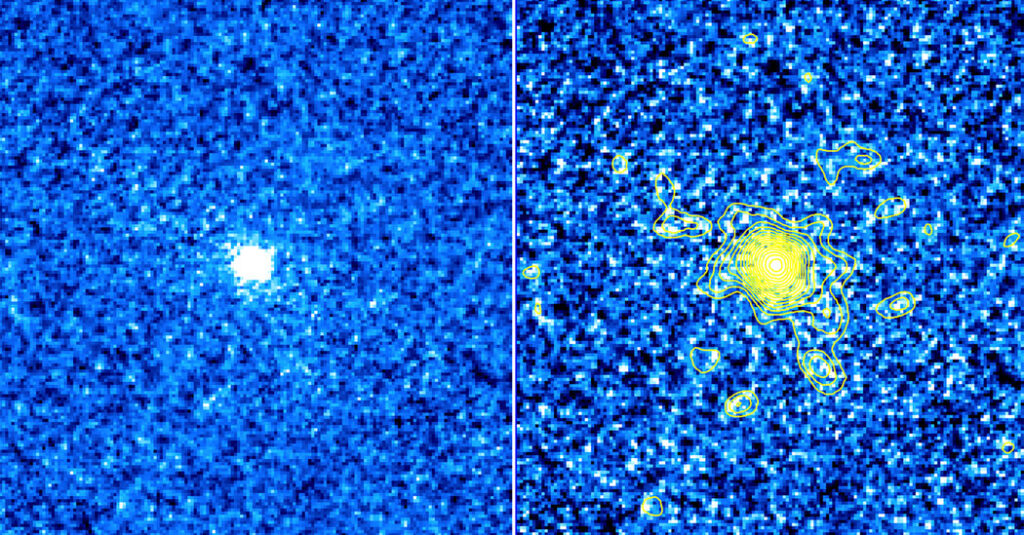
David Jewitt, an astronomer at the University of California, Los Angeles, used images taken by the Hubble Space Telescope in 2017 to study this unusual comet. Like planets, moons and asteroids, comets spin naturally, and astronomers had already seen that 41P’s spin was slowing substantially, before Hubble’s observations revealed it was spinning in the opposite direction.
“We’ve seen changes in spin” on a comet before, said Dr. Jewitt, who published his findings last week on the website arXiv ahead of publication in The Astronomical Journal. “But not this big and so quick.”
Comets are chunks of rock and ice that originate in the outer solar system, left over from the birth of the planets. Occasionally they are gravitationally nudged into the inner solar system and swing past the sun.
Their surfaces then heat up and their ice turns from solid to gas, sometimes producing magnificent tails that we can see on Earth. Often the comets are shrouded in a dense cloud of dust and gas too, a coma around the solid central nucleus, as material rises from the surface.
But some comets experience more significant events where material fires out from the surface in a rocket-like jet akin to a garden hose, said Dennis Bodewits, an astronomer at Auburn University. Exactly how the process takes place is a little murky. “We don’t really understand that,” Dr. Bodewits said, but the force of the jet can be enough to change the comet’s spin.
This process is taking place on Comet 41P, but in an extreme form.
As it approached the sun in 2017, Dr. Bodewits and his colleagues used NASA’s orbiting Swift telescope to watch the comet, estimated at about 0.6 of a mile across.
While they couldn’t see its surface, they could monitor the change in brightness as it spun, and the astronomers witnessed the comet’s precipitous change.
First its rotation slowed between March and May 2017, taking 46 hours to complete a spin where it had once taken only 20 hours. This occurred as the comet neared its closest point to the sun, roughly the same distance as Earth’s orbit.
Rotation periods of comets are known to change, but normally only by minutes. “By so many hours and so drastically, that we’ve never seen,” Dr. Bodewits said.
No observations of the comet were taken after May 2017 because it was too close to the sun from our point of view to be visible. But when it emerged into view again in December 2017, Hubble was able to spy the comet.
When Dr. Jewitt examined the images recently, they showed the comet’s spin had quickened again to once every 14 hours or so. The only way this made sense is if, at some point between May and December, it had “slowed down to zero, and then kept going in the opposite direction,” Dr. Jewitt said.
“People have thought this should happen, but as far as I know this is the first observation to catch a comet doing that in the act,” said Jane Luu, an astronomer with the University of Oslo who was not involved in the study.
The finding is important because comets, particularly smaller ones, are less common in the solar system than astronomers would expect. One explanation might be that some like Comet 41P have jets that make them spin faster and faster until they are “blown to bits by their own spin,” Dr. Jewitt said.
“The evidence is that comets just don’t live that long,” he added. “There’s some other process that destroys the comets, and I think it’s rotation.”
Comet 41P will swing past the sun again in early 2028. There are likely to be more comets undergoing chaotic changes awaiting discovery, particularly as telescopes such as the Vera C. Rubin Observatory in Chile begin new surveys of the sky.
“We’ll get a big flood of data on a whole bunch of comets,” Dr. Jewitt said.
The post This Comet Stopped Spinning. Then It Started Rotating Backward. appeared first on New York Times.