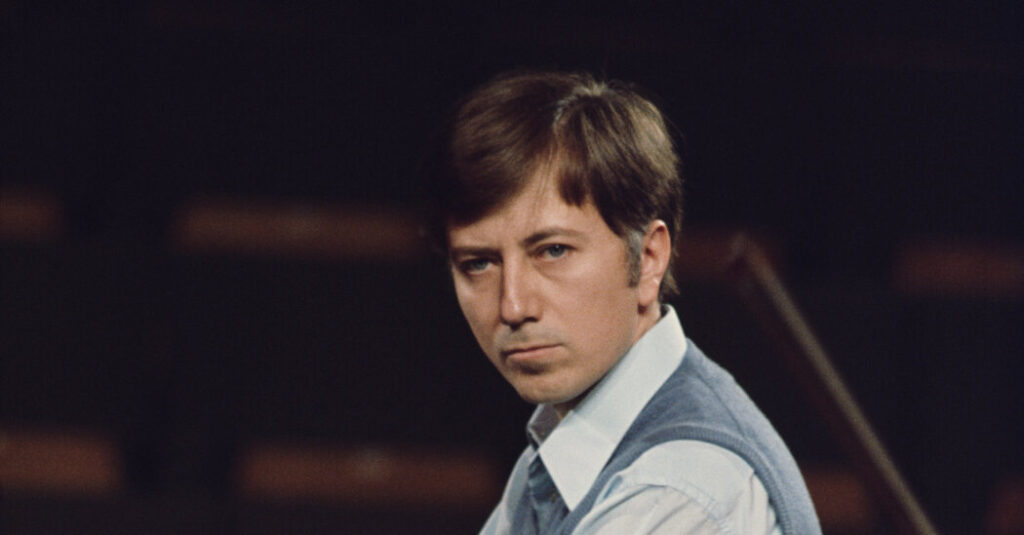
Tamas Vasary, a Hungarian pianist who brought technical brilliance, stylistic authority and bejeweled lyricism to performances of Romantic-era music, particularly the works of Frédéric Chopin and Franz Liszt, died on Feb. 5 in Budapest. He was 92.
His death, in a hospital, was announced by the Hungarian Academy of Arts, of which he was a member.
Mr. Vasary (his full name was pronounced TAW-mahsh VAH-shah-ree) fled his homeland in 1956, when the Hungarian Revolution was crushed by the Soviet Union. He spent much of his subsequent career living in Switzerland, then England, before returning to Hungary not long after the Communist regime collapsed in 1989.
Among classical music aficionados, he was best known for his many recordings, most of them on the Deutsche Grammophon label. He was a Chopin specialist, producing an admired set of the nocturnes and rendering the composer’s dance rhythms with unusual assertiveness while never failing to give full attention to their inner poetry.
Mr. Vasary also recorded many of the most celebrated works by Schumann (a marvelously variegated “Scenes From Childhood,” for example) and Liszt, and the complete concertos of Rachmaninoff. Although he was a fine Brahms player, sensitive and powerful, he mostly ignored the solo piano music when he was in the studio and kept to the chamber repertoire.
Tamas Vasary was born on Aug. 11, 1933, in Debrecen, Hungary’s second-largest city. His father, Jozsef Vasary, was a politician and member of the Hungarian parliament; his mother, Erzsebet (Baltazar) Vasary, was the daughter of a bishop.
Tamas was musically precocious, conducting along with knitting needles to symphonic recordings by the age of 5. He was accepted into the Debrecen Conservatory several years later, after playing Liszt’s ferociously challenging Hungarian Rhapsody No. 2 on the piano.
At 10, he began studying with Ernst von Dohnanyi, one of Hungary’s leading composers and pianists. In an interview with the pianist and broadcaster David Dubal, Mr. Vasary remembered Dohnanyi as a kindly man who wanted his young pupil to have a well-rounded childhood.
“He would say, ‘How many hours do you practice a day?’,” Mr. Vasary recalled, “and I would reply, ‘I practice four hours.’ ‘That’s too much,’ he would say. ‘Go out and play games.’”
The renowned composer Zoltan Kodaly also played a crucial role in guiding Mr. Vasary’s career, particularly after Jozsef and Erzsebet Vasary were placed under house arrest in 1951.
Under Kodaly’s auspices, Mr. Vasary was able to continue his musical career, and in the spring of 1956 he entered the Queen Elisabeth Competition in Brussels, named for the Belgian queen dowager; he placed sixth.
Mr. Vasary later said that Elisabeth herself intervened to get his father released as a political prisoner. When the Hungarian Revolution broke out that fall, the family escaped to Switzerland.
After that, Mr. Vasary played steadily and to strong notices throughout Western Europe. He made his American debut playing Liszt’s First Piano Concerto with the Cleveland Orchestra and George Szell in January 1962, and came to Carnegie Hall with the orchestra the following month.
“The pleasing thing about his performance, aside from his well-groomed pianism — we all expect complete technicians these days, and generally get them — was its sensitivity,” Harold C. Schonberg wrote in a review of the Carnegie concert in The New York Times. “Mr. Vasary gave a big performance without banging or indulging in empty rhetoric.”
He made his Carnegie recital debut later that year, with what was then an unusual program of Bach’s “Goldberg” Variations and Beethoven’s longest and most abstract piano sonata, the “Hammerklavier.”
Mr. Vasary’s conducting career began in 1970, when he directed the Franz Liszt Chamber Orchestra at the Montreux Festival in Switzerland. He soon was leading his own orchestras, serving as head of the Northern Sinfonia and later the Bournemouth Sinfonietta, both in England. He also conducted major ensembles including the New York and Berlin philharmonics.
After the Cold War, Mr. Vasary returned to Budapest and was chief conductor of the Hungarian Radio Symphony Orchestra from 1993 to 2004. He continued playing until his late 80s.
He was married to Ildiko Kutasi-Kovacs, a cultural anthropologist, from 1967 until her death in 1994. His second marriage, to Henriett Tunyogi, a ballerina, actress and director more than 40 years his junior, ended in divorce in 2019. He leaves no immediate survivors.
Mr. Vasary tended toward mysticism and liked to analyze his dreams, which often involved horses. He said that music was an opportunity to create emotional and spiritual bonds with an audience often distracted by superficial concerns.
“Everyone is a creator and has wonderful dreams and fantasies,” he told The Baltimore Sun in 1995. “If you can resonate to any great work of art, then you have it in you. But we strive too much for material goods, and we are atrophying our imaginations. I see children who are like dry, old people. If you cannot have emotions, then everything is useless.”
The post Tamas Vasary, Pianist of Power and Sensitivity, Dies at 92 appeared first on New York Times.