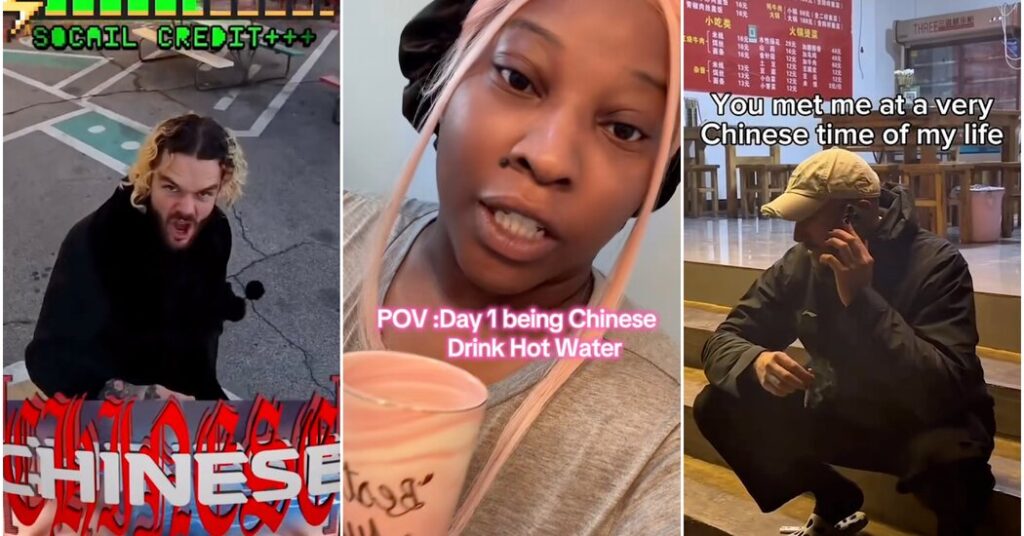
If you drink hot water, wear slippers indoors or shop at Asian supermarkets, you may be Chinese, according to the internet.
You might be thinking, “I’m not Chinese,” but your race is beside the point. Think of “being Chinese” as more of an absurdist joke, a wellness goal or a subtle, ironic expression of protest. Or all of the above.
On TikTok and Instagram, some users boast that their minds are so Chinese that they see Chinatowns as just “towns” and Chinese food as just “food.” Others say, “You met me at a very Chinese time in my life,” a parody of the line “You met me at a very strange time in my life” from the 1999 movie “Fight Club.”
Some have declared themselves Chinese “baddies” — confident, attractive women — while adopting mundane East Asian lifestyle habits, having been invited into the trend by Chinese American influencers.
The meme is not bound by nationality or ethnicity; anyone can be Chinese if they wish. And right now, many do.
As Labubus and other Chinese cultural exports win over global audiences, experts say that “being Chinese” memes may signal China’s growing soft power abroad. For some American creators, they are also a wry expression of disillusionment with politics at home.
“It’s partly meme logic, but it’s also a sign of growing cultural cachet,” said Shaoyu Yuan, a professor at New York University’s Center for Global Affairs who studies China’s soft power.
The memes, he said, reflect a broader shift in which online audiences are developing a new level of familiarity with China as they engage with it through lifestyle trends and aesthetics — not as the geopolitical rival and security threat it is often portrayed as in the United States.
“The underlying familiarity is now widespread enough to become widely ‘meme-able’,” he added.
“Becoming Chinese,” according to Chinese American influencers, involves adopting habits like boiling apples and drinking hot water in the mornings. One popular TikTok personality, Sherry Zhu, 23, has amassed millions of views by explaining the appeal of these everyday practices.
“Now that you’re Chinese, you need to stop walking around your house barefoot,” she says in one video, adding that many Chinese families wear slippers indoors.
The trend has taken off partly because health and wellness is a popular topic at the start of a new year, said Crystal Abidin, the author of “TikTok and Youth Cultures” and a professor of internet cultures at Curtin University in Australia.
The simplified version of Chinese culture appeals to a non-Chinese audience, she added. “It’s easy to digest. It’s palatable. It’s accessible.”
For some social media users, the meme feels implicitly political at a time of polarization and uncertainty in the United States.
Renn Lazzerin, 33, who lives in Los Angeles, said there was a political undertone in her effort to incorporate daily habits like drinking hot water and eating rice porridge.
“For me it feels like a way to resist — in a subtle way, it’s more of an undercurrent — and to protest a government that doesn’t care about keeping people healthy,” she said in an interview.
China has long sought to build soft power alongside its economic and military might, but it has struggled to cultivate cultural cachet overseas through state-driven propaganda, partly because of concerns about its authoritarian politics.
That has begun to change as Chinese products shaped more by market forces than by the state — including Labubus, the grinning fuzzy toys, and the video game “Black Myth: Wukong” — attract global followings. And as China has expanded visa-free travel programs, its image has been softened by foreign travel bloggers posting videos that gush over Shanghai’s skyline or the futuristic aesthetics of Chongqing, a megacity in the country’s west.
Chinese officials have incorporated the trend into their efforts to attract visitors. On Friday, China’s Foreign Ministry spokesman, Lin Jian, said he was “very glad to see that more and more foreign friends show interest in experiencing today’s China.” And the Chinese ambassador to the United States, Xie Feng, referenced the meme last month when he encouraged Americans to discover for themselves a country that is both “cool and welcoming.”
In some ways, social media users, particularly on TikTok, were primed for the trend, said Qian Huang, an expert on digital youth cultures at the University of Groningen in the Netherlands. Last year, when the Trump administration briefly banned TikTok in the United States over concerns about interference by the Chinese government, some users pushed back by migrating their accounts to Rednote, a popular Chinese app.
TikTok was owned by a Chinese company until last month, when the owner agreed to spin out a U.S. entity. A study last year found that its algorithm often seemed favorable to positive content related to China.
That could contribute in part to the trend’s popularity, Professor Yuan said.
“Even if the trend is not coming from official Chinese channels, the distribution environment can still tilt what gets amplified,” he said.
Some Americans have their own reasons for wanting to be Chinese.
Take Daniel Kairoff, a singer from California who created a parody song in which he headbangs while screaming, “I’m tired of not being Chinese.” The video has more than 700,000 views on Instagram.
Mr. Kairoff, who is in his 30s, said in an interview that he saw the trend partly as a “yearning for some kind of alternative” among young Americans encountering idealized portrayals of China as they witness social upheaval in the United States, including the killing of two American citizens by federal agents in Minneapolis.
“It kind of naturally begets the question of ‘Dang, what else is out there?’” he said.
Yan Zhuang is a Times reporter in Seoul who covers breaking news.
The post Why Are People ‘Becoming Chinese’ on Social Media? appeared first on New York Times.