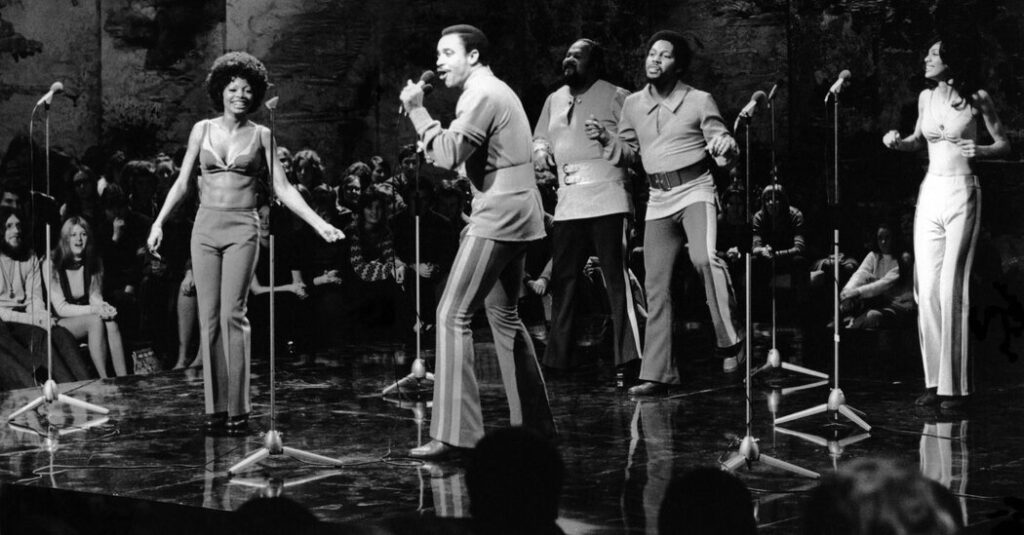
LaMonte McLemore, a founding member of the 5th Dimension, the sleek, genre-blurring vocal quintet whose soaring Top 10 hits “Up, Up and Away” and “Aquarius/Let the Sunshine In” became carefree anthems of hippie-era idealism, died on Feb. 3 at his home in Las Vegas. He was 90.
His death was announced in a statement by Robert-Allan Arno, who co-wrote Mr. McLemore’s 2014 memoir, “From Hobo Flats to the 5th Dimension.” He did not cite a specific cause but noted that Mr. McLemore’s health had deteriorated after a stroke in 2019.
The 5th Dimension — which also featured Ron Townson, Billy Davis Jr., Florence LaRue and the future solo star Marilyn McCoo — was a commercial force. From 1969 to 1972, the group notched 20 Top 40 singles on the Billboard Hot 100 chart, including seven in the Top 10s and two chart toppers: “Aquarius” and “Wedding Bell Blues” (1969).
“Up, Up and Away,” which hit No. 7 in 1967, was a helium-light ode to hot air balloon travel by the hit-making songwriter Jimmy Webb, recorded in a shimmering production with vocals as soothing as a deep-tissue massage.
“Aquarius” (known by various titles, including “The Age of Aquarius”) was an astrologically-themed paean to a radiant new era and a signature of the late-1960s hit musical “Hair,” which took the spirit of the turned-on, tuned-in generation — along with a famous dash of nudity — to Broadway.
The 5th Dimension’s version, adapted from “Hair” and backed by the heralded Los Angeles session musicians known as the Wrecking Crew, rode the top spot on the Billboard Hot 100 for six weeks in 1969.
Both songs earned multiple Grammy Awards, and the group’s appearances on “The Ed Sullivan Show” and other variety programs were only further indications that the sunny spirit of flower power had spread well beyond the beaded-curtain dens of Haight-Ashbury and dusty commune yurts to become a mainstream phenomenon.
Even the group’s name had a feel of astral projection. “There are other dimensions — height, weight and depth — so we took the fifth and made it a sound,” Mr. McLemore told The Journal Times of Racine, Wis., in 1970.
The group’s sound at times echoed the lush, intricate pop harmonies of the Mamas & the Papas, but it also incorporated elements of R&B, jazz, easy listening and even light opera, creating a blend that its members, all of whom were Black, called “champagne soul.”
That slick sound led to critical barbs.
“We were constantly being attacked because we weren’t ‘Black enough,’” Ms. McCoo once said. “Sometimes we were called the Black group with the white sound, and we didn’t like that. Our voices sound the way they sound. How do you color a sound?”
Mr. McLemore maintained that widespread appeal was the point. “We wanted to do something fresh, and bring all people together — the kids, the parents, the grandparents — with unique harmonies and positive messages,” he told Mr. Arno.
Herman LaMonte McLemore was born on Sept. 17, 1935, in St. Louis, the first of four children of Herman and June (Shaver) McLemore. (He always went by LaMonte). He was 5 when his father, a janitor, left the family. With his mother straining to raise the family, LaMonte was also raised by his maternal grandmother.
Baseball was his first love as a youth, although he began singing doo-wop as a teenager to attract girls, Mr. Arno said in an interview. After graduating from Charles H. Sumner High School in St. Louis, LaMonte joined the Navy and trained as a medical photographer.
Following his discharge, he pursued a professional baseball career as a fireballing pitcher, eventually landing in the Los Angeles Dodgers farm system, but a broken arm soon derailed his prospects, he said.
Mr. McLemore did portrait photography as a parallel career through his decades as a recording artist. Over the years, he shot for Harper’s Bazaar, Jet and Ebony magazines, capturing music stars like Marvin Gaye, the Supremes and Stevie Wonder as well as screen celebrities, including Jayne Kennedy, the actress, model and television host.
His music career began flowering in 1965, when he formed a Los Angeles vocal group called the Versatiles with Mr. Townson and Mr. Davis, friends of his from St. Louis. He brought in Ms. McCoo and Ms. LaRue, already accomplished singers, after photographing them for the Miss Bronze California beauty pageant.
The group’s record label, Soul City Records, pressured the Versatiles to find a hipper name, and they chose the 5th Dimension. Other major hits included “Stoned Soul Picnic” (No. 3, in 1968); “One Less Bell to Answer” (No. 2, in 1970); and “(Last Night) I Didn’t Get to Sleep at All” (No. 8, in 1972).
Ms. McCoo and Mr. Davis, a married couple, left the group in 1975 to pursue a career as a duo and eventually solo careers. The 5th Dimension continued on for decades, with Mr. McLemore and Ms. LaRue joined by varying lineups. Among Mr. McLemore’s other ventures, he was a co-owner of a soul food restaurant, Catfish Alley, in Las Vegas.
He married Mieko Tone in 1995. She survives him, along with two children, Ciara and Darin; a sister, Joan; and three grandchildren.
“With the 5th Dimension,” Mr. McLemore told Mr. Arno, “every type of listener came to us; we crossed racial, generational and record-chart boundaries. I may have been the least religious of all the group’s members, but I was truly grateful, never took a thing for granted, as we appeared on world stages.”
Alex Williams is a Times reporter on the Obituaries desk.
The post LaMonte McLemore, Founding Singer With the 5th Dimension, Dies at 90 appeared first on New York Times.