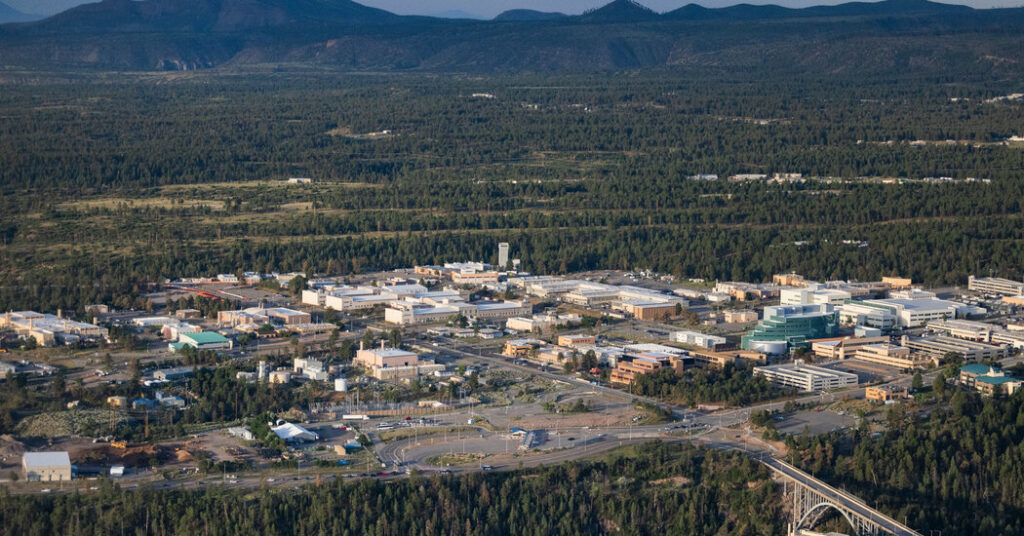
After years of missed deadlines, New Mexico is demanding that the Energy Department expedite the cleanup of so-called legacy nuclear and hazardous waste at the Los Alamos National Laboratory, the birthplace of the atomic bomb, state environmental regulators announced on Wednesday.
The state will also fine the agency up to $16 million for violating groundwater safety standards near the lab, civil penalties outlined by the New Mexico Environment Department in a series of regulatory enforcement actions.
“The continued presence of a large volume of unremedied hazardous and radioactive waste demonstrates a longstanding lack of urgency by the U.S. Department of Energy,” regulators wrote in a statement, “and elevates the risk of waste storage failures” at the lab, in northern New Mexico.
The regulators’ action comes amid rising fears of a new global arms race. Just days ago, the only remaining nuclear arms control treaty between the United States and Russia expired, lifting limits on their arsenals. Today, Los Alamos is producing plutonium bomb cores, making the lab the linchpin of a $1.7 trillion federal effort to modernize the nation’s nuclear weapons.
But in doing so, the lab is creating new waste before dangerous legacy byproducts, from the Cold War era, have been properly mitigated. That waste often contains plutonium, uranium or other radioactive and chemical contaminants that pose environmental and human safety risks.
“It’s a legacy of failed legacy waste cleanups,” said James Kenney, who leads the New Mexico Environment Department.
In a statement, a representative for the Energy Department said the agency was “committed to public safety, efficiency, and transparency,” and was reviewing the actions by the state regulators.
The concerns cited by the New Mexico regulators date back decades, when Los Alamos buried nuclear and hazardous waste in unlined landfills, septic tanks and firing sites. The Energy Department estimates that roughly 500,000 cubic meters of legacy waste — the equivalent of about 200 Olympic swimming pools — remains on the campus.
Between 1956 and 1972, workers also released water contaminated with hexavalent chromium from the lab’s cooling towers into a nearby canyon. The highly toxic chemical, a heavy metal and known carcinogen, drained into the ground and was discovered in the regional aquifer in 2005.
In November 2025, the chemical was detected outside the lab’s eastern border, in the groundwater of the San Ildefonso Pueblo, home to a Native American tribe. Levels were found up to 140 percent higher than the state’s groundwater standard. Both the state and federal government said that drinking water drawn from the aquifer was safe.
The Energy Department and New Mexico have long been embroiled in disputes over waste cleanup and disposal.
New Mexico is the nation’s only “cradle-to-grave” state for nuclear production: It has mined uranium, produces weapon components and stores waste near Carlsbad at the Waste Isolation Pilot Plant, a salt mine 2,000 feet underground. For over 25 years, federal weapons production and research sites across the United States have sent Cold War-era nuclear waste to the facility, the country’s sole repository for long-term storage.
While the facility is run by a contractor and overseen by the federal government, New Mexico holds a permit for some of its waste disposal.
Over the years, the Energy Department has reached agreements with a number of states to ship their waste to the facility. Idaho, for example, negotiated with the department to prioritize the removal of its waste, much of which the state had inherited from the Rocky Flats Plant, near Denver, where bomb cores were produced during the Cold War.
But New Mexico regulators say that the federal government made those deals without their input — and without making enough progress on legacy cleanup in Los Alamos, the only place in the nation that currently produces bomb cores. The Energy Department may not be able to meet its commitments to individual states while taking in new waste, according to the Government Accountability Office, a federal watchdog that provides reports to Congress.
The repository’s top shippers are the Idaho National Laboratory; Los Alamos; and the Savannah River Site, in Aiken, S.C. In recent years, shipments from Idaho have made up more than 70 percent of the annual total waste shipped to the facility, records show. In 2023, the amount from Los Alamos was 30 percent; last year, it was just 14 percent, less than half of which was legacy waste.
New Mexico is pushing for priority disposal of the lab’s legacy waste over new waste.
This year, over 500 containers filled with the remnants of 34 glove boxes — protective work stations where radioactive materials are handled — were removed from the plutonium facility at Los Alamos to make room for new ones. That waste will go to the repository in the spring, regulators say, after it is compacted at a facility in Idaho. But as of January, only one glove box had arrived in Idaho, according to Idaho’s Department of Environmental Quality.
At recent public forums, Jessica Kunkle, the head of environmental management at Los Alamos, said that legacy waste was being prioritized for shipment, citing efforts to dig up and remove 158 corrugated metal pipes containing radioactive waste from an unlined landfill in 1986.
But federal funding for legacy cleanup has been reduced, and progress is slow-moving. More than 2,000 drums of waste are stored in tents in a 63-acre section of the lab’s campus. Citizen groups fear the area is fodder for wildfire. On its website, the lab said it had established a “defensible perimeter.”
Then there’s Material Disposal Area C, an unlined landfill filled with chemicals, sludge from waste treatment plants and objects contaminated with plutonium and uranium. Area C closed in 1974 and has yet to be cleaned up.
New Mexico pushed for Area C to be fully cleaned up, as opposed to cheaper options that would cap and cover the waste in the ground, as part of a consent order with the Energy Department. But in July, the department said it would defer the cleanup indefinitely because Area C was near the lab’s plutonium handling facility and was congested with car and foot traffic.
The site is in a “safe and stable configuration,” Ms. Kunkle said in December.
The state’s Environment Department says such deferral is a violation of the consent order and is now requiring the federal government to submit supporting documentation for the deferral, according to one of the enforcement actions listed in Wednesday’s announcement.
According to 2023 regulatory documents, contaminants from the landfill “have been detected at concentrations that pose a risk to groundwater,” which local communities use for drinking water.
Alicia Inez Guzmán is a reporter covering nuclear weapons production in New Mexico as part of The Times’s Local Investigations Fellowship.
The post New Mexico Rebukes Federal Agency Over Nuclear Waste at Los Alamos appeared first on New York Times.