Harvard, where I teach computer science, used to consistently lead the Leiden Ranking, which rates the research output of universities around the world. Recently, though, Harvard fell to a dismal third, while eight of the top 10 universities came from China. Harvard remains at the top of two other rankings, the Nature Index and the University Ranking by Academic Performance, but the upper tiers of those rankings are also increasingly crowded with Chinese universities. (Notably, one ranking that still looks favorably on American universities is Chinese.)
It’s tempting to conclude, as one observer recently told The Times, that there’s “a big shift coming, a bit of a new world order in global dominance of higher education and research.”
I disagree. It’s true that Chinese universities have made remarkable strides, and some of them host superb centers of research and education. However, they aren’t nearly as dominant as those rankings suggest. To borrow a phrase from Mao Zedong, many Chinese universities are paper tigers: They churn out papers at a ferocious pace, but the quality of these publications is too often in question. American universities will remain the front-runners in the race that truly matters — attracting the most brilliant minds — unless our government continues to withdraw the support needed to produce world-leading research.
The gap between the rankings and reality can be explained by Goodhart’s law, which says that when a measure becomes a target, it ceases to be a good measure. It’s like trying to cure a fever by icing the thermometer: You’ve cooled the instrument, but the patient is still burning up. China has made success in global university rankings a national policy goal, in the process creating incentives that prioritize the appearance of excellence over the health of the research environment.
For a long time, it was common for Chinese universities to award cash payments for publications as a way to boost the share of papers their researchers placed in international journals; the more prestigious the journal, the higher the payout. According to one analysis, publishing a single paper in Nature or Science fetched more than $43,000 on average in 2016, with one university doling out a $165,000 bonus. Obviously, scholars in America and elsewhere also have incentives to publish, especially as they work to gain tenure. But even modest cash rewards can invite rushed, shoddy or outright fraudulent research, which is why this practice is frowned upon here.
In 2020, the Chinese government issued new guidance that banned monetary rewards for publications and sought to promote quality over quantity. However, the excessive pressure to publish is still present, as are its consequences for academic integrity. A Chinese researcher quoted in a 2024 study argued that an “inhumane” — harsh and unrealistic — demand for research productivity essentially made academic misconduct a necessity. This climate paved the way for paper mills — large-scale operations that sell authorship of fabricated or plagiarized papers — with some so brazen that they hawk their services by reportedly handing out business cards in the hallways of Chinese hospitals.
Retractions are another indicator of systemic issues with research integrity. One assessment found that the rate of published papers later withdrawn for fraud or major flaws is over seven times as high in China as in the United States and that China’s retraction rate is three times the global average.
The problem isn’t just how universities react to rankings; it’s how the rankings themselves are built. It’s possible to achieve almost any desired outcome depending on the criteria. A global university ranking from Times Higher Education employs over a dozen criteria; interestingly, this British organization has arrived at the same conclusion every year for the past decade: Oxford reigns supreme.
A more substantive way to evaluate universities is to ask, “Who’s hiring whose Ph.D. graduates as professors?” After all, appointing a faculty member is a long-term investment, one that amounts to a vote of confidence in the research program that trained that scholar. Going by this measure, American academia still has a considerable edge over China.
Take, for example, my field. The Institute for Interdisciplinary Information Sciences at Tsinghua University is arguably China’s most elite computer science program. By my count, at least 26 out of 33 professors there received their Ph.D.s from American universities. At another prestigious program, Peking University’s Center on Frontiers of Computing Studies, at least eight of about 14 professors hold American Ph.D.s. By contrast, it’s rare to come across a professor in a top-tier computer science program in the United States with a Ph.D. from a Chinese university.
None of this is to say that America’s academic strength can’t be challenged — or undercut. Recent actions taken by the federal government have begun to weaken our longstanding advantage in recruiting the world’s best and brightest. Changes to immigration policy quite likely contributed to a 19 percent drop in international students arriving in the United States at the start of the fall semester last year. The current restriction on travel from Iran is especially damaging, as the country is a consistent source of extraordinary talent in science and engineering. An array of cuts to universities’ federal funding has also taken a toll. Harvard, in particular, exemplifies that even the most formidable ivory tower can’t withstand a protracted siege: In the past year, the university has largely frozen faculty hiring and has slashed admissions to science Ph.D. programs.
Ultimately, the greatest threat to the global standing of American universities comes from Washington, not Beijing. What’s at stake is not the position of our universities in some hollow ranking, but the enduring excellence of institutions that have long driven innovation and prosperity in this country.
Ariel Procaccia is the Alfred and Rebecca Lin Professor of Computer Science at Harvard. He is a visiting researcher at Meta Superintelligence Labs.
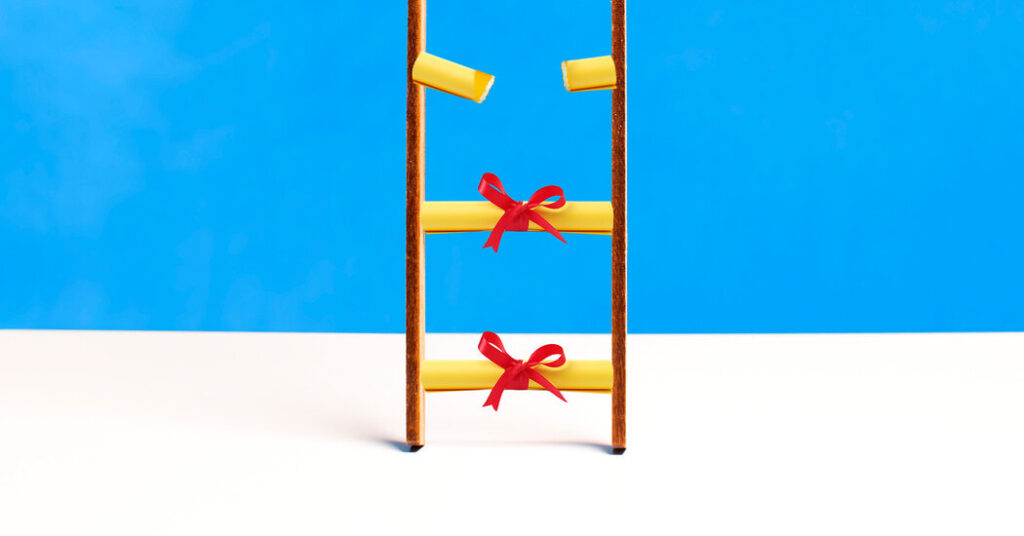
Illustration by The New York Times; source images by Sandor Mejias Brito, Chengyu Zheng and PM Images/Getty Images.
The Times is committed to publishing a diversity of letters to the editor. We’d like to hear what you think about this or any of our articles. Here are some tips. And here’s our email: [email protected].
Follow the New York Times Opinion section on Facebook, Instagram, TikTok, Bluesky, WhatsApp and Threads.
The post Don’t Trust the Rankings That Put China’s Universities on Top appeared first on New York Times.