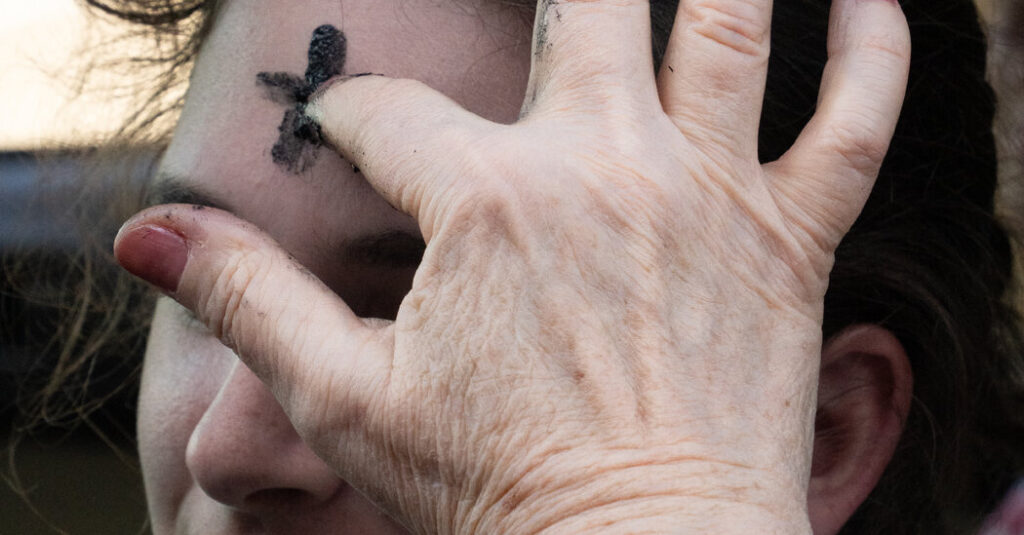
Next week marks the beginning of Lent, the 40-day liturgical season leading up to Holy Thursday. On Ash Wednesday, I’ll join millions throughout the world in fasting, abstaining from meat and receiving ashes on my forehead, along with the reminder that I am dust, and that to dust I will return.
Although a handful of Protestant denominations practice the imposition of ashes, it is generally considered among the most distinctively Roman Catholic traditions. Because it occurs in the middle of a seemingly random winter week, not during a widely recognized holiday season, it tends to sneak up on people outside the faith. It’s the time each year when they are reminded exactly which of their daily acquaintances are practicing Catholics, and it’s often assumed to be a sign of particular devotion.
In reality, however, it is one of the few Catholic rituals that is truly open to anyone. Lapsed or wavering Catholics, non-Catholic Christians, non-Christian theists, and even agnostics and atheists are all welcome. You don’t even have to sit through Mass; many churches simply hand ashes out at the door. The only thing asked of recipients is an awareness of their own fallibility and a desire to repent for their mistakes.
The sense of my own imperfection and my need for help played a large role in my return to the Catholic faith about a decade ago, which is one reason the Lenten season means so much to me. To this end, I have taken since my “reversion” to marking its beginning in another way, by reading T.S. Eliot’s great poem “Ash Wednesday.”
“Because I do not hope to turn again,” the poem begins, insistently. “Because I do not hope / Because I do not hope to turn.”
Eliot wrote “Ash Wednesday” around the time of his conversion to the Anglican faith in 1927, and I read it at this time each year in part to memorialize my own turnings, from devoted former altar boy to militant atheist and, later, from atheist back to believer. I read it also as a reminder that I might still turn again, however much I hope otherwise. As a reminder to practice what I’ve come to call “skeptical belief.”
To many, this will sound like a bit of a paradox, since skepticism and belief are understood to be in serious tension, if not outright opposition. We are all skeptical at certain times about certain things, but when we refer to someone more generally as a “skeptic,” we tend to mean that this person bases beliefs about the world entirely on the rational examination of objective evidence. More pointedly, we almost always mean that this person does not believe in God. But this is not at all the term’s historical meaning.
The Greek philosopher Pyrrho of Elis is often counted as the first philosophical skeptic. His complete doubt about the possibility of any human knowledge extended so far that, according to an ancient, possibly apocryphal account, he refused even to accept the evidence of his senses while walking down the street, “taking no precaution, but facing all risks as they came, whether carts, precipices, dogs or what not.” (His less skeptical friends followed behind to keep him out of trouble.)
Pyrrho’s first great modern disciple, the French essayist Michel de Montaigne, would not even say that he knew nothing, which seemed to express too much certainty. He preferred to put the matter as a question: “What do I know?” Yet Montaigne’s essays contain countless expressions of Christian piety. Precisely because we can’t have knowledge about even the most basic points, he argued, we must inevitably take certain things on faith — at least, if we don’t have friends kind enough to spend their lives guiding us around dogs and carts.
It’s possible to understand the entire modern philosophical tradition as an effort to grapple with the extreme skepticism that Montaigne reintroduced to Western culture without falling, as Montaigne did, back on faith. Four hundred and fifty years later, that project has brought us to a strange point.
Seemingly the worst thing a person can be in our era is “credulous.” We understand ourselves as surrounded on all sides by cons and grifts, and we take great pride in seeing through them all. On the other hand, skepticism as practiced by Pyrrho and Montaigne seems almost entirely absent from our culture. The kind of skepticism we practice today involves seeing through all the pseudo truths around us to the actual truths they attempt to conceal. The dominant intellectual mode is not unknowing but knowingness. We all have our one great truth, which allows us to pierce the pretensions of others.
In the face of this I attempt — with varying degrees of success at varying times — to take a page from Montaigne’s book and embrace skeptical belief. I’m well aware that religion has often served as precisely that “one great truth” that people are punished for refusing to accept. But it has also served as an expression of the fundamental mystery at the heart of reality and the radical limitations of human understanding. It is a way of living with skepticism.
What does this mean in practice? Embracing skeptical belief does not mean believing things without “really” believing them. It means understanding your beliefs as limited, contingent and fallible, recognizing that they can’t be proven correct, that someone else’s refusal to come around to them does not indicate stupidity or obstinacy or bad faith.
Similarly, a skeptical believer recognizes doubt as an essential component of belief, rather than its opposite. To a skeptical believer, the great mark of sincerity is the extent to which you attempt to live out your beliefs in your own life despite your own doubts, not the extent to which you silence those doubts or the doubts of others.
We are all familiar with the phenomenon of the “zeal of the convert,” the tendency of those whose minds have been changed to embrace their new position with particular ferocity. I had more than my share of it when I became an atheist, and I found it frankly a bit embarrassing to tell some of the people to whom I’d most stridently expressed my new opinions that I had given them up in turn.
I’d like to think that I now have some of the humility of the re-converted. Like Eliot, I do not hope to turn again, but I try to imagine the conversations that would result if I did. And I try to apply what the great skeptic David Hume called a “tincture of Pyrrhonism” to even my most precious certainties.
That doesn’t mean that I’ve given up arguing on behalf of my beliefs. One of the reasons I love Ash Wednesday is that for one day these beliefs are conspicuous to others without my having to say a word. I think I’m a better person on this day on account of that fact.
To push ahead of someone on the train, to refuse a dollar to the woman selling candy with a baby on her back, to make a snarky remark at the register about my misunderstood coffee order, all while I have ashes on my head, would announce to anyone who cared to notice the disjunction between my supposed beliefs and my life in the world.
What I try instead to do on this day is simply meet each choice I face with my fallible and limited beliefs, and respond to that choice in the way those beliefs actually commend. Then I try, on the next day and the next, to imagine I still have that mark on me, that I am constantly being called to live up to the beliefs I claim to hold, to imagine that this is the best case I can ever make for them. As a skeptic, I’ve come to think this is the only way that beliefs can ever really be proven.
But then, I could be wrong.
Christopher Beha is a memoirist and novelist.
The Times is committed to publishing a diversity of letters to the editor. We’d like to hear what you think about this or any of our articles. Here are some tips. And here’s our email: [email protected].
Follow the New York Times Opinion section on Facebook, Instagram, TikTok, Bluesky, WhatsApp and Threads.
The post My Conversion to Skeptical Belief appeared first on New York Times.