“Where is the obstacle?” In a trailer for the new film adaptation of “Wuthering Heights,” Emily Brontë’s 1847 Gothic novel about obsessive love and calamitous revenge in the moors of Northern England, a servant puts this question to her distressed mistress, Catherine Earnshaw, played by Margot Robbie. Cathy, as she’s known, has accepted an offer of marriage from her affluent neighbor despite — or because of — her love for Heathcliff, the mysterious orphan her family took in years prior, who became her childhood companion and has now grown into a ruggedly handsome young man. Tearful for the bargain she has made, Cathy presses her hand to her chest and replies with one word: “Here.”
Put the same question to the many early detractors of this adaptation, directed by Emerald Fennell, and they might point not at their hearts but at everything that’s on the screen — the sweeping, romantic tone and sexual content of the promotional materials, which they see as an affront to the book. Elsewhere in the trailer, we glimpse shots of an elaborate dollhouse, bountiful table spreads and smothering fog, as well as a suggestively worked mound of dough, characters fondling a wall that appears to be made of flesh and ecstatic gasps from Cathy at Heathcliff’s touch. All of it rushes by to the beat of an electro ballad by the pop star Charli XCX. It presents the film as an epic, explicit romance, rendered like a contemporary high-concept fashion editorial. Online commenters have denounced it as “50 Shades of Brontë,” “wine-mom pornslop” and a “middle finger to the source material.” In a Reddit thread about a teaser, a user lamented that “Emily is rolling in her grave”; another wrote that it “feels like some historically inaccurate, poorly written, cringey, questionable and tasteless dark romance.” This is not your great-great-great-grandmother’s “Wuthering Heights,” and to these viewers, that is a problem.
Something similar happened with the trailer for Christopher Nolan’s upcoming adaptation of Homer’s “Odyssey,” in which Matt Damon plays Odysseus. (“After years of war, no one could stand between my men and home,” he sets up in a voice-over.) Many viewers immediately took umbrage. The problems weren’t about the familiar story beats that flit by, like the Cyclops entering his cave or dead warriors rising to face the living. The issue was historical accuracy. Dozens of videos, posts and articles boasting millions of views object that the austere cuirasses — “drab leather nonsense,” in one user’s words — and red-plumed helmets worn by Odysseus and his crew do not resemble actual Bronze Age Greek armor circa 1200 B.C. The gray, Kevlar-like helmet we see atop Agamemnon’s head, meanwhile, has been compared to a leftover prop from Nolan’s Batman series and “like a toy helmet” that viewers fear will “break the immersion.” They also noticed that Nolan put Odysseus on a Viking-style boat rather than an ancient Greek penteconter and, in some shots, substituted Scottish isles, with their local flora, for Mediterranean ones.
That people enjoy complaining online about movies, especially ones they haven’t seen, is hardly a revelation. Still, it’s a little surprising, after a century-plus of book-to-screen adaptations — including dozens of “Wuthering Heights” films and series — and given the glut of adapted content, remakes and reboots pumped out by studios and streamers, that some still want new adaptations of canonical works to be dutiful retreads of their source material or history lessons in movie form. The “Wuthering Heights” trailer describes the film as “inspired” by the book — there are even telling quotation marks around the title — and Fennell herself has said her adaptation was inspired by the emotions unleashed by her first encounter with the novel at age 14, but this makes little difference to these purists. The book is sacred, and deviations from it amount to violations. Cathy should be a brunette teenager, not a mid-30s blonde; Heathcliff should be racially ambiguous, whereas the actor playing him, Jacob Elordi, is merely partly Basque; a haunted, febrile tale of quashed desire and ruinous violence should not be billed as “The Greatest Love Story of All Time,” as the trailer has it, nor should it look like “a smuttified version of ‘Wuthering Heights,’” as a YouTuber says in a video titled “Why Margot Robbie Is So Wrong for Wuthering Heights.”
Movies that have failed to replicate their sources have maddened viewers and authors alike for decades. Some Stephen King readers, like the author himself, hated Stanley Kubrick’s 1980 adaptation of “The Shining”; fans have cataloged, disdained and celebrated the differences between J.R.R. Tolkien’s books and their various adaptations. More recently, Guillermo del Toro’s “Frankenstein” effort drew criticism for its unfaithfulness to Mary Shelley’s novel. But social media and streaming video have enabled (and incentivized) a new degree of online pedantry and nit-picking. Netflix and its ilk strip-mine existing works for content; when they do produce something nominally new, it’s often edited, shot and lit like the rest of their library. We are subjected to the same stories, with the same aesthetics, again and again, and we are dazed by the monotony. On YouTube and TikTok, meanwhile, trailer breakdowns scrutinize every frame of movies and their advertisements for hidden meanings and Easter eggs. This situation has inspired, among select viewers, a form of spectatorship that resembles the way you might compare values across spreadsheets — a kind of anxious, professional monitoring in which the images onscreen must be checked and rechecked for their accordance with the original text and preexisting notions about it.
Just as every new rendition of an old work is said to reflect contemporary concerns — to tell us something about “where we are now” — this mode of spectatorship might clue us in to how we see, and fail to see, our own overwhelmingly complicated world. Looking to canonical texts for something unchanging (as well as for a representation of a more concrete, ostensibly simpler past, however fantastical or realistic) might imply a certain queasiness or instability in our relation to the present.
When it’s impossible to know where we’re headed, the supposedly determined facts of the past can be a comfort. (Odysseus may have had a rough go of it, but we know how his story ends.) If we feel incapable of changing the course of current events, we can turn, at least, to our screens — to express our nagging sense that there is something wrong in the world, something to be uncovered and, if not set right, then at least critiqued. Never mind that the original works will remain unaffected by these latest films and that additional adaptations will be made — nor that one of the purposes of narrative art is to mold life into a new object that offers an invigorating perspective on our world. Hollywood is plenty capable of churning out insipid, numbing content. But a funereal reverence for source material can produce boring results, too.
The texts themselves, of course, are not as stable as we might like to believe. Reading a new translation of the “Odyssey,” or rereading “Wuthering Heights” or “Frankenstein,” I tend to discover both how little I remember of the particulars of the stories and how much my responses to individual passages can evolve. We might as well embrace the inevitable changes in our relationships to the canon, and reserve our displeasure for the bland, patronizing interpretations of today, forgiving those that aspire to genuine difference or real artistry. We might as well relish the opportunity for some kind of discovery. Better to return to the texts, and to give daring adaptations their fair shake, than to live like Heathcliff — cantankerous and volatile, hoping to coax a ghost of the half-remembered past back into our hearts.
Paul McAdory is a writer from Mississippi who lives in Brooklyn.
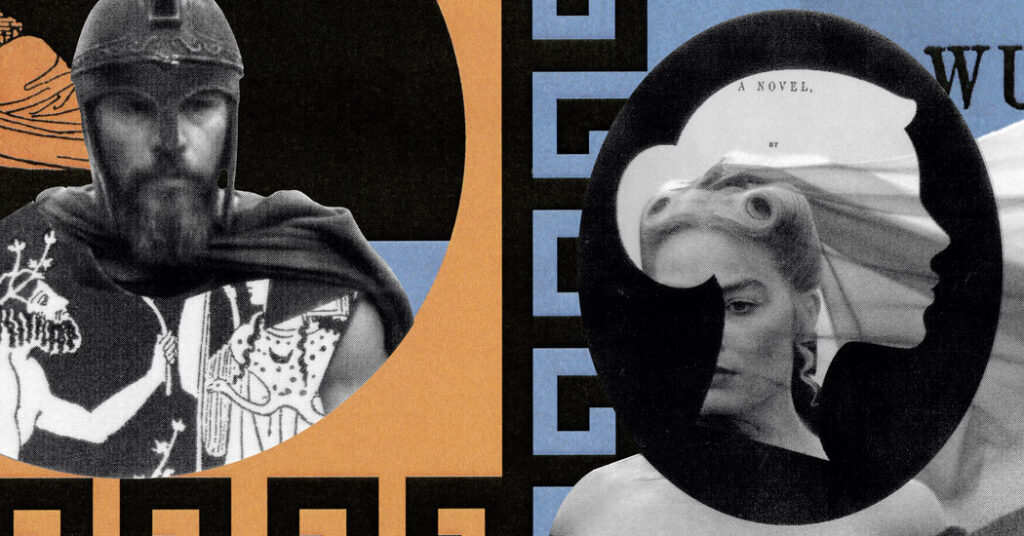
Source photographs for illustration above: Warner Bros. Pictures; screenshot from odysseymovie.com; Hulton Archive/Getty Images; Culture Club/Getty Images; ZU_09/Getty Images; Merovingian/Getty Images.
The post Who Cares if Matt Damon’s ‘Odyssey’ Helmet Is Historically Accurate? appeared first on New York Times.