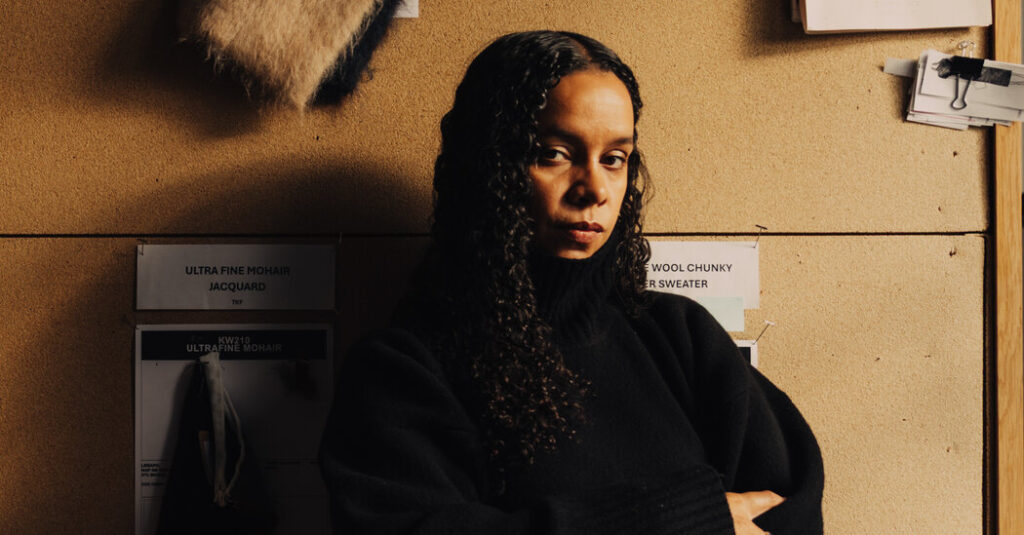
About a year ago, just after her Diotima show at New York Fashion Week, Rachel Scott had a meeting with Anna Wintour, the global editor in chief of Vogue. Ms. Scott had been named designer of the year by the Council of Fashion Designers of America, becoming the first female, Black designer to take home that prize, and she had been a finalist for the LVMH Prize and the CFDA/Vogue Fashion Fund.
She was, in other words, as feted as a newish independent fashion designer could be. So she had come to Condé Nast and the altar of Anna looking for some advice about where to take the four-year-old Diotima next.
As Ms. Scott recalled, Ms. Wintour leveled a look at her from behind her dark glasses and said: “Look, your business is never going to be as big as the big businesses. I’m sorry to be disparaging.”
That would have been a body slam for most designers’ dreams, but Ms. Scott said she wasn’t offended. In fact, she agreed. For her, being big was not the point. She is after something altogether more complicated.
She wants to change the status quo.
On Wednesday, she will take a bow at her first show for Proenza Schouler, the label that once embodied the uptown-downtown New York gallery scene and seemed poised to be the breakout American brand of the 21st century. It is not only the official opening show of New York Fashion Week, but also the most anticipated show of the New York collections.
As the tectonic plates of the industry have shifted in the face of a broad slowdown in spending and a backlash against soaring prices, an unprecedented number of fashion houses have changed designers — with a majority of the newly named designers being white men.
Ms. Scott is a self-described “immigrant, Black, queer woman with a disability.” (She was born and grew up in Jamaica and has Charcot-Marie-Tooth disease, a degenerative neurological condition that affects mobility.) She is everything that has traditionally been excluded from the power positions of fashion.
And she is aiming to prove not only that she can take Proenza Schouler to a globally competitive level while continuing her work with Diotima, but also that, in doing so, she can reimagine New York fashion and who gets to define it.
“Fashion is very reflective of the world we live in,” Ms. Scott said. “And we live in a world that has taken a severe right turn. If you want to do something with some form of meaning, you’re kind of an insurgent within a very conservative space. Fashion is not politics with a big P, but it’s my way to get at it.”
There’s a reason Rama Duwaji, the new first lady of New York City — also the city’s first Gen Z first lady and first Muslim first lady — was in the Diotima front row in September.
Owning the Mess
Ms. Scott officially took the reins of Proenza Schouler last summer, after the founders, Jack McCollough and Lazaro Hernandez, became creative directors of Loewe, but she has yet to move into her SoHo office. She hasn’t had time. Mr. McCollough and Mr. Hernandez’s books are still on the shelves, and their cactus lists sadly on a table.
“But the mess is mine!” Ms. Scott said 10 days before her debut, pulling a plastic bag filled with makeup out of her Phoebe Philo tote, along with various fabric swatches, her iPad, two notebooks and a paperback copy of “The Book of Promethea” by Hélène Cixous, which she had been reading for inspiration.
She loves the work of Ms. Philo, another female designer who is doing fashion her own way. She had intended to bring in orchids to liven up the office — they remind her of her childhood — but she hadn’t gotten around to it, so she had settled for incorporating an orchid print into the collection. Not the generic white phalaenopsis kind that is in every waiting room, but the spiky dendrobium kind.
She has pretty much been living in the Proenza offices since the new year, trundling over to the Diotima studio, which is three blocks away on Canal Street, at night and on weekends, laptop and bags in tow. “I’m destroying my shoulders and back,” Ms. Scott said, “but I’m in the show bunker.”
She actually lives in Brooklyn with her wife, Chaday Emmanuel, who works in gender justice in Jamaica and New York. (They were married in 2024). “I didn’t think she could get busier,” Ms. Emmanuel said, “but now her superlong days are into the night.”
Her next Diotima collection features a collaboration with the estate of the Cuban artist Wifredo Lam, currently the subject of a Museum of Modern Art retrospective. The Proenza Schouler collection, by contrast, started with her reading and rereading books like “Speculum of the Other Woman,” a foundational text of feminist theory by Luce Irigaray, and watching the 1968 film “Teorema” by Pier Paolo Pasolini about the wild inner life of a bourgeois Italian family.
If Diotima is visceral, Proenza is cerebral. You can see why Ms. Scott likes working on each of them. When she talks, she conveys both great calm and a sense that when she commits to something, she could become an immovable object.
Tiny Skirts and Triangle Bikinis
When Shira Suveyke Snyder, the Proenza Schouler chief executive, was looking for a new designer, she saw between 30 and 40 candidates. Most of them, she noted, were from big European houses.
“A lot of them would have brought something that was similar to where we’d been,” Ms. Snyder said. But, she recalled thinking: “Is that what’s really going to take Proenza into the next decade or even the next five years? Does anyone really need that?
The answer led her to Ms. Scott. (Well, that and Ms. Scott’s facility with textiles, long a Proenza signature.)
The daughter of a furniture designer and a flight attendant for Air Jamaica who also had her own boutique in Kingston, Ms. Scott, now 41, worked in her mother’s store as a child and later sewed her own clothes on their portable Singer sewing machine. It wasn’t because she dreamed of being a designer but because she wanted something to wear clubbing.
“Tiny skirts and triangle bikinis,” she remembered, rolling her eyes.
She went to Colgate University, where, during orientation, she met her best friend, Shinae Lee, who is now the director of strategy and operations at Diotima. Ms. Scott still remembers Ms. Lee’s Juicy Couture tracksuit.
“We were on the lawn, and she refused to sit on the grass in her suit, so she squatted for the entire hour,” Ms. Scott said. They both double-majored in fine arts and French literature.
“Rachel would always talk about how much she wanted to bring Jamaica into the forefront in some way,” Ms. Lee said. “It was deeply personal for her.”
Ms. Scott loved Italian Vogue and briefly considered working in magazines, but an internship at Vogue changed that. It is also where she first met Ms. Wintour.
“I was in the hallway, and she kind of just walked past and stopped and looked at me, then kept walking,” Ms. Scott said. “I think that was the moment where I was like, ‘Maybe this isn’t for me.’”
Pivoting to design, she went to the Istituto Marangoni in Milan, followed by a tour through various brands, including Costume National, J. Mendel and Elizabeth and James. Then she was hired by Rachel Comey, the indie New York designer beloved by funky professionals, where she spent eight years before deciding to go out on her own after “an existential pandemic crisis.”
“So much of my life, I was trying to build security because of being an immigrant,” Ms. Scott said. “But in that moment, I realized there was no such thing as security, and I needed to find a way for my every day to mean something.”
Women of Interest
Ms. Scott became an American citizen in 2020, and shortly thereafter started Diotima, which treats traditional Jamaican crochet like Chantilly lace, and Jamaican craftspeople as an artistic resource. She conceived it as “an anti-imperialist project to reorient where value is placed, decentering it from Europe.”
“She was scared,” Ms. Lee said. “She didn’t know how the industry would react.”
By early 2021, she had orders. The British stylist and consultant Marika-Ella Ames, whose father’s family was from Jamaica, signed on. She said she liked the idea of showing that “Jamaica was not just rum, Bob Marley and colorful shacks.”
The whole venture was self-financed, largely through prize money. But Ms. Scott knew she would need new revenue streams to expand, which led to Proenza. “There are so many other things I’m interested in that I can explore here,” she said.
“A lot of these white men designers flatten the idea of women,” she said. “They’re either sexy or they’re proper or they’re uptight or they’re flashy. The woman can never embody complexity. I think that is problematic.”
She continued: “A New York woman in 2026 is very global. There’s a certain precision to her, but I don’t really believe in perfection. It can be quite restrictive. I have these characters in my mind. Like a lady who is a professional but who also goes fencing, though you would never know because she doesn’t talk about it. She has esoteric obsessions, private pastimes.”
While her Proenza clothes are fit for the office, they are also slightly twisted. The waists of the dresses are a little high, to elongate the legs; skirt suits are knit, rather than wool, so they are both buttoned up and relaxed. Like many female designers, Ms. Scott wears her own designs, as do her mother and her wife. She hates even the concept of the corset.
What she likes are bell bottoms with big white buttons at the calf, like sailor pants, that can actually be undone to flash a bit of leg. Shoes that are witchy-pointy or pumps with a bulbous square toe that look like a cross between a clown shoe and a career girl’s uniform. A skinny rectangular evening bag that is big enough to actually put stuff in and derives its fanciness from contrasting textures rather than decorative beading.
To get to know the Proenza clients better, she was introduced to a group of V.I.C.’s over a dinner in December. One was a Pilates instructor, one was a retired lawyer, one was a writer, three were art advisers. “Proenza has always had this relationship to the art world,” Ms. Scott said. But more than the art that often inspired Proenza collections, she was interested in the people who made it.
To that end, she name-checked the kind of women she had in mind for in her show, including the artists Cecily Brown and Rita Ackermann and the curator Samantha Ozer. The psychoanalyst Jamieson Webster and the writer Zoe Dubno will be on the runway amid the professional models, who include not just the usual group of youngsters but the 50something Jamaican model Romae Gordon, who recently came out of retirement. In the audience: Thelma Golden, the director of the Studio Museum in Harlem; Mindy Seu, the creator of the Cyberfeminism Index; and the gallerist Bridget Donahue.
“You can be really put together and a superpowerful professional woman, but you don’t have to be that self-serious,” Ms. Scott said. “Those are the women I’m interested in.”
Vanessa Friedman has been the fashion director and chief fashion critic for The Times since 2014.
The post The New New York Woman appeared first on New York Times.