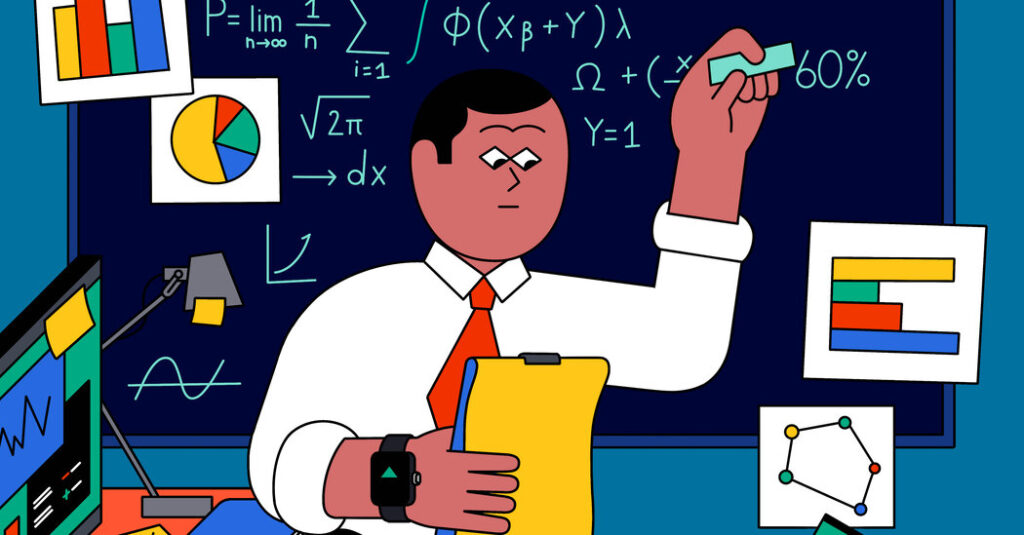
Economists at top banks and investment firms who command high salaries to divine the direction of the economy expect the latest jobs report on Wednesday to show that about 68,000 jobs were added last month.
A crowd of anonymous online gamblers placing bets on Kalshi, a prediction site, expect to see 54,000 new jobs.
The gamblers may have the upper hand.
Over the five years that Kalshi has existed, its thousands of gamblers have proved as accurate on average at predicting certain economic indicators as the highly trained forecasters, a working paper published last month by the National Bureau of Economic Research found. The crowd is also pretty good at predicting interest rate decisions from the Federal Reserve, and even better than the professionals at predicting the rate of inflation.
“Getting information from a large pool of people can be a remarkably good form of forecasting,” said Jonathan Wright, an economics professor at Johns Hopkins University who co-wrote the paper.
Thomas Simons, a U.S. economist with Jefferies, the investment firm, took notice when Kevin Warsh was leading in the prediction markets to be President Trump’s nominee for chair of the Federal Reserve. Mr. Simons had dismissed the possibility because of Mr. Warsh’s past advocacy for higher interest rates, rather than the lower rates that Mr. Trump prefers.
“‘How could it possibly be that he’s at the head of this? It doesn’t make any sense,’” Mr. Simons recalled thinking.
But the markets turned out to be right, and he decided he shouldn’t disregard the odds. Bettors, he realized, have one advantage: They don’t have to make a prediction if they’re not highly confident that they’re right. Professional forecasters don’t have a choice; even if the data are confusing and they don’t have much conviction in the number, they guess.
“You have to forecast these numbers every month even when you don’t necessarily think you have some kind of edge,” Mr. Simons said. “So it starts to make me feel like, if I go back to my priors on this, the people who have edge are the ones who are going to participate.”
Another working paper, by economists at the London Business School and Yale University, found that Polymarket bettors as a whole forecast corporate earnings more accurately than the analysts who are paid to advise investors on whether to buy or sell.
Theis Jensen, a Yale professor who worked on the paper, thinks the comparatively good performance by thousands of amateurs can be chalked up to incentives. Professional analysts may have conflicts of interest, such as their firm’s trading commissions, which might rise in response to rosier forecasts. Analysts may also avoid publishing earnings forecasts that are out of the norm, which can lead to more embarrassment than sticking with the crowd.
“The nice thing about prediction markets is that you have to put your money where your mouth is,” Mr. Jensen said, “and so that highly incentivizes you to state your true beliefs.”
Of course, that has been true for decades. The first online prediction markets emerged in the early 2000s. Sites like Intrade focused mostly on elections and the likelihood of other world events, and were generally found to be fairly accurate. In the 2010s, U.S. regulators cracked down, ruling that they were operating as illegal gambling platforms.
But some platforms continued to operate in Europe, where political and economic contracts are a sideshow to enormous volumes of sports betting. The same is still true of Kalshi, which won a lawsuit allowing it to operate legally in 2024, and Polymarket, which is only sporadically accessible in the United States as lawsuits have blocked trading in many states.
And yet betting volume even on nonsports questions has expanded at such a torrid pace that forecasters and analysts are taking notice. On any given day, more than $60 million is at stake on the platforms on political and economic questions — far more than the earlier platforms reached.
Edward Ridgely runs Stand, a company that allows bettors to trade simultaneously on Kalshi and Polymarket and follow other large traders. He said many of his highest-volume customers worked in the same fields where they wagered. One user in Hong Kong buys and sells Nvidia stock in his day job and uses the tariff-related prediction market contracts as a hedge.
“If the Trump tariffs escalate toward China or something, he can get out of his position and not get blown away,” Mr. Ridgely said.
He sees another piece of evidence that bettors specialize: Most of them aren’t good at everything. “You can see that a lot of the traders who are really good at elections aren’t very good at crypto. Or if you’re really good at crypto, you’re not very good at geopolitics,” he said.
Michael Feroli, chief U.S. economist of J.P. Morgan, has access to a deep well of expertise from the bank’s political affairs staff, country specialists and equity researchers. But he still looks at the markets to get a more precise estimate.
“Whenever you talk to D.C. people, they’ll say, ‘Well, I think they’ll get the budget done.’ So, what’s the probability?” Mr. Feroli said. “It’s a different language. Oftentimes you’ve got to really push to get a quantitative answer.”
On the quantitative questions that are his stock in trade, like forecasting changes to the Consumer Price Index and gross domestic product, Mr. Feroli suspects something else is going on: The betting markets are just following the experts. That could mean monitoring the Bloomberg consensus, reading research from the big investment houses or tracking the futures markets and investor expectations that groups like the Chicago Mercantile Exchange already aggregate.
Tara Sinclair, an economist at George Washington University who studies forecasting, agrees that is likely. And therein lies a danger in prediction markets: If the crowd were to supplant professional forecasters, individual bettors would lose out.
“They would be making the jobs of their contributors harder, because now they have individual sources of information to draw from,” Ms. Sinclair said. “If they replace all of that, then they won’t have those to also go to.”
Most forecasters aren’t worried about that, because they do more than predict numbers. Every estimate comes with a detailed analysis of the factors underneath the headline number, which is what investors and companies need to figure out how to spend money.
“Surprises happen, and people want to know, ‘What does this mean, what’s going to happen, what’s driving it?’” said Michael Pugliese, a U.S. economist with Wells Fargo. “I think that’s a lot of nuanced, important information that you’d want to have when you are making decisions, as an operator in these markets.”
But prediction markets could become an input for some complex forecasts, like those constructed by the Federal Reserve. Justin Wolfers, an economics professor at the University of Michigan who studied and wrote about the earlier iterations of prediction markets, has told Fed officials that they should take those markets into consideration. They have been hesitant, he said.
“There’s a deep problem, which is, if you were to do this, you democratize decision making,” Mr. Wolfers said. “Right now the senior economist has a ton of power. Their view goes.”
It may also be true that neither individual experts nor a collective of thousands are the best at predicting the future. Over the past decade, a group called Good Judgment has developed a model of selecting people with good track records of figuring out what will happen. These “superforecasters” are applied to longer-range questions of interest to paying clients. They work collaboratively, but ultimately cast their own votes.
Warren Hatch, the organization’s chief executive, thinks prediction markets complement his group’s services because they focus on shorter-term questions and expand the use of probabilistic thinking.
Now he is watching the emergence of another predictive force: artificial intelligence, which can synthesize large amounts of standardized information to come up with reasonably good estimates. But A.I. can have a tough time with questions that more have to do with humans and culture, and less to do with numbers and metrics.
“When the data is sparse and the environment is in flux, machines are backward looking by definition,” Mr. Hatch said. “And that’s where I think the space for humans will remain.”
Lydia DePillis reports on the American economy for The Times. She has been a journalist since 2009, and can be reached at [email protected].
The post Thousands of Amateur Gamblers Are Beating Wall Street Ph.D.s appeared first on New York Times.