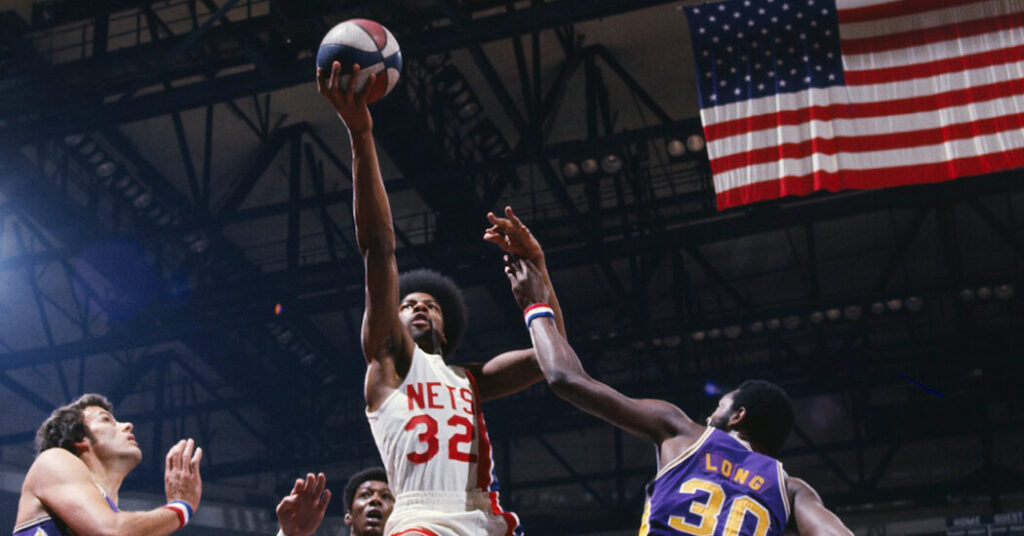
While Kenan Kamwana Holley was shooting his documentary series “Soul Power: The Legend of the American Basketball Association,” he asked basketball players what they knew about the long-defunct A.B.A.
“We had young N.B.A. players like Tyrese Haliburton and RJ Barrett send us videos talking about what the A.B.A. means to them, and they all started with Dr. J,” Holley said. “We went to courts around the country like Rucker Park in Harlem and the court in Los Angeles where they made ‘White Men Can’t Jump.’ And when we asked players about the A.B.A., they all said, ‘Dr. J, Dr. J, Dr. J.’”
Dr. J, of course, is Julius Erving, the sublime superstar and three-time league M.V.P., whose above-the-rim play changed the game and helped keep the A.B.A. afloat. Fifty years ago, the A.B.A. introduced the slam-dunk contest to basketball, and it was Erving’s astonishing flight from the foul line to the basket that provided a memorable exclamation point to the league’s final season.
Premiering Thursday on Amazon Prime Video, the four-part series, of which Erving is an executive producer, goes far beyond being a Dr. J highlight film, however. There was a rich history of fun, rebelliousness and innovation — the league invented the 3-point shot, for starters, and used a red-white-and-blue basketball — that Holley, who directed the series, wanted to show to younger generations.
The A.B.A., which included early versions of the Denver Nuggets, Indiana Pacers, San Antonio Spurs and Brooklyn Nets (then the New York Nets), was started in 1967 with the explicit hopes of eventually forcing a merger with the already well-established N.B.A. — just as the American Football League had initiated the previous year with the N.F.L.
Previous books and documentaries about the A.B.A. emphasized the wacky behind-the-scenes stories of an underfinanced underdog league, effectively relegating it to footnote status, Holley said. But as he dug in, he found a fast-paced game that was more of a precursor to the modern game than was the N.B.A. of the late ’60s and early ’70s. There was also plenty of talent, including the future Hall of Famers Rick Barry, George Gervin, Artis Gilmore, Spencer Haywood and Dan Issel. As Holley discovered, A.B.A. teams beat N.B.A. teams in exhibition games more often than they lost.
“That was pretty incredible,” Holley said. “I’d never heard that before.”
“Soul Power” downplays zany anecdotes about volatile players like Marvin Barnes in favor of a story about the playing style and relative racial harmony in a league that was far more integrated at the time than the N.B.A. (which for years had an unwritten racial quota). There’s also a focus on the business battle to gain a merger with the N.B.A. and on the players’ fight for respect and fair pay, which was also ahead of its time.
“The players who we interviewed all felt like they’ve been depicted like clowns” in earlier accounts, Holley said, “and no one really knows what they contributed to basketball history.”
Erving’s contributions are an obvious exception. Born and raised on Long Island, Erving went on to a storied N.B.A. career in Philadelphia, winning a league M.V.P. award and championship. But in a recent video interview about the docuseries, he made clear that he particularly cherished his glory days in the upstart league.
“I’m all A.B.A.,” Erving said. “Anything associated with the league, I’m there for it.” These are edited excerpts from the conversation.
What do you hope “Soul Power” shows people about the A.B.A.?
We knew in our hearts we were as good as the N.B.A. teams. It’s big to share that with the public. And the negotiations that went on between A.B.A. and N.B.A. in terms of the merger is one of the key things in basketball history that was forgotten about.
Also the A.B.A. lives in the N.B.A. today, no question about it. There’s the 3-point shot and the three referees and extra lines in the way stats are recorded. But there’s also the spirit of the A.B.A. game, spreading the court, running the ball, the faster pace of play.
Growing up, did you originally hope to play in the N.B.A.?
I didn’t even know I could be a pro until the summer after my sophomore year of college [at the University of Massachusetts Amherst], after I’d had a growth spurt and put on some weight and posted good numbers. I got invited to the Olympic development camp for the 1972 team but only as an alternate.
I went back to Roosevelt [on Long Island], and I was working at the park when two guys on the team got hurt. I got called out to Colorado and I got fitted for a jacket, but I still I had no reason to believe that I was going to make this team. There were 40 players and 12 spots. The jacket didn’t even fit.
But we went on a tour and went 10-3, and I led the team in scoring and rebounding even though we had two seven-footers. So I made the team, and the coach said I had a good shot at being a professional. I didn’t have any wish lists, but my assumption was I’d go to the N.B.A.
How did you end up in the A.B.A.?
After my junior year, an agent brought me to a meeting with the general manager and coach for the Virginia Squires. I didn’t know anything about the Virginia Squires. They were offering $500,000 for four years of play — which rivaled Bill Russell’s and Wilt Chamberlain’s contracts [with the N.B.A.] — although they’d pay it over seven years.
My mom was a hairdresser, and my stepfather worked for the sanitation department, and together they made $15,000. It was a no-brainer. What’s a brother to do?
The documentary positions you as a Black superhero to the youth of the 1970s, running together footage of you and “Shaft.” Did you feel a sense of responsibility to maintain a certain public image?
Well, Shaft was way cooler than me. But in terms of being a role model and the personal image, it started with my public service and charity — I was doing stuff for the Boys and Girls Clubs, the Salvation Army and other groups. Just volunteering and being at the front of the line, helping to do something that was very unselfish.
Who were your role models?
I had heroes like Martin Luther King and Bill Russell. I met Bill when I was 19 years old, and he extended the hand of friendship. There were things about him that I didn’t like and I wouldn’t do — he would be rude to people and he had some ways about him — but he had those ways because of how he grew up and how people treated him. So I accepted that. And he taught me a lot of life lessons.
But it started with my mom, because I never wanted to do anything to disappoint her. Her life was hard enough, so I didn’t want to be the child who made it more difficult. The business side of the game and being a sports icon and a brand grew out of that. And that wasn’t my intention. My intention was just being a good citizen.
Did you practice taking off from the free throw line to dunk before the 1976 All-Star Game?
I did it at a lot of basketball camps. I’d usually wrap up a session with some dunks, and I’d wrap up that with the dunk from the foul line … and I’d just keep going right into the locker room.
The post In ‘Soul Power,’ a Fresh Look at the League That Helped Launch Dr. J appeared first on New York Times.