
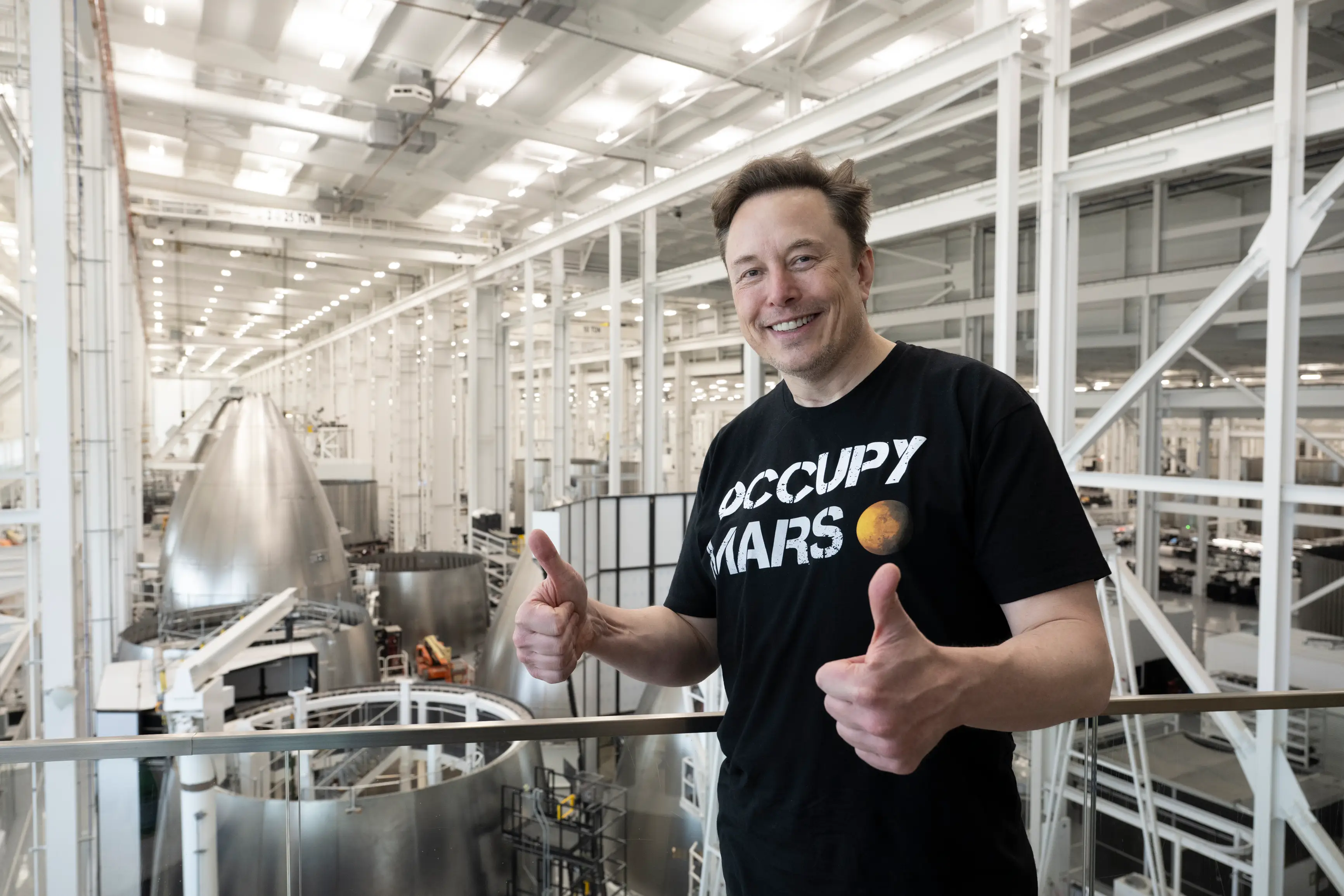
Elon Musk has long framed SpaceX’s mission in sweeping terms: to send humans to Mars and make humans interplanetary.
Along the way, the moon has played an inconsistent supporting role.
SpaceX is under contract with NASA, for example, to send people to the moon, and that funding plays a key role in some of SpaceX’s major projects. However, Musk’s main messaging for years has been to build cities on Mars, not the moon.
On Sunday, that messaging seemed to take a hard 180.
“For those unaware, SpaceX has already shifted focus to building a self-growing city on the Moon, as we can potentially achieve that in less than 10 years, whereas Mars would take 20+ years,” Musk wrote on X. “The mission of SpaceX remains the same: extend consciousness and life as we know it to the stars.”
“The overriding priority is securing the future of civilization and the Moon is faster,” Musk added.
The latest from Musk has sparked debate on forums about whether he has changed his mind about the moon. A closer look at his statements over the years suggests a more nuanced picture.
Musk has simultaneously had his eyes on missions to both the moon and Mars, but has treated lunar missions as a shorter-term objective within his broader push toward Mars.
That reframing was most explicit in the Sunday post on X, where Musk said SpaceX would prioritize building lunar infrastructure before sending people to Mars.
“It is only possible to travel to Mars when the planets align every 26 months (six month trip time), whereas we can launch to the Moon every 10 days (2 day trip time). This means we can iterate much faster to complete a Moon city than a Mars city,” Musk wrote. “That said, SpaceX will also strive to build a Mars city and begin doing so in about 5 to 7 years.”
For those unaware, SpaceX has already shifted focus to building a self-growing city on the Moon, as we can potentially achieve that in less than 10 years, whereas Mars would take 20+ years.
The mission of SpaceX remains the same: extend consciousness and life as we know it to…— Elon Musk (@elonmusk) February 8, 2026
The message also echoed language from an internal SpaceX memo on February 2 that announced the company’s acquisition of Musk’s AI startup, xAI.
The science nerd-coded memo described futuristic plans such as extending “the light of consciousness to the stars,” floating AI-generating data centers — and permanent lunar bases that weren’t on Earth.
‘The moon is a distraction’
Both the memo and Musk’s recent post came roughly a year after he appeared to dismiss some lunar missions as a “distraction,” writing that SpaceX was “going straight to Mars.”
No, we’re going straight to Mars. The Moon is a distraction.
Mass to orbit is the key metric, thereafter mass to Mars surface. The former needs to be in the megaton to orbit per year range to build a self-sustaining colony on Mars.— Elon Musk (@elonmusk) January 3, 2025
In his 2025 post, Musk said the key constraint to building on Mars is how much payload you can routinely launch into orbit.
He has repeatedly argued that long-term moon exploration could help. But ultimately, Musk’s past quotes suggest he wants moon missions to push momentum toward the peak goal of establishing a Mars colony.
Public statements dating back to at least 2017 also show Musk making a distinction between limited activity on the moon and a full-scale human civilization on Mars.
It is high time that humanity went beyond Earth. Should have a moon base by now and sent astronauts to Mars. The future needs to inspire. https://t.co/6HjDQnRSA5
— Elon Musk (@elonmusk) December 13, 2017
What has seemingly changed is SpaceX’s timeline for reaching the red planet.
The company has repeatedly missed self-imposed deadlines for reaching Mars. Now, the intra-planetary timeline appears bound to be even more prolonged.
Musk — who has admitted he can be overly optimistic when it comes to timelines — initially said SpaceX would fly humans to the red planet by 2024. In 2021, he pushed that timeline back to 2026. Now, he’s saying SpaceX would have to wait until at least 2030 for its first Mars mission — if the lunar city is successful.
At the same time, SpaceX is under contractual pressure from the government to reach the moon.
In 2021, NASA hired the company to develop a reusable version of its Starship vehicle capable of ferrying astronauts to the moon as part of the Artemis program. Those contracts, worth billions of dollars, helped fund Starship’s development.
NASA expects the SpaceX-built rocket will take off for the moon’s South Pole in 2028, according to the agency’s website.
Starship can enable a permanently crewed science station on the Moon, which would be super cool!
Moonbase Alpha!!— Elon Musk (@elonmusk) October 18, 2024
Overall, what looks like a change in philosophy might actually be a doubling down on SpaceX’s initial plans to fly to the moon and Mars. Details for those missions may just be coming years later than initially expected.
‘The biggest opportunity on the moon’
Musk, who plans to launch data centers in space, has also talked about the manufacturing opportunity that the moon represents.
“The biggest opportunity on the moon is to make solar cells and radiators, and then, you’re manufacturing on the moon anything that weighs a lot, chips maybe still come from Earth, they weigh very little,” Musk said during a December 30 X Spaces conversation.
“And then you can use a mass driver to put a billion tons of AI powered satellites into orbit per year. You could set a scale to 100 terawatts of AI compute per year from the moon,” he added.
SpaceX, which is preparing for a possible 2026 IPO and recently acquired Musk’s AI company, xAI, is looking to scale up its compute resources to power increasingly powerful AI models. Musk has argued that space offers a more attractive medium to build out data centers than the Earth.
Musk also suggested earlier this week that SpaceX would build a “system that allows anyone to travel to the moon,” without providing more details.
Musk has previously said he’d like to travel to Mars — and possibly die on the planet. “Just not on impact,” he joked.
Read the original article on Business Insider
The post SpaceX is leaning into the moon. Here’s why. appeared first on Business Insider.