The House on Tuesday rejected a Republican effort to change the chamber’s rules and delay for months any vote on canceling President Trump’s tariffs, as G.O.P. defectors rebuked party leaders who have tried for a year to avoid weighing in on levies that are unpopular with many voters.
The defeat cleared the way for Democrats to immediately force a vote on terminating the emergency Mr. Trump declared more than a year ago that imposed tariffs on several nations and kicked off his global trade war.
It came after Republicans had sought for the third time this congressional term to use a procedural trick to bend the rules of time, turning months into a single day in the interest of avoiding a tariff vote, and effectively nullifying their chamber’s statutory authority to have a say on the matter.
By law, the House would ordinarily be required to vote within 15 days on any bid to cancel the tariffs. But by manipulating how long a legislative “day” is, Republican leaders have in effect ignored the calendar.
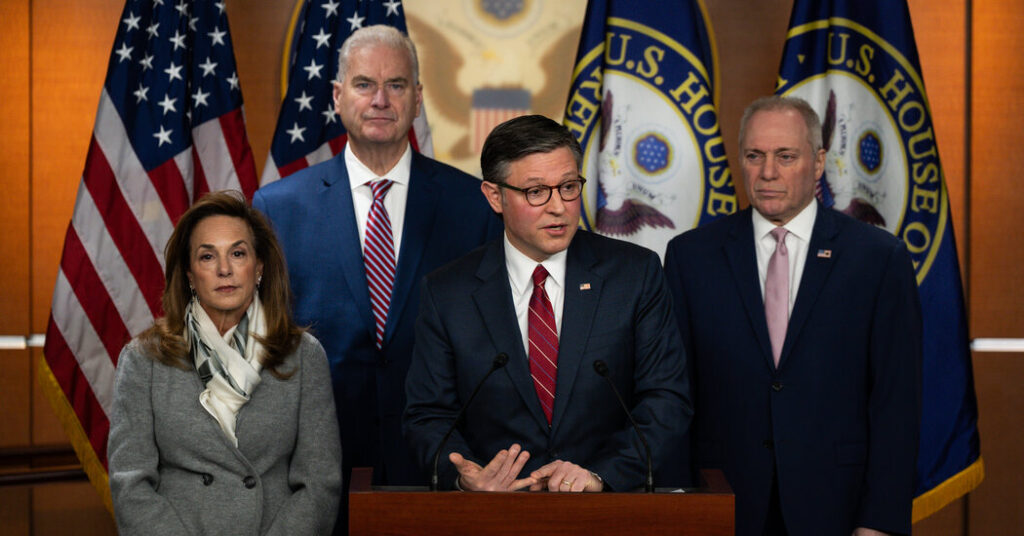
Speaker Mike Johnson had quietly tucked language into a procedural measure needed to bring up unrelated legislation that would have again changed the rules and blocked a tariff vote until after July 31. But after spending most of Tuesday pressing his members to support the maneuver — including nearly an hour on the House floor while the vote remained open — three Republicans refused to do so.
The Republican opponents who broke ranks and joined all Democrats in voting against the measure were Representatives Thomas Massie of Kentucky, Don Bacon of Nebraska and Kevin Kiley of California.
“I’m not in favor of changing the definition of a day in order to diminish the power of members of the House,” Mr. Kiley said in an interview before voting down the effort. “I object to smuggling in some extraneous provision that diminishes the power of the House.”
For a year, House Republicans had successfully used the same trick to shield their members from having to choose between supporting tariffs many of their constituents opposed and angering Mr. Trump by voting to cancel them. Their latest effort had blocked action until after Jan. 31.
Initially, Mr. Johnson had signaled that he would not seek to renew the rule change. As he bargained with recalcitrant Republicans to muster the votes for unrelated legislation last year, he had agreed to shorten the period when the bar on tariff votes was in effect from March 31 to Jan. 31. But he changed course this week as Democrats signaled their intent to challenge the tariffs.
With the procedural block expired, Democrats, led by Representative Gregory W. Meeks of New York, have queued up resolutions that seek to end the president’s tariffs on Mexico, Canada and Brazil, hoping to build on the momentum from similar measures that were passed by the Senate in October last year.
Mr. Trump invoked the International Emergency Economic Powers Act to impose some of his tariffs last year under the National Emergencies Act. That law allows any member of the House to challenge an emergency by introducing a resolution that must receive a vote after 15 days.
The rule that failed on Tuesday would have declared the period between Feb. 10 and July 31 as just one day, meaning that such resolutions would be stuck in a sort of legislative purgatory and not receive a vote during that time.
Mr. Bacon, who had previously objected to the rule change and pressed Mr. Johnson to shorten the period in which tariff votes would be blocked, voted “no” and immediately exited the House chamber, denying Republican leaders the opportunity to try to pressure him to change course.
Earlier in the day, Mr. Bacon, who is retiring from Congress, had repeatedly expressed skepticism about Mr. Trump’s tariffs, and called for open debate of the issue.
Still, the vast majority of Republicans, including the most vulnerable members facing tough re-election battles this cycle, backed the move to avoid challenging Mr. Trump’s tariff policy.
Representative Zach Nunn of Iowa, a Republican facing one of the most competitive races this cycle, waited to cast his vote until nearly all members had voted and the measure was on track to fail. G.O.P. leaders corralled him into an antechamber off the House floor, from which he emerged moments later, his cellphone pressed to his ear, as he voted “yes.”
A January poll from The New York Times and Siena University found that 54 percent of voters opposed Mr. Trump’s tariffs, and 51 percent said the president’s policies had made life less affordable for them.
Robert Jimison covers Congress for The Times, with a focus on defense issues and foreign policy.
The post House Defeats Republican Bid to Block Votes on Trump’s Tariffs appeared first on New York Times.