The Guatemalan government said on Tuesday that it would begin phasing out its longstanding use of Cuban doctors, a nearly 30-year program that is a vital source of income for the Cuban government but one that has come under heavy strain from the Trump administration.
Guatemala, with a population of more than 18 million, is the latest country in the Americas known to have canceled the Cuban medical program.
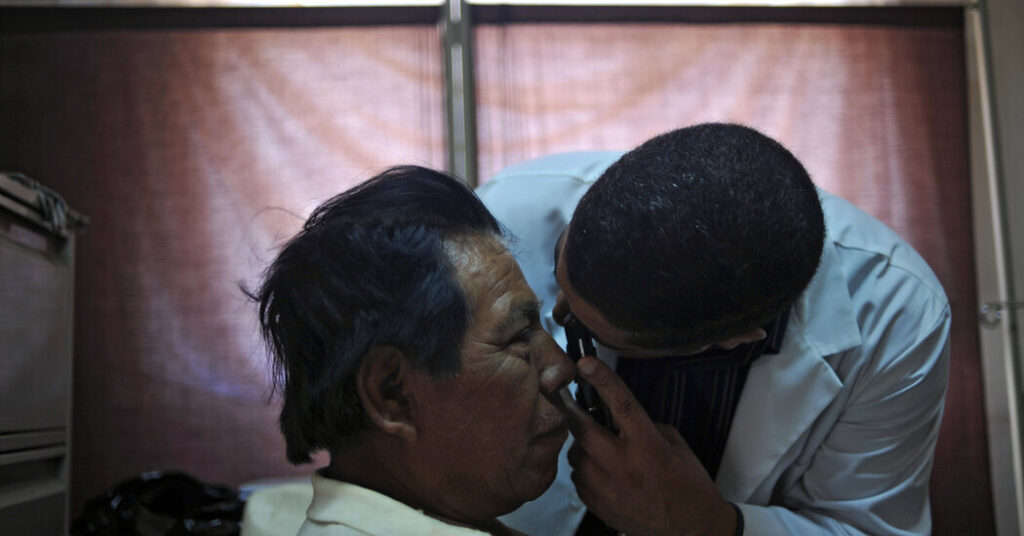
The Central American country’s health ministry said in a statement that the Cuban brigade was made up of 412 medical workers, including 333 doctors, working throughout Guatemala’s health care system. The ministry said that it would begin a “gradual termination” this year as medical workers complete their missions.
The ministry said that the change was based on “a technical analysis” aimed at strengthening Guatemala’s national health care system and “guaranteeing the continuity of services.”
Under President Bernardo Arévalo, Guatemala has cooperated with the Trump administration, recently striking a reciprocal trade deal with the United States, accepting more deportation flights and working more closely with U.S. law enforcement authorities on prison and gang issues.
Since U.S. forces captured President Nicolás Maduro of Venezuela last month, however, President Trump has turned his attention to Cuba, which provided many doctors to Venezuela and received oil from Venezuela, its largest supplier.
The Trump administration has pressured countries in the region to end the Cuban medical brigades. Last February, Secretary of State Marco Rubio announced the restriction of visas not only for current and former Cuban officials involved in the country’s overseas medical missions, but also for foreign government officials and their immediate families linked to the program.
“Cuba’s labor export programs, which include the medical missions, enrich the Cuban regime, and in the case of Cuba’s overseas medical missions, deprive ordinary Cubans of the medical care they desperately need in their home country,” Mr. Rubio said.
Since then, several countries have ended their Cuban medical programs: Paraguay, the Bahamas and Guyana, whose health minister said Cubans would now be independently and directly hired.
In August, Mr. Rubio announced visa restrictions against several Brazilian and Grenadian officials for their roles in the Cuban program.
This month, Prime Minister Philip J. Pierre of Saint Lucia said that the United States was pressuring his government not to send doctors to Cuba for training and that his colleagues in other countries had barred Cuban doctors, which his country used. He called it “a major, major problem.”
The U.S. Embassy serving that part of the Caribbean denied that it had talked to St. Lucia about its doctors’ training, but called for an end to Cuba’s overseas medical program.
Last month, the U.S. Embassy in Guatemala criticized the Cuban program in a social media post, saying the “exploitation of medical workers by Cuba is not just a human rights issue,” but “it can also endanger patients.” It said there were reports that claimed Cuban medical workers did not have adequate training. The embassy did not identify those reports.
In a letter dated Jan. 6, the Guatemalan foreign ministry said it had informed the Cuban Embassy in Guatemala about the phaseout of Cuban doctors. An official who answered the phone at the Cuban Embassy in Guatemala on Tuesday afternoon said the embassy had no comment.
For decades, the Cuban government has sent thousands of health professionals to work in remote villages and cities in dozens of countries. The medical workers receive a small fraction of what the countries pay Cuba for their services.
It’s unclear how much money the medical program generated for Cuba. But according to some studies, including one by Cuba Archive, a human rights organization based in Miami, it is estimated that Cuba makes more than $4 billion a year by exporting health care employees, construction workers, educators and other skilled workers.
As the Cubans doctors withdraw, the Guatemalan health ministry said, “a phased replacement plan” will be put into effect, including hiring more local employees, boosting incentives to fill hard-to-reach positions and redistributing workers.
Guatemala began its Cuban medical brigade program in 1998, the same year that its president at the time, Álvaro Arzú, restored relations with Cuba.
A Guatemalan expert in international relations, Fernando González Davison, said the Cuban doctors went to Indigenous and poorer parts of Guatemala that had been neglected by the government or hit hard by the country’s long civil war.
Widespread corruption in Guatemala’s social services and the fact that young doctors did not want to live in more remote areas created holes in the medical system that were filled by Cuban doctors, he added.
Mr. González Davison said that the U.S. government’s drastic cuts in its foreign assistance to developing countries last year had already been a “hard blow” to Guatemala. With this latest move, he added, “it’s an attack on the health of poor people.”
Frances Robles contributed reporting.
James Wagner covers news and culture in Latin America for The Times. He is based in Mexico City.
The post Guatemala to Phase Out Use of Cuban Doctors Amid U.S. Pressure appeared first on New York Times.