Ever been jealous of your brother or sister for getting too much attention from your mom or dad? Scientists believe you’re not the only creature in the animal kingdom to feel that way.
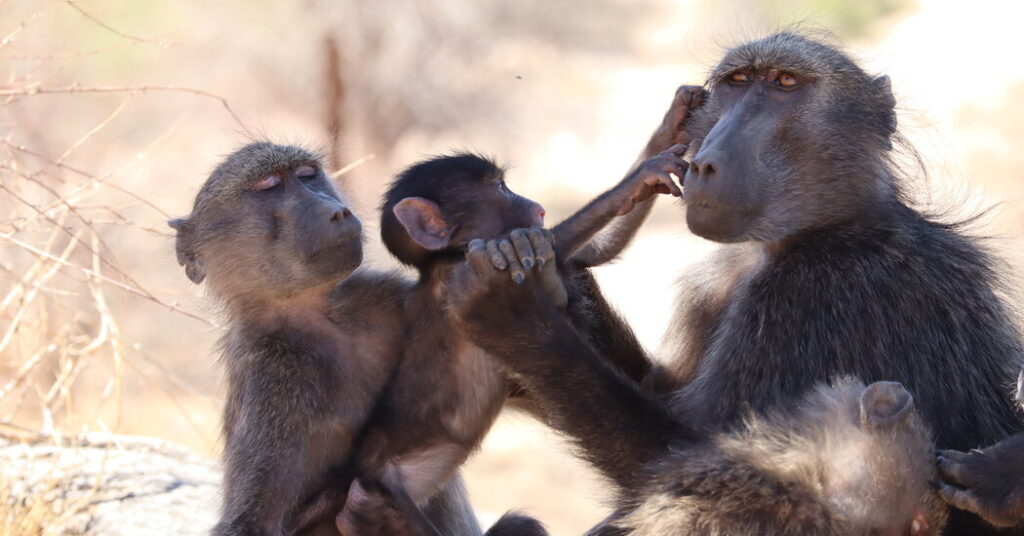
A team of Finnish scientists spent the majority of 2021 in Tsaobis Nature Park in Namibia, following chacma baboon families on foot from dusk till dawn. Every day, they would see adolescent baboons trying to steal their mother’s attention while a sibling, often a younger one, was being groomed.
Some would throw tantrums; some would try to wedge their way in between mother and sibling; and some particularly clever baboons would employ trickery. On one occasion, Axelle Delaunay, a behavioral ecologist at the University of Turku in Finland, described seeing a young female baboon who lured her sister away from her mother with the promise of play, then took her spot in her mother’s arms.
“She played with her for about 10 seconds, just long enough to drive her away from mom,” Dr. Delaunay said. “It felt really strategic.”
In a study published Wednesday in Proceedings of the Royal Society B, scientists hypothesize about the motivation for this arguably annoying behavior. As those with siblings or children of their own may guess, their answer is jealousy. Whether primates can experience complex emotions such as jealousy has long been debated, but scientists say this new study offers some of the strongest evidence yet.
“It’s totally relatable,” said Joan Silk, a primatologist at Arizona State University who was not involved with the study. “I have two sisters and two children, so I can relate, but the fact that it’s relatable doesn’t always mean it’s true.”
In this case, Dr. Silk said, the evidence speaks for itself.
“This group of researchers has really pushed the envelope about what we know about relationships between individuals,” she said.
The study also prompts new questions about the evolutionary value of envy.
Chacma baboons, also known as Cape baboons, are a highly social species of monkey found in Southern Africa. Roughly the size of a Doberman pinscher, these monkeys live in close-knit multifamily groups, which males leave upon reaching sexual maturity.
Females stay in these groups for life, giving birth to one baby every 1.5 to 2 years. With so many simian siblings growing up side by side, sibling rivalries spring up frequently. But whether these rivalries resemble those in humans has long been a mystery.
Jealousy has been well studied among humans, but only a handful of studies have been done to determine whether primates feel jealousy, all conducted on a small number of captive animals.
During their field work, the researchers observed siblings competing for maternal attention hundreds of times. Much of the behavior occurred in the context of grooming, which involves the removal of bugs and dirt from another individual’s fur. It strengthens social bonds, much like hugs do for humans.
In a very human twist, the young baboons bothered their mothers far more often when she was grooming a sibling than when she was free. What’s more, the baboons were twice as likely to interfere when the sibling getting the grooming was younger. They also disrupted grooming more when a sibling of the same sex was the one getting groomed.
The researchers also found that the older a baboon grows, the less likely it is to interrupt a sibling’s alone time with its mother.
Dr. Delaunay and her colleagues proposed several theories as to what might be driving this behavior, including a desire for sibling interaction, but after crunching the numbers, the only theory that made sense was jealousy.
The discovery of demonstrable jealousy among Chacma baboons provides some of the strongest evidence yet that primates can feel complex emotions. It also leads to questions about why nonhuman primates might feel these emotions.
While the researchers observed baboons exhibiting jealousy hundreds of times, such behavior was rewarded on only a handful of occasions. Less than 10 percent of interruptions resulted in an interrupter receiving grooming. The vast majority of the time the interrupter was ignored, and the grooming of the sibling continued.
“Most of the time, interference doesn’t really work,” Dr. Delaunay said. “So what are the benefits?” She and her colleagues hope future research will answer this question. They also hope more scientists will take the time to study the diverse array of emotions primates possess.
“While we can’t ask them how they feel, we know that emotions provoke physiological changes, behavioral changes, some cognitive changes — and this you can measure,” she said.
The post Baboon Sibling Rivalry Suggests Monkeys Feel Jealousy Like People appeared first on New York Times.