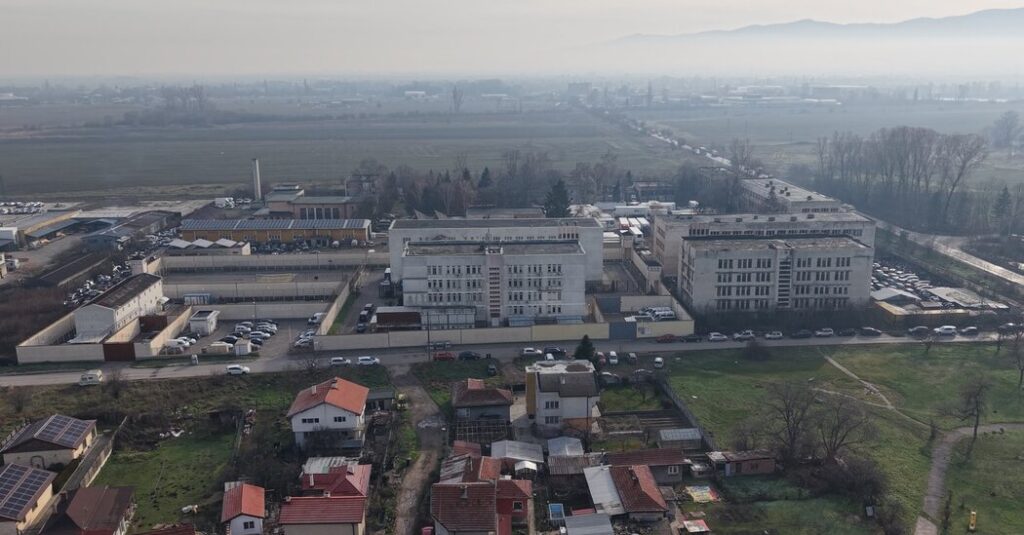
The smell of Busmantsi’s “special home for foreigners” is indescribable, but if you had to use words they would be some combination of stale urine, mildew, dried sweat and rot. Thirty people are packed into each cell, which guards lock at 10 p.m. and don’t open again until 7 a.m. The rooms do not contain toilets, so at night men urinate out the window. There is no running water, so those with flu or food poisoning vomit into plastic bags. Some men hang sheets around their beds in a gesture toward privacy, but in the corner is a camera, with its telltale red eye.
Occasionally, a few of the men housed in this former military barracks seven miles from Bulgaria’s capitol, Sofia, are brought to a small room, where officials from the Bulgarian police and the European Union border police, called Frontex, are waiting. There are no lawyers present. The officials tell them they can leave if they sign an agreement to return to their home countries — Syria, Afghanistan, Iraq and elsewhere. If they don’t, they will be locked up for a year and a half. At first, most refuse to sign, but it is hard to hold onto sanity in a Bulgarian cell when you have not committed a crime, so occasionally men sign, and a week or so later, they are gone. Those inside rarely hear from them again.
Some, though, decide to hold out for the full 18 months, after which most will be released and allowed to remain in Bulgaria; many hope they’ll be able to move on from there. Hesham, a Syrian with honey brown hair and a shy smile who arrived last spring, was among 100 or so men who had chosen to wait. Just a few months earlier, he had been living in a town in southern Germany, learning the language and dreaming of returning to his job as a tailor. But when he arrived for an appointment at the local immigration office in Saxony-Anhalt last February, the police arrested him, detained him for weeks at the Munich airport, then deported him to Sofia.
“I want to file a lawsuit against the prison here,” Hesham wrote me on WhatsApp in early June. “Do you know anything about this?”
I began speaking with Hesham last May. We were connected by Astrid Schreiber, an advocate with the Munich Refugee Council, who met him in Munich’s detention complex. Soon I was texting with or speaking to a dozen detainees from Algeria, Iraq, Morocco, Gaza and Syria, most of whom had been deported from Germany and other E.U. countries.
One man wrote that German police raided his house in the middle of the night. He said that he fled but was chased by dogs and surrendered in a forest. “They grabbed me by the feet while my hands were tied, and they dragged me like an animal,” he said.
Another man wrote: “They are threatening to deport me to Iraq. Here I have scabies and there is no treatment. The situation is very bad, beyond imagination.”
‘I want to file a lawsuit against the prison here. Do you know anything about this?’
No phones with cameras are allowed inside Busmantsi, which meant that most of the detainees did not have phones. Those who did shared them, sometimes charging a small fee for access. The detainees told me that they awoke each morning with rosy bedbug bites across their arms and legs. They tried spraying the dirty mattresses with local chemical products that promised to eradicate insects, but it never worked, or at least not for long. Three times a day, they filed to the cafeteria for colorless meals. Breakfast was white bread. A typical lunch was one chicken wing and some cabbage; dinner was boiled potatoes, bread, an apple. They were offered no education, Bulgarian language classes or any chance to earn money.
Not long after I began texting with Hesham, my messages stopped going through. I also lost touch with two other men, an Algerian and an Iraqi, who had been deported from Germany. One detainee told me they had signed the papers to return to their home countries. Hesham, it turned out, was still inside. The prison guards had confiscated his phone, and I could now reach him only through an intermediary.
Detention centers like the one where Hesham is held form a kind of demarcation line along the bloc’s external borders. There can be as many as 1,060 people locked up in Bulgaria’s two sites: Busmantsi, in Sofia, and Lyubimets, in the south. There are centers on the idyllic Greek islands Samos, Lesbos, Khíos, Leros and Kos, as well as on the tiny Italian island Lampedusa and the volcanic landmass of Sicily. These are difficult to visit and sealed off from the public. Unless you work there or know someone detained there, they are largely invisible. “Most tourists don’t even know there is a detention center,” Robert Nestler, a German asylum lawyer who frequently visits Kos, told me. “It is at the end of the world.”
But if detention sites like Busmantsi sit at the margins of Europe geographically, they are increasingly central to the European Union’s immigration policies. Following the 2015 influx of 1.3 million refugees, mostly Syrians fleeing war, Brussels began to restrict migration, pushing border management and asylum processing to the bloc’s farthest edges. Billions of euros were also funneled to neighboring countries to prevent onward migration to the European Union, resulting in detention sites in Libya that are run by militias and mass deportations from Turkey. Now the most restrictive asylum policies in the bloc’s history are unfolding inside its borders. The Pact on Migration and Asylum, finalized by Brussels in 2024 and coming into full effect later this year, expands detention, including for children, and speeds up deportations.
Western European countries are now capitalizing on an E.U. law that requires refugees to apply for asylum in the first country they enter; those who instead leave for another member country can be sent back to the E.U. nation where they first arrived. This regulation has long been controversial, says Catherine Woollard, the former director of the European Council on Refugees and Exiles, because it places “huge responsibility on the countries at the borders.”
‘Most tourists don’t even know there is a detention center. It is at the end of the world.’
Refugees deported to Bulgaria find themselves trapped in a country that does not want them. Bulgaria has low asylum-recognition rates and has lacked an official integration program for the past 13 years. Migrants have died on Bulgarian territory after authorities failed to prioritize their rescues: In December 2024, three Egyptian teenage boys froze to death in the snowy southern woods. Those who enter from Turkey are often assaulted by border guards and violently pushed back, as both Frontex and human rights organizations have documented. Nonetheless, Germany, one of the bloc’s wealthiest states, is on track to deport five times as many people to Bulgaria, its poorest, as it did in 2022.
The conditions in Bulgaria’s detention sites and abuses along the border have been largely ignored by the European Union. Instead, Bulgaria has become a kind of testing ground for the future of European migration — a heavily patrolled border, fast deportations and policies that encourage, or even coerce, refugees to leave.
I first entered Busmantsi in late August, along with an acquaintance who was visiting a Palestinian refugee from Gaza. As we approached in a taxi, two four-story concrete blocks loomed behind a high wall topped with barbed wire. It was easy to see how Busmantsi served as a stand-in for a West Virginia penitentiary in the 2009 Hollywood slasher “Wrong Turn 3: Left for Dead.” Near the gated entrance hung two signs highlighting six million euros in E.U. funding.
We passed through two gates and entered a concrete courtyard. On the left was a smaller building managed by the State Agency for Refugees, which then housed people with pending asylum claims, including families with children. On the right was the Interior Ministry section, which typically holds those whose asylum claims have been denied. This is where Hesham was kept. At least a dozen men clustered around the windows, waving their hands frantically through the bars. “Hello!” they shouted. “How are you?”
The Bulgarian government claims that Busmantsi has the capacity to hold 400 people, but it depends on how you define capacity. In the summer, a Turkish woman fleeing domestic violence was forced to stay in the male section for almost three months, sharing a bedroom and showers with 20 men. Time spent in the outdoor courtyard is restricted to 30 minutes a day, including for children. People with severe mental-health conditions are isolated.
The center does not have translators, and the Bulgarian staff do not speak Arabic, Pashto, Dari or French; it falls on the detainees to translate for one another. When an Afghan man was locked in a room alone, the Arabic speakers on his floor struggled to communicate with him. Still, they pleaded with the guards to unlock his door so he could use the bathroom; some five days later, the guards complied. Another man arrived at Busmantsi with both legs amputated. The other detainees carried him around. (Site-visit reports from the European Committee for the Prevention of Torture and Inhuman or Degrading Treatment or Punishment have extensively documented conditions inside Busmantsi and refer to the center as “prisonlike.”)
“What should I do?” Hisham wrote to me on WhatsApp when we first began chatting. “I can’t go to Syria because my house is completely destroyed.”
Busmantsi has the capacity to hold 400 people, but it depends on how you define capacity.
It was not the first time Hesham had found himself locked up in Busmantsi. Through WhatsApp phone calls, legal documents and interviews with his sister and advocates, I pieced together how he ended up there three times in the space of two years.
Hesham first entered Bulgaria in September 2023, when he was in his early 20s, crossing the southern land border from Turkey. Conditions for Syrian refugees in Turkey worsened after the country agreed to seal its borders following a deal with the European Union that included six billion euros in aid. A decade earlier, at the beginning of the Syrian civil war, his father, a farmer who was not politically active, was arrested at a government checkpoint. He never returned home. A year into his absence, Hesham, then 14, left Damascus for Istanbul, where he lived for eight years. Two of Hesham’s sisters also fled Syria, one settling in Germany and the other in Oman. Hesham’s mother and younger brother remained behind.
When Hesham arrived in Sofia, he went first to Tsar Simeon Street, locally referred to as Arab Street for the many Middle Eastern shops there, to purchase goods for his onward journey. Then the police arrived. They arrested Hesham for illegally entering the country and took him to Busmantsi. After a week, an NGO came with a translator and told him he could either request asylum or remain confined for 18 months. As an asylum seeker, he would be released from detention in a week or so. Hesham immediately applied. He needed to reach his older sister in Germany, whom he had not seen in 11 years.
In preparation for his release, Hesham was asked to roll his fingers across the glassy surface of a portable biometric machine, which uploads fingerprints from every asylum seeker into an E.U. database called Eurodac. This allows a government in one country to check whether someone’s fingerprints were originally taken in another. The E.U.-wide system began in 2003 and has been rapidly expanding, part of a renewed effort to track asylum seekers and other migrants through biometrics.
The authorities dropped Hesham at Vrazhdebna Camp, one of three open facilities in Sofia where asylum seekers receive a bed and meals as their claims are processed. Vrazhdebna means “hostile” in Bulgarian; the area surrounding the camp on the city outskirts bears the same name. Guards with guns patrol the inside. Here, as in facilities in Greece, residents have a curfew and cannot have visitors. “I’d go to Germany if I were you,” an employee told Hesham, who left the next day. Hesham traversed Serbia, the Czech Republic and Austria, entering Germany a few weeks later.
After reaching Saxony-Anhalt, where his sister lives, Hesham went straight to the police and requested asylum. The officers confiscated his phone; he never got it back. Hesham was initially assigned to Halberstadt Camp, north of the Harz Mountain range, near his sister, who barely recognized the adult version of her brother. At dinner, she served plates of kibbe, stuffed zucchinis, rice with dumplings, food from their childhoods, while her 4-year-old daughter giggled and stared.
Hesham threw himself into studying German. A local Amazon warehouse offered to hire him once his papers came through. A possible future took shape, though he dared not hold onto any one vision for too long. The memory of giving his fingerprints to the officials inside Busmantsi played on a loop. To quiet the fear of being sent back, he focused on his family. In a photo from those months of waiting, Hesham grins, holding his niece as she makes a peace sign with tiny fingers.
Hesham had come to Germany at the wrong time. “We are limiting irregular migration to Germany,” the chancellor at the time, Olaf Scholz, told the magazine Der Spiegel a few months before Hesham arrived. “Too many people are coming,” he said, adding, “We have to deport people more often and faster.”
After four months in Germany, Hesham received notice that he would be deported to Sofia. The police arrest refugees in the middle of the night so they cannot flee. Hesham spent several months couch-surfing with friends, hoping he could wait out the order. In January 2025, the police found him and put him on a commercial flight to Sofia. Once aboard, Hesham protested that he didn’t wish to return and the pilot refused to take off. The authorities released him, and Hesham went back into hiding. Two weeks later, when he went to renew his ID card at the local immigration office, the police were waiting. They did not let him pack a bag or pick up his belongings. After Hesham was captured, his sister cried for a week. She told her daughter that Hesham had gone on a long trip.
Deportations are difficult for the German government to execute. They require an agreement with the receiving country, as well as infrastructure — detention facilities, extra police officers, arrangements with commercial airlines or private carriers — that the United States has built up over two decades. Deportations are humiliating and sometimes violent. Some men are subjected to airport strip and body-cavity searches. Deportees are sometimes handcuffed and shackled; some are restrained with belts. Pilots have at times refused to fly, as happened with Hesham, after realizing refugees are onboard against their will, resulting in 342 canceled flights in 2024 alone.
When deporting refugees to other E.U. countries, German courts must consider appeals on several grounds: whether sending someone back would cause serious harm or lead to torture; whether the person has certain family ties in Germany or serious medical conditions. Refugees are often not deported to Greece, because mistreatment there has been well documented. Conditions in Bulgaria are less well known. “Almost all of them are sent back, regardless of what happened to them in Bulgaria,” says Stephan Reichel, who coordinates church asylum in Germany.
In 2024, the German government submitted some 75,000 deportation requests to other E.U. countries, but little more than half were approved; only 5,740 individuals were deported within the bloc. Chancellor Frederich Merz has vowed to close that gap. Germany has poured millions of euros into building detention centers. Four deportation centers opened this year; one near the Polish border can house 250 people.
‘It was one of the worst days of my life.’
The day of Hesham’s deportation in late February, the police came before the sun rose. The officials that day were respectful. He was not handcuffed. He was given food and water. In the end, there were only four other passengers, three Syrians and one Afghan, all men, flying to Sofia on a private plane. The shame colored everything. “It was one of the worst days of my life,” Hesham told me later.
Upon arrival in Sofia, the Bulgarian authorities took Hesham to Busmantsi. It would be harder to leave this time. Bulgaria had long served as a transit country for refugees heading north, but it remained shut out of the full rights afforded E.U. members for failing to control immigration. So it began violently policing its borders. In 2025, after scaling up detention and tightening border security, it was finally admitted to the Schengen Area, which allows freedom of movement among member states. To assist its operations, the European Union has, over the past decade, granted the country hundreds of millions of euros for additional immigration control. Under the pact, Bulgaria has also received 90 million euros; the interior ministry is creating two new detention centers and expanding Busmantsi and Lyubimets.
At Busmantsi, Hesham was informed that his asylum file was closed. Hesham lodged a new claim and after a month was transferred back to Vrazhdebna Camp. During his asylum interview, he suspected that his translator was not interpreting correctly, but he had no way to prove it, just a bad feeling. A rejection came two months later; it stated that Hesham had migrated for economic reasons. It was true that Hesham wanted, desperately, to start working, but his main reason for leaving Syria was fear for his safety. After Hesham’s father was abducted, his family’s house was bombed.
Under Bulgarian law, you can appeal an asylum rejection twice. Hesham needed a lawyer to file an appeal within 14 days. At the time, the Bulgarian Helsinki Committee had been contracted by international organizations and the Bulgarian government to provide legal aid to asylum seekers; a tall, thin man with glasses told Hesham he would process his paperwork. The committee does not give out private contact details for its lawyers, and all Hesham had was a generic email address. He did not even know the lawyer’s name. A few weeks later, some officials came to the camp and asked residents for their IDs. When they saw Hesham’s, they took his residency permit away and told him to report to the camp office. Inside, the officials locked the door. Then the police arrived. They arrested Hesham and drove him back to Busmantsi.
A few days later, Hesham saw his lawyer by chance in a meeting room set aside for legal-aid consultations. “Why didn’t you file my appeal?” Hesham demanded. The man, Hesham told me, said “he forgot.” Hesham was in disbelief: “How can you call yourself a lawyer? How could you forget?” Hesham recalled that the man became agitated and began speaking in Bulgarian. Hesham walked out. (The Bulgarian Helsinki Committee denies any involvement in the case.)
From his cell, Hesham searched for a private lawyer in Sofia. One wanted a minimum of 1,500 euros. He didn’t have the money. Hesham had only one friend in Sofia, a fellow Syrian who brought him some clean T-shirts and socks.
After his deportation, Hesham appealed his case in Germany, but as time went on, it seemed unlikely a court would allow him to return. Schreiber, the advocate with the Munich Refugee Council, told me that the only person she knew who had been allowed back into Germany was an elderly Syrian woman receiving cancer treatment. Although a German court ruled the deportation illegal, she had to pay for her return flight.
One of the hardest things for Hesham about life in Busmantsi was the waiting. He had nothing to fill his days and longed to return to his work as a tailor. As a boy, he spent hours after school in a Damascus factory, slicing shapes with an electric blade. Each fabric had a different feel. Hesham loved black velvet, with its density and plushness, the most. In Istanbul, he had designed suits and dresses, sharing the drawings with his sister. Now the future was a blank, dreamless space.
He found it impossible to escape the almost casual violence that he and the men I spoke with regularly witnessed. One day, a group of guards dragged the Afghan man from solitary confinement and beat him with an iron rod. Another man was punched in the face. Detainees told me that the guards knew where there were missing surveillance cameras — near the laundry room, for instance — and assaulted people there. Last year, a Syrian man in his mid-30s named Ahmad was locked inside Busmantsi, even though he had a valid German residence permit, making it legal for him to travel. Ahmad, who suffers from psychosis, was put in solitary confinement. His sister told me that the guards beat him so brutally after he resisted his deportation that he could not walk for five days. (The Bulgarian Interior Ministry, which oversees the Migration Directorate that runs Busmantsi and other centers, declined to comment on individual cases, and the Migration Directorate did not respond to a request for comment.)
Medical care inside Busmantsi is either inadequate or absent. In 2021, an 83-year-old Armenian woman was brought to Busmantsi; she died five hours later from heart failure. A review by the European Committee for the Prevention of Torture found a pattern of factually inaccurate medical information. All the recorded vitals of detainees were the same. All the medical intake forms said “no complaints” and “language barriers.”
The longer someone stayed inside Busmantsi, the more reality deteriorated. “People in the cell have told me I cry in my sleep,” Hesham said. Visits are limited to 30 minutes, but many inmates never had a visitor. Some of the people isolated for mental-health conditions had not arrived that way. Suicidal ideation is common in immigration detention facilities around the world, increasing in proportion to the length of time detained, but no one wanted to speak on the record for fear it would harm their chances of release.
‘Returning home might be difficult, but a counselor can help you.’
A week after I first visited Busmantsi, I arrived for my appointment with Hesham. I pushed the doorbell at the designated time, hearing a sharp chime on the other side. Some five minutes later, the door swung open into a courtyard surrounded by tall metal walls. This time I noticed the U.N. Refugee Agency registration sign that hung near the entrance. Under the list of rules was: “You do not have the right to choose the European country where you want to live and receive international protection.”
I was ushered into a ground-floor room that functioned as a visitors’ center. At last, Hesham appeared. Dressed in an oversize purple T-shirt, with a few pimples on his cheeks and wispy facial hair, he could have been a sleep-deprived graduate student. A female guard eyed us from the corner. On the wall were Frontex posters. “Thinking of returning home?” read one, beneath which was a telephone number. “Returning home might be difficult, but a counselor can help you,” another read. From January to September 2025, Frontex sent its “return specialists” to conduct 744 meetings with detainees, a spokesman told me.
Since Hesham and I first made contact, the guards had yanked him out of his cell three times and put him in the room where we were now sitting. Officials pressured him to return to Damascus, once kicking him in the leg, he said. The authorities slid across a document in Bulgarian and told him to sign. He declined. Tacked to a corkboard on the back wall was a Frontex notice on how to file a complaint.
I asked if he had more to say about the detention conditions. “You’ve already seen it yourself,” Hesham said, gesturing to the room. He pressed his thumb to his lip as if quieting himself. “I don’t need to say anything more.” In the corner, the guard titled her head and snapped a selfie.
Under the European Union’s new migration pact, it has become easier for governments to detain asylum seekers, like holding anyone deemed a national security risk or a threat to public order. According to Diana Radoslavova, who founded the Center for Legal Aid — Voice in Bulgaria in 2009, this will only render the situations many refugees already find themselves in more precarious. One of her clients, Adbulrahman al-Khalidi, a Saudi human rights activist, entered Bulgaria seeking asylum. Though his case is still open, he has been held in Busmantsi for more than four years, well beyond the legal limit, because Bulgaria’s national security agency labeled him a threat. The authorities have bounced al-Khalidi between the refugee agency and the Interior Ministry section of the facility, threatening to deport him to Saudi Arabia. A Sofia court has ordered him released three times; each time, the Bulgarian government has refused. The Bulgarian ombudsman stated that it would be best if another European country, like France or Germany, gave al-Khalidi asylum. So far none has offered.
When it comes to people like Hesham, the biggest question is the misuse of detention, Radoslavova said. The use of detention in the absence of active removal proceedings violates E.U. law, and under Bulgarian law, rejected asylum seekers can only be detained for the purpose of deportation for 18 months. But Bulgaria cannot force Syrians to return to their home countries, because it has no agreement with the government of President Ahmed al-Sharaa. “If you know that this person cannot be forcibly returned,” she said, “why do you detain them for 18 months?”
Once people with rejected asylum claims are released from Busmantsi, they have no access to health care, subsidized housing or social services. Over the past year, Radoslavova has been contacted frequently by German advocates, dismayed to find that clients deported to Bulgaria are destitute. Families have difficulty enrolling their children in school or finding a place to live. When I asked the German Interior Ministry if it had considered halting deportations to Bulgaria because of conditions there, a spokeswoman referred me to the Bulgarian government.
Daniel Mitov, Bulgaria’s interior minister, defended the lack of alternatives to detention. He told me that if asylum seekers were free, they would head north, and then other European countries would call and say: “Well, you have allowed these individuals to cross illegally through your territory. Now we’re going to get them back to you, and it’s your problem.” Mitov pointed out that the border between Bulgaria and Turkey was the second-busiest in the world, after the U.S.-Mexico border. The European Union has sent hundreds of Frontex police officers to assist local forces and piloted a new surveillance system with drones. Even the Americans, Mitov said, were helping the Bulgarian border police: The Interior Ministry coordinated its efforts with the U.S. Embassy and Washington. Bulgaria shares the biometrics of people who enter the country illegally with U.S. Immigration and Customs Enforcement (ICE); the biometrics are run through databases at the Department of Homeland Security, Department of Justice and Department of Defense. (The State Department spokesman in Sofia confirmed that the United States shares equipment, training and advice with Bulgaria, calling it a “close and effective relationship” on border operations).
‘Quite often, the people who stay there do not appreciate the environment.’
As for the conditions inside Busmantsi, Mitov blamed the refugees. “Quite often, the people who stay there do not appreciate the environment,” he remarked dryly. “You’re saying that people staying inside damage the facility?” I asked. “Yes,” he said. “The human traffickers are giving them advice to treat the facilities in ways that afterward they can complain.”
Across the European Union, Ukrainians have been received very differently from Syrians, Afghans and others. In 2022, as Ukrainians fled Russian bombs, the Bulgarian government rented empty hotels along the Black Sea to house them. The bloc contributed money for private housing and language classes. Kiril Petkov, then the prime minister, explained the government’s logic: “These people are Europeans,” he told journalists. “These people are intelligent. They are educated people.” He added: “This is not the refugee wave we have been used to, people we were not sure about their identity, people with unclear pasts, who could even have been terrorists.”
As the migration pact comes into full force this summer, countries will have even more flexibility in how they treat those seeking asylum. One provision relies on what is known as the legal fiction of “non-entry”: states can claim someone is not on European territory despite having crossed the border, creating liminal spaces where they can argue that E.U. law does not apply. Those interviewed and rejected for asylum in these borderlands are no longer guaranteed legal representation.
In late October, Busmantsi guards notified Hesham and some 80 other detainees — mostly Syrian and Moroccan men — that they would be moved to the Lyubimets detention center, just 18 miles from the Turkish border. They did not tell them why. Hesham packed his few belongings and traveled three hours south by bus. A few days later, a delegation from the European Commission toured an almost empty Busmantsi to see if it met E.U. standards. Abdulrahman, who later requested to be transferred to Lyubimets, spoke with members of the mission, as Bulgarian officials hovered nearby.
In Lyubimets, a vast facility that includes accommodation in metal shipping containers, the food was still inedible, but the room that Hesham shared with 20 men was cleaner. Hesham and the others were more isolated, though, because it was harder to receive visitors from Sofia. After two weeks, officials called Hesham into a room and told him they were offering 150 euros for him to return to Syria, promising another 700 euros upon arrival.
Hesham refused. Every week, when his mother called, she begged him to come home, but he didn’t think Syria was a country he could live in yet. After the fall of the Assad regime, some prisoners were released, but there was no information about Hesham’s father, one of many men who were still missing.
On Jan. 1, Hesham turned 27. As one day of confinement followed another, Hesham thought back to advice his father had given him, encouraging him to study. He was a feisty kid, not as interested in school as his sisters, who pursued degrees in law and chemistry. Hesham was sorry that he hadn’t yet lived up to his father’s vision. Maybe there was still time. If he could make it 11 more months, he would be free by his next birthday — but what that freedom would look like remained uncertain.
The post Inside a Detention Site at the Heart of Europe’s Harsh New Approach to Immigration appeared first on New York Times.