President Trump has extravagant plans for the Gaza Strip. The only problem is that they bear no connection to the grim realities on the ground—nor is there much prospect that the two will align in the foreseeable future.
Trump has declared that the cease-fire in Gaza—such as it is, given that Hamas continues to attack Israeli forces, and Israeli strikes continue to kill Palestinians—has now entered Phase 2. But the only sign of progress has been Israel’s agreement to reopen the small crossing between Gaza and Egypt for individual Palestinians seeking medical care or other necessities. And that development came mainly in response to the recovery of the body of the final Israeli hostage held in Gaza, rather than from any plan of Trump’s.
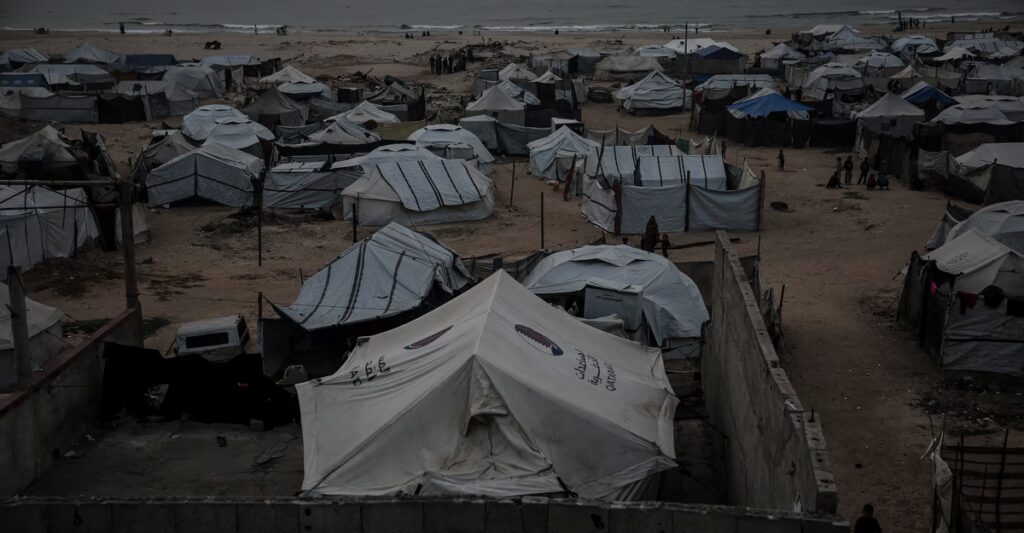
Washington has, in fact, unveiled an elaborate “master plan” for the reconstruction of Gaza. It is profoundly unserious. It promises industrial parks, educational centers, residential zones, and beach resorts, likely inspired by cities such as Dubai and Singapore. But those cities evolved through decades of careful urban planning. Gaza is, at the moment, a rubbled wasteland. Approximately 80 percent of all structures have been badly damaged or destroyed, and Gazans have nowhere to live except in squalid tents or the ruins of former homes.
[Read: The Trump administration has a new plan for Gaza]
Any serious reconstruction plan would have to begin by providing for the urgent needs of more than 2 million Palestinians, which include housing, food, and potable water, as well as basic health and education services. Instead, the Trump plan imagines “coastal tourism” towers; “industrial complex data centers” and “advanced manufacturing,” an airport, a port, trains, parks, and “agriculture and sports facilities.”
The fantasy is beguiling, and its realization would be a magnificent accomplishment—if it weren’t so unimaginably absurd. Trump’s master plan treats Gaza as if it were a greenfield site rather than a partitioned pile of wreckage populated by destitute, hungry, unsheltered people. The plan also totally disregards the historical and religious sites in the Strip. If it all sounds like a real-estate developer’s fantasy run amok, that’s because it is. Trump’s son-in-law Jared Kushner, who has assumed a major role in the project, has breezily conceded that the plan presumes conditions contrary to fact—a demilitarized Hamas and an end to the Strip’s parition—but that “we do not have a Plan B.” In other words, reconstruction in Gaza will remain a cruel diplomatic pantomime, while millions of people huddle in tents waiting for the next humanitarian aid box.
In addition to being physically destroyed, Gaza is now partitioned between two hostile, armed entities. The Israeli military officially controls 53 percent of the Strip, and unofficially a bit more, and a resurgent Hamas runs the rest. The eastern, Israeli-controlled side of the dividing “yellow line” is now virtually unpopulated and contains most of Gaza’s arable land. The western, Hamas-controlled area consists mainly of demolished cities and towns and sandy beaches—as well as almost the entire Palestinian population.
[Read: Nobody wants Gaz-a-Lago]
Phase 2 of the Gaza cease-fire agreement was supposed to involve the introduction of an international stabilization force and a technocratic Palestinian governance committee. But no international force has yet been deployed, and the governance committee that has been appointed is largely powerless. Moreover, neither Israel nor Hamas has any interest in allowing such an entity to actually run Gaza.
That’s in part because the committee members are reportedly aligned with Fatah, which is locked in a zero-sum political power struggle with the heavily armed Hamas. At best, Hamas might seek to maintain its armed forces behind this technocratic cover. In such a scenario, Hamas, rather like Hezbollah in Lebanon, would remain the key decision maker in Gaza.
But even that may be optimistic. Israel, too, is leery of strengthening Fatah, which already dominates the Palestinian Authority in the West Bank and the Palestine Liberation Organization internationally. Israeli Prime Minister Benjamin Netanyahu and his allies have long sought to keep Hamas in power in Gaza, though contained and periodically battered, and Fatah in control of only small, self-ruled areas of the West Bank. Netanyahu has openly embraced a divide-and-conquer strategy for blocking any possibility of Palestinian statehood, likely in the ultimate pursuit of annexing the West Bank.
And so both parties in control of Gaza seem to be hunkering down for the current yellow-line cease-fire to become semipermanent. Israel will hold an election sometime between May and October; a new government could change the equation. So could greater seriousness on the parts of Trump, Kushner, and the so-called Board of Peace (which includes such noted peacemakers as Netanyahu and the Belarusian strongman Aleksander Lukashenko, but no Palestinians).
Then again, Trump specializes in announcing supposedly major diplomatic initiatives that grab headlines but signify nothing. Virtually everything he’s touting in Gaza—the international stabilization force, the master plan, the Board of Peace, the technocratic governance committee—amounts to little more than a Kabuki show, utterly divorced from the gruesome realities in the Strip.
The post Trump’s Gaza Plans Are Profoundly Unserious appeared first on The Atlantic.