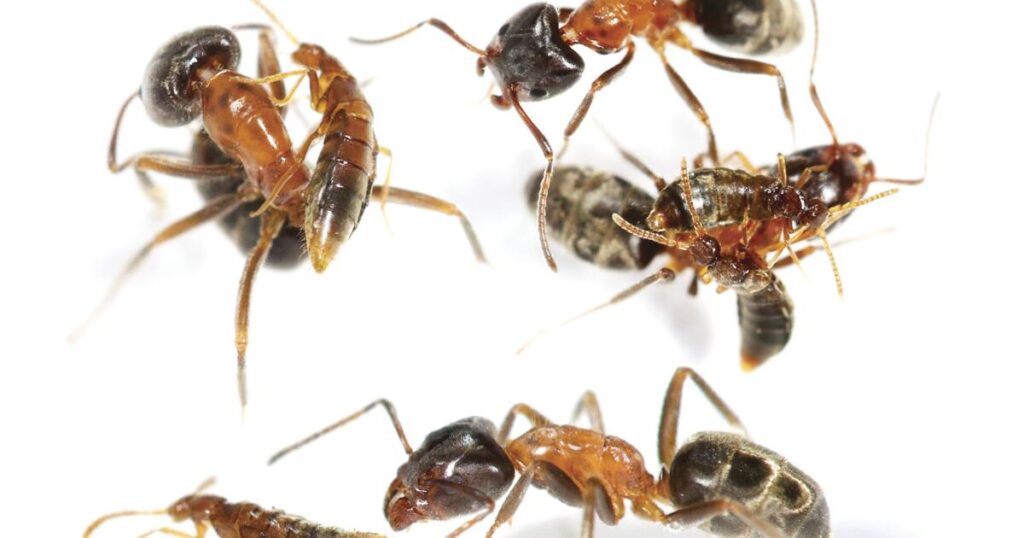
The showrunner of the Angeles National Forest isn’t a 500-pound black bear or a stealthy mountain lion.
It’s a small ant.
The velvety tree ant forms a millions-strong “social insect carpet that spans the mountains,” said Joseph Parker, a biology professor and director of the Center for Evolutionary Science at Caltech. Its massive colonies influence how fast plants grow and the size of other species’ populations. That much, scientists have known.
Now Parker, whose lab has spent 8 years studying the red-and-black ants, believes they’ve uncovered something that helps answer a key question about evolution.
In a paper published in the journal “Cell,” they break down the remarkable ability of one species of rove beetle to live among the typically combative ants.
The beetle, Sceptobius lativentris, even smaller than the ant, turns off its own pheromones to go stealth. Then the beetle seeks out an ant — climbing on top of it, clasping its antennae in its jaws and scooping up its pheromones with brush-like legs. It smears the ants’ pheromones, or cuticular hydrocarbons, on itself as a sort of mask.
Ants recognize their nest-mates by these chemicals. So when one comes up to a beetle wearing its own chemical suit, so to speak, it accepts it. Ants even feed the beetles mouth-to-mouth, and the beetles munch on their adopted colony’s eggs and larvae.
However, there’s a hitch. The cuticular hydrocarbons have another function: they form a waxy barrier that prevents the beetle from drying out. Once the beetle turns its own pheromones off, it can’t turn them back on. That means if it’s separated from the ants it parasitizes, it’s a goner. It needs them to keep from desiccating.
“So the kind of behavior and cell biology that’s required to integrate the beetle into the nest is the very thing that stops it ever leaving the colony,” Parker said, describing it as a “Catch-22.”
The finding has implications outside the insect kingdom. It provides a basis for “entrenchment,” Parker said. In other words, once an intimate symbiotic relationship forms — in which at least one organism depends on another for survival — it’s locked in. There’s no going back.
Parker, speaking from his office, which is decorated in white decals of rove beetles — which his lab exclusively focuses on — said it pays to explore “obscure branches of the tree of life.”
“Sceptopious has been living in the forest for millions of years, and humans have been inhabiting this part of the world for thousands of years, and it just took a 20-minute car ride into the forest to find this incredible evolutionary story that tells you so much about life on Earth,” he said. “And there must be many, many more stories just in the forest up the road.”
John McCutcheon, a biology professor at Arizona State University, studies the symbiotic relationships between insects and the invisible bacteria that live inside their cells. So to him, the main characters in the recent paper are quite large.
McCutcheon, who was not involved with the new study, called it “cool and interesting.”
“It suggests a model, which I think is certainly happening in other systems,” he said. “But I think the power of it is that it involves the players, or organisms, you can see,” which makes it less abstract and easier to grasp.
Now, he said, people who study even smaller things can test the proposed model.
Noah Whiteman, a professor of molecular and cell biology at UC Berkeley, hailed the paper for demystifying a symbiotic relationship that has captivated scientists. People knew Sceptobius was able to masquerade as an ant, but they didn’t know how it pulled it off.
“They take this system that’s been kind of a natural history curiosity for a long time, and they push it forward to try to understand how it evolved using the most up-to-date molecular tools,” he said, calling the project “beautiful and elegant.”
As for the broader claim — that highly dependent relationships become dead ends, evolutionarily speaking, “I would say that it’s still an open question.”
The post A SoCal beetle that poses as an ant may have answered a key question about evolution appeared first on Los Angeles Times.