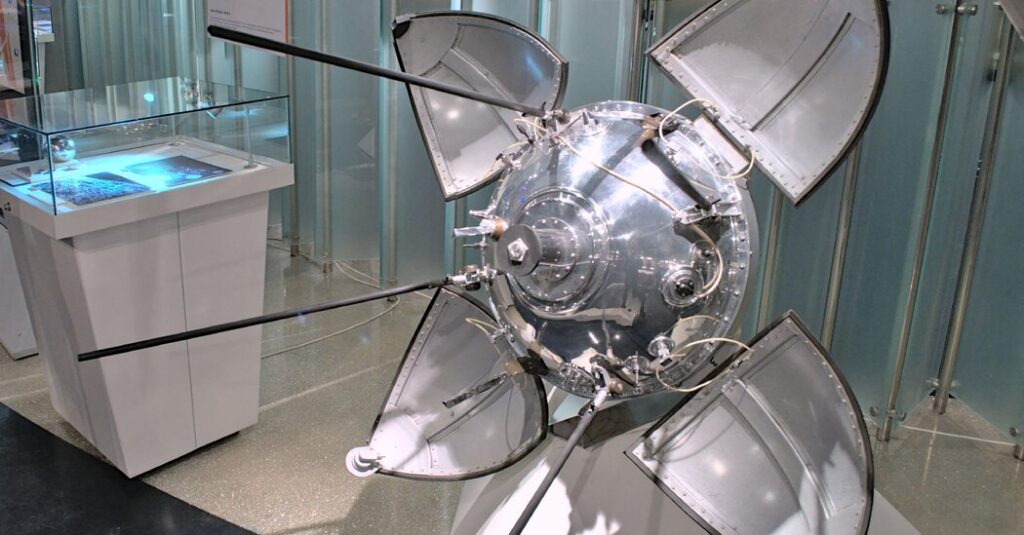
In 1966, a beach-ball-size robot bounced across the moon. Once it rolled to a stop, its four petal-like covers opened, exposing a camera that sent back the first picture taken on the surface of another world.
This was Luna 9, the Soviet lander that was the earliest spacecraft to safely touchdown on the moon. While it paved the way toward interplanetary exploration, Luna 9’s precise whereabouts have remained a mystery ever since.
That may soon change. Two research teams think they might have tracked down the long-lost remains of Luna 9. But there’s a catch: The teams do not agree on the location.
“One of them is wrong,” said Anatoly Zak, a space journalist and author who runs RussianSpaceWeb.com and reported on the story last week.
The dueling finds highlight a strange fact of the early moon race: The precise resting places of a number of spacecraft that crashed or landed on the moon in the run up to NASA’s Apollo missions are lost to obscurity. A newer generation of spacecraft may at last resolve these mysteries.
Luna 9 launched to the moon on Jan. 31, 1966. While a number of spacecraft had crashed into the lunar surface at that stage of the moon race, it was among the earliest to try what rocket engineers call a soft landing. Its core unit, a spherical suite of scientific instruments, was about two feet across. That size makes it difficult to spot from orbit.
“Luna 9 is a very, very small vehicle,” said Mark Robinson, a geologist at the company Intuitive Machines, which has twice landed spacecraft on the moon.
Dr. Robinson is also the principal investigator of the camera on NASA’s Lunar Reconnaissance Orbiter, which has been studying the moon’s surface since 2009. While the camera, known as LROC, can see the moon down to a few square feet, Luna 9’s small size is just beyond its capabilities.
“You can stare at an image, and maybe that’s it, but you can’t really know for sure,” he said.
That hasn’t stopped the research teams from scouring LROC’s pictures.
Vitaly Egorov, a Russian-born science communicator who runs the space blog Zelenyikot, has spent years looking for Luna 9. He recently revived the search with a crowdsourcing effort. Because tracking spacecraft was an imprecise art in 1966, he expanded the target area to a 62-mile-wide region and live-streamed data from LROC so his viewers could search for tiny, out-of-place pixels that might be signs of the lander.
Mr. Egorov also pored over the panoramic images made by Luna 9, studying their horizon features in order to match them with details captured from orbit. He also relied heavily on a website, LROC QuickMap, which converts LROC’s orbital data into a Google Street View-like surface.
“One day, the landscape looked familiar,” Mr. Egorov wrote over text message. “I ‘looked around’ and realized this was the same place Luna 9 had seen.”
Mr. Egorov said he was “fairly confident” that he virtually stumbled into the right area. But he is not sure exactly which pixel at his site might be the glare of the metal lander. “I do not exclude an error of several meters,” he wrote.
Confirming his find will take another spacecraft, Chandrayaan-2, an Indian orbiter traveling above the moon since 2019. It has a camera with slightly higher resolution, and Indian scientists agreed to collect images of Mr. Egorov’s target area in March.
Ahead of Mr. Egorov’s announcement, a team led by Lewis Pinault, a researcher at the University College London/Birkbeck’s Centre for Planetary Sciences, presented a different site for Luna 9 last month in the journal npj Space Exploration.
Dr. Pinault and his colleagues developed a machine-learning algorithm they called You-Only-Look-Once–Extraterrestrial Artefact (YOLO-ETA). It was trained on lunar artifacts that have already been located in NASA data, such as the Apollo landing sites.
The system flagged several candidate sites for Luna 9 within a few miles of the official coordinates. One in particular stood out to the team. The image includes a bright pixel that may be the spherical lander, alongside a pair of darker spots that could be the two halves of the lander’s airbag-like shell. The team also used LROC QuickMap.
“At the least, we have detected an unknown artifact,” Dr. Pinault said. “I’m very optimistic that, maybe, it could be the Luna 9.”
While it would be exciting to have pinpointed the Soviet lander, Dr. Pinault’s broader research project is to detect alien artifacts on the moon and elsewhere in the solar system. He hopes his work will help identify detritus that doesn’t belong in space or on other worlds, a sign of extraterrestrial technologies, he says.
“This is a bit of my obsession,” said Dr. Pinault, who is also an affiliate scientist at the SETI Institute.
Philip Stooke, a professor emeritus and adjunct research professor at the University of Western Ontario, has tracked down many lunar artifacts. Dr. Stooke provided guidance to both teams, but said neither site provided slam dunk evidence of Luna 9.
“The parts of the spacecraft landing system should be visible — it had five components — and typically a landing site also shows a bright patch where the thrusters blow away dust during the landing,” Dr. Stooke said in an email. “I am not convinced that either of these sites really has good candidates for these things, but Egorov’s is better.”
Jeffrey Plescia, a planetary scientist at Johns Hopkins University Applied Physics Laboratory who has searched for Luna 9, also slightly favored Mr. Egorov’s location because of the close match with the horizon features in the probe’s panorama.
“I think he’s got a good case,” Dr. Plescia said. “But I don’t know how you’d prove it without higher-resolution pictures.”
Space archaeologists now await the results from the Indian moon orbiter. If that doesn’t work, they may have to be patient until other lunar orbiters, like the private company Firefly’s Elytra spacecraft, launch in the near future.
In addition to finding Luna 9, future observations may also track down its virtually identical successor, Luna 13, or long-lost components of NASA’s Surveyor and Apollo programs.
“It’s just a matter of placing bigger and better cameras into orbit around the moon,” Mr. Zak, the Russian spaceflight expert, said. “In our lifetimes, we probably will see those sites.”
The experts see value in continuing the search for Luna 9, if only to burnish its legacy.
In 1966, nobody on Earth was sure that it was safe to land on the moon. Some proposed that it was covered in quicksand-like dust that would consume any landers.
Though the Soviets were not ultimately able to put their cosmonauts on the moon, Luna 9 provided the ground-truth that made six successful Apollo moon landings possible.
For Mr. Egorov, who was forced to leave Russia for Montenegro for opposing the invasion of Ukraine, the search for the remains of Luna 9 is a reminder of humanity’s grandest shared aspirations.
“I hope my work encourages at least someone to look up at the stars, the moon and Mars, and admire not only their beauty but also our ability to explore them,” he said.
Becky Ferreira is the author of “First Contact: The Story of Our Obsession With Aliens.”
The post Lost Soviet Moon Lander May Have Been Found appeared first on New York Times.