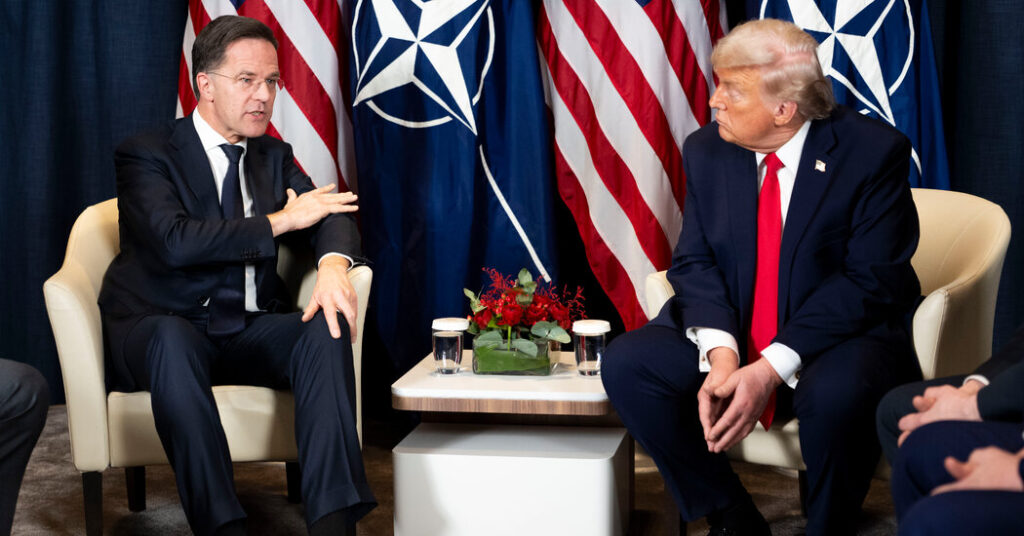
The United States will hand over some NATO commands to European allies, NATO said on Tuesday, in an effort to show that European allies of NATO are taking more responsibility for conventional war planning.
The United States will remain in overall charge of NATO and allied forces through the Supreme Allied Commander Europe, a post that has always been held by an American. The role is currently filled by Gen. Alexus G. Grynkewich of the U.S. Air Force.
The move further underscores the American command role in NATO. The United States will take over maritime forces, NATO said, and is now in charge of the three core capabilities: land, air and maritime.
The United States has said for years that its European allies should take on more responsibilities within NATO, allowing Washington to shift its focus to the Pacific in line with its own security priorities. That push has been amplified under President Trump, though the moves announced on Tuesday are about sharing the burden, not shifting overall responsibility for NATO command.
The American ambassador to NATO, Matthew Whitaker, told reporters in a telephone briefing on Tuesday that the move would strengthen the alliance.
“Anything that allows our allies to step up and do more and take on more leadership in the alliance is a good news story and a common-sense move,” Mr. Whitaker said. Eventually, he said, “we want Europe to take over the conventional defense of the European continent” so that Washington can move forces to the Pacific as needed.
“The United States is not receding or going away,” he said. “But we do need to make sure that the critical capabilities are, you know, enhanced and by our European allies.”
Within NATO, three Joint Force Commands — Naples, Italy; Brunssum, the Netherlands; and Norfolk, Va. — are in charge of planning operations. Britain will now run the Norfolk-based command, and Italy will run Naples. Germany and Poland will now share control of Brunssum, the command that would be most responsible for any land war in Eastern Europe. A German commander already runs Brunssum.
These changes will be carried out incrementally in the coming years, in line with the existing scheduled rotation of personnel, NATO said.
The agreement will allow Europeans to take on “greater leadership roles in NATO’s Command Structure, while also making clear the U.S. commitment to NATO command and control, including in maintaining the role of Supreme Allied Commander Europe,” NATO said.
Steven Erlanger is the chief diplomatic correspondent in Europe and is based in Berlin. He has reported from over 120 countries, including Thailand, France, Israel, Germany and the former Soviet Union.
The post U.S. Hands Over Some NATO Commands to European Allies appeared first on New York Times.