For the first time in years, Democrats are sounding the alarm about money problems.
The Republican National Committee began this year with nearly $100 million more than the Democratic National Committee.
The Supreme Court is widely expected to loosen restrictions on party funds in the coming months in a way that could help Republicans take fuller advantage of their fund-raising edge.
President Trump is sitting atop a super PAC with more than $304 million — a huge sum for which there is no Democratic counterweight.
The world’s richest man, Elon Musk, has re-engaged with the Republican Party after his blowup with Mr. Trump last year, donating tens of millions of dollars in the last two months and attending the recent wedding of a top Trump aide at Mar-a-Lago. And Democrats worry that well-funded super PACs tied to the cryptocurrency and artificial intelligence industries, which have cozied up to Mr. Trump, could further fuel a Republican financial edge.
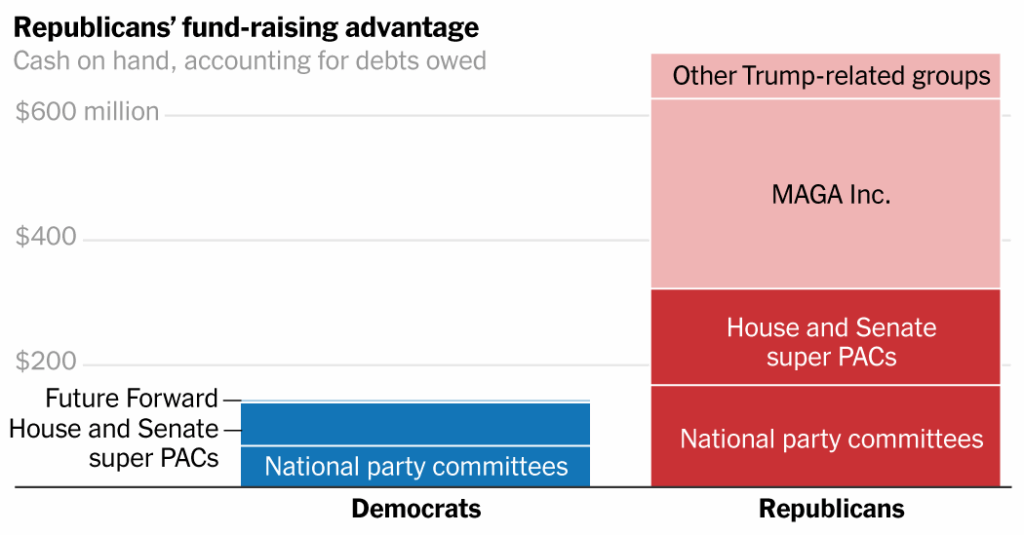
All told, new federal records show that the three leading arms of the national Republican Party and the two super PACs aligned with House and Senate Republicans entered this year with more than double the cash of the equivalent Democratic groups. The Republican groups had a combined $320 million, compared with roughly $137.2 million for the Democrats after accounting for debts.
“Any Democrat who isn’t concerned isn’t serious,” said Bradley Beychok, a co-founder of American Bridge, a Democratic donor network and super PAC. His group held a closed-door conference with more than 100 contributors in Florida late last month, and the financial disparity was a hot topic. “Yes, Democrats have momentum on our side and a wide opportunity map, but we have a glaring disadvantage in overall money.”
While individual Democratic candidates in some top races are far outpacing Republicans in fund-raising, the main party operations tell a different story. Add in Mr. Trump’s super PAC money — plus roughly $70 million he has scattered across other federal accounts — and Republicans began the year with an unheard-of edge of more than $550 million.
Interviews with more than two dozen strategists and officials in both parties reveal that money — which has been a strength for Democrats throughout most of the Trump era — could suddenly be a liability for the party.
That would be a sharp reversal from 2024, when Vice President Kamala Harris’s campaign and the D.N.C. raised $2 billion while Mr. Trump and the R.N.C. brought in $1.2 billion. But some Democratic donors were dispirited after spending so much en route to defeat.
“Donald Trump has 99 problems going into the midterms,” said Jesse Ferguson, a Democratic strategist involved in races up and down the ballot. “But money ain’t one.”
New Republican Advantages
Exactly how much of Mr. Trump’s super PAC war chest he will be willing to spend is the $300 million question looming over the midterm elections.
About 10 of Mr. Trump’s top White House and political advisers — including Susie Wiles, his chief of staff; Chris LaCivita, his former campaign co-manager; Tony Fabrizio, his top pollster; and James Blair, a deputy chief of staff — gathered last week at The Ben, a luxury hotel in the Palm Beach, Fla., area, to discuss midterm spending plans, according to people with knowledge of the discussions who insisted on anonymity to describe the private deliberations.
The gathering had the feel of a reunion, the people said, as Trump strategists reviewed 2026 races and discussed how the path to victory would run through the same Trump coalition of less engaged voters as in 2024. One person noted that a financial advantage would help them find and mobilize those hard-to-reach voters.
“He’s sitting on a huge war chest to help these people — and he’ll use it,” Ms. Wiles said on a podcast at the end of last year.
Still, the president can be mercurial and possessive when it comes to money. His advisers are strategizing about when to start spending, including funding a possible advertising blitz as early as this spring or summer. Those briefed on the super PAC’s plans said the president had not yet decided on a specific amount to be spent.
The main Democratic super PAC in the 2024 election, Future Forward, went largely dormant in 2025 and entered this year with just $2.3 million.
It is not all doom and gloom for Democrats. Many of the party’s top candidates for Senate — Roy Cooper in North Carolina, Sherrod Brown in Ohio, Senator Jon Ossoff in Georgia and Mary Peltola in Alaska — are running fund-raising laps around Republicans, driven mostly by liberal enthusiasm and small online donations.
But the pending Supreme Court decision is widely expected to water down Democrats’ yearslong advantage in grass-roots donations. That is because under federal law, candidates can buy television ads at the cheapest rates, while super PACs often pay much more — sometimes five to 10 times as much.
The court case could open the floodgates for political parties to leverage big-money donations to pay those cheaper rates for the first time.
Republicans said the Supreme Court decision — depending on its scope — could remake the financial playing field. Some operatives drew parallels between its possible impact and the effect of a seemingly obscure decision by the Federal Election Commission in 2024 that quietly opened the door for super PACs to pay for a candidate’s field operation — a ruling that Republicans exploited far more effectively and quickly than Democrats.
Steven J. Law, who led the top Senate Republican super PAC for a decade through 2024, said that super PACs had been — and still were — crucial to help Republicans overcome Democratic candidates’ superior online fund-raising.
“The next frontier is finding ways to put more money directly in the hands of candidates and campaigns,” he explained, “which is what this decision is all about.”
Senior Trump officials inside the R.N.C. and beyond have been planning for months to take maximum advantage of potential new rules, according to four people involved in the efforts, by limiting expenses and hoarding cash to buy cheaper TV ads later.
“It’s O-type blood — it’s limited supply and everybody can take it,” said one Republican official, who was granted anonymity to candidly describe the party’s preparations.
The D.N.C., in contrast, took out a $15 million loan last year and now has more debts than cash in the bank. Some Democratic donors continue to be skeptical of party leadership, including Ken Martin, the D.N.C. chair, who is hosting a spring retreat for his top fund-raisers next month in Park City.
Other Democratic donors are skittish about making public contributions out of fear of Mr. Trump. The opposite is true for Republicans: Corporate donors see advantage to outwardly supporting the party in power.
Last year, the campaign arm for House Republicans also narrowly out-raised its Democratic counterpart for the first time in a decade.
Speaker Mike Johnson said in a statement that House Republicans had entered the year with “unprecedented resources” and that “we are just getting started.” Mr. Trump is planning to headline a fund-raising dinner next month for House Republicans after one in 2025 raised $35.2 million.
In the Senate, the leading Republican super PAC, the Senate Leadership Fund, entered 2026 with about four times as much cash as its Democratic counterpart, Senate Majority PAC, inclusive of the Democratic group’s $12.4 million in debt. The Republican group has announced a $42 million reservation for television, radio and digital ads in Maine to defend Senator Susan Collins.
Lauren French, a Senate Majority PAC spokeswoman, said that the group traditionally did more fund-raising in an election year itself and that it had a strong start to 2026. She said that on Tuesday, the group would begin to reserve $24 million in television advertising time in Maine.
The Musk Question
In many ways, the 2026 political environment appears similar to the 2018 midterm elections, when Democrats flipped the House. Then, as now, Mr. Trump’s approval rating had dipped and Democrats had recruited strong candidates to take advantage.
The financial landscape, however, is a big difference. In 2018, Democrats benefited from a “green wave” of cash. Now Republicans expect to be competitive in the money wars.
“Money is a luxury we wish we had in 2018,” said Matt Gorman, a Republican strategist who worked on House races that year, “and is a real advantage this time around.”
Mr. Musk is a particular question mark. He spent more than $290 million in the 2024 election, served in the Trump administration and then declared he would “do a lot less” political spending after a public split with Mr. Trump.
But after months of inactivity, Mr. Musk’s advisers have restarted operations at his super PAC. His aides are polling races where the group could get involved and taking meetings with top Republican officials, according to a person close to the group.
Mr. Musk is unpredictable. But in December and January he donated $20 million to help Republicans, and in another sign of thawing relations, he recently attended the Mar-a-Lago nuptials of Dan Scavino, a longtime Trump aide.
Mr. Musk is publicly lobbying Republicans to pass the Safeguard American Voter Eligibility Act, which would require proof of citizenship to register to vote. The person close to Mr. Musk’s group said the billionaire was likely to make spending decisions based in part on how Democratic and Republican lawmakers voted on the measure.
Brian Derrick, who runs Oath, a Democratic fund-raising platform, argued that spending by big Republican donors was “not insurmountable” and could even backfire, as it seemed to in a high-profile Wisconsin election last year.
Mr. Musk’s spending then, Mr. Derrick said, was “more toxic than the Chernobyl gift shop.”
G.O.P.-Friendly Tech Money
The A.I. industry has stockpiled $50 million into three interlinked super PACs, largely from companies and people who have cultivated the Trump administration. The groups plan to intervene in Democratic primaries. But come the fall, they are expected to have a pro-Republican tilt, according to a person close to them, because Republicans are largely seen as having a more pro-A.I. agenda.
The crypto industry is similarly expected to engage in Democratic primaries, as it did in 2024. Republicans are lobbying the industry, now with $193 million in its main super PACs, to again spend tens of millions of dollars against Mr. Brown and other Democrats.
“Thank you to all of y’all for getting rid of Sherrod Brown,” Senator Tim Scott of South Carolina, the chairman of Senate Republicans’ campaign arm, said pointedly at a crypto conference last summer. He added, referring to the Republican who beat Mr. Brown, “Literally, the industry put Bernie Moreno in the Senate.”
Mr. Scott, the chairman of the Senate Banking Committee, which has jurisdiction over some crypto legislation, then offered an unsubtle reminder about 2026.
“He’s running again, by the way,” Mr. Scott said of Mr. Brown.
Shane Goldmacher is a Times national political correspondent.
The post Republican Cash Edge Threatens to Swamp Democrats in the Midterms appeared first on New York Times.