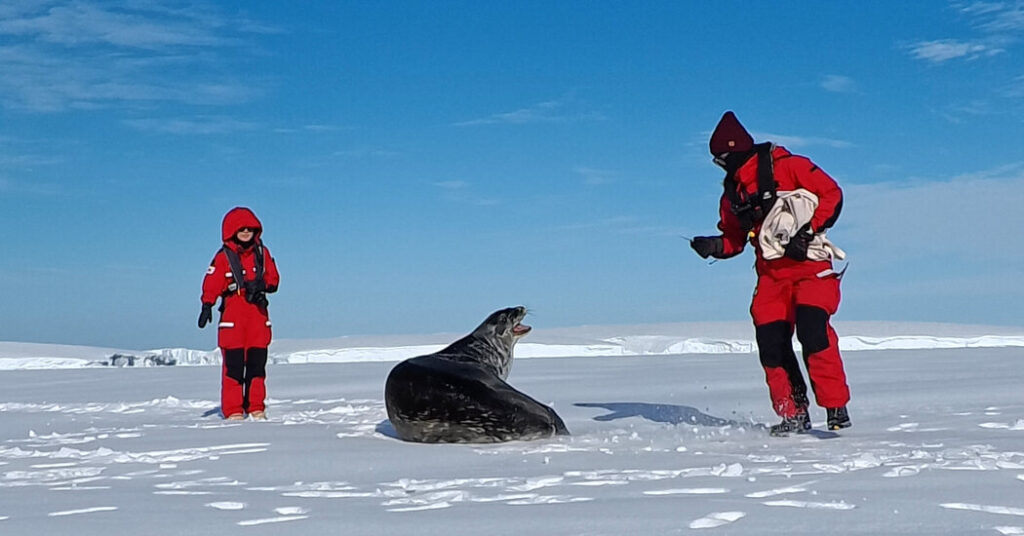
To recruit the Antarctic expedition’s newest deputy scientist, Ji-Yeon Cheon had to approach the candidate carefully, from behind.
Step by gentle step, Ms. Cheon walked sideways across a patch of sea ice, avoiding eye contact. Once she was close, she held a five-foot blowpipe to her lips and shot a dart filled with sedative into the animal’s blubbery, speckled-gray rump.
Ms. Cheon and a fellow behavioral ecologist, Hyunjae Chung, have spent the past few weeks tagging Weddell seals on patches of frozen sea around Antarctica’s Thwaites Glacier. As the seals dive, swim and feed over the coming months, pocket-size devices glued to their heads will log their movements and the properties of the water around them, and transmit the information by satellite when they surface.
Ms. Cheon and Mr. Chung, both doctoral candidates at Seoul National University, are hoping to better understand how the warming ocean is affecting the animals’ diving and foraging behavior. The same warm water that is eroding Thwaites from below also brings up iron and other nutrients from the seafloor, helping nourish fish and other creatures that seals like to eat. Similar changes might also be underway in the ecosystems beneath melting icebergs around the glacier.
“In the Amundsen Sea, especially near the Thwaites Glacier, there is fast environmental change,” Ms. Cheon said. Weddell seals are not considered a threatened species right now, but scientists still have more to learn about how the animals are responding to new conditions today and in the future, she said.
Antarctica’s seals have no natural predators on the ice, so they are not typically inclined to fear incursions by blowpipe-wielding ecologists. Still, tagging is risky work for scientist and seal alike.
First, as Ms. Cheon and Mr. Chung approach by helicopter, their pilot uses the chopper’s noise and movement to nudge the target seal toward the center of an ice floe so it can’t make a quick escape into the sea. Once they’ve landed on the ice, Mr. Chung sways back and forth to distract the animal while Ms. Cheon creeps toward it from the other direction.
In goes a needle six centimeters long, or 2.4 inches, either shot through a blowpipe or, if the seal is calm, injected by hand through a syringe. The seal whips its tail. Its jaws fly open. It does a little roll. Ms. Cheon and Mr. Chung turn and walk away briskly.
From a safe distance, they watch as the sedative does its work over the next 10 minutes or more. Once the animal has stilled, they whisk a cloth bag over its head to block its field of view and help it fall asleep. The bag is tapered for a snug fit but open at both ends so the animal can breathe. Then the scientists super-glue a tag onto the seal’s snoring head.
The tags themselves don’t seem to bother the animals. Each one has roughly the weight and dimensions of a stack of three smartphones, 600 grams or 1.3 pounds, with an antenna poking out. The tags will stay on the seals’ furry heads until they molt again next summer.
But the tagging process tugs on some complicated heartstrings, Ms. Cheon said. Sometimes, when she is injecting a seal with sedative, it looks up at her with big wet puppy eyes, and she wants to apologize, she said.
She and Mr. Chung agreed: This is not the kind of work they can talk about easily with their friends back home.
The data the seals collect isn’t of interest only to ecologists. It is the best source of information about ocean physics around Antarctica in winter, when thick blankets of sea ice render the continent inaccessible by ship.
Weddell seals can dive down to about 1,000 meters, or two-thirds of a mile, allowing them to gather measurements at depths that scientists would have to spend lots of time lowering and raising instruments to take themselves.
Over the past decade, seals have sent back “absolutely mind-boggling” amounts of information about the waters around Thwaites, said Lars Boehme, a specialist in animal-borne technology at the University of St. Andrews in Scotland.
In his lifetime, data from seals has gone from being a “laughingstock” in oceanography to such a common source that scientists don’t even specifically mention in their academic papers when they use it, Dr. Boehme said. “I love that,” he said. “It’s good data, necessary data, that really helps you to understand the ocean and the climate.”
Like other agencies, the Korea Polar Research Institute, which is operating this expedition, has rules for tagging to keep both humans and animals safe. Scientists don’t tag pups, nursing females or any individuals that look, by a rough eyeball estimate, too big for the bag. Once the sedative is injected, researchers must stay and monitor the seal’s recovery for at least 40 minutes. If a seal slides into the water before it’s fully awake, it could drown.
Even with such precautions, tagging doesn’t always go as planned. At times, the seals have been too aggressive or the sedative too weak, forcing Ms. Cheon and Mr. Chung to retreat. On an excursion last month, a seal bit their field guide, Seokju Woo, in the arm. The bag was over the animal’s head, so Mr. Woo walked away with a bruise, some scratches and a torn jacket sleeve.
In response, the Korean institute revised its protocols to say that only experienced scientists can be involved in bagging and tagging, and that they should do so only once the animals are sufficiently tranquilized.
It would also help for the scientists to have protective Kevlar sleeves, Ms. Cheon said. And a rigid handle for the bag so they could slip it over a seal’s head from farther away, like a dogcatcher’s net.
Despite the risk, the stress and the feeling of intruding upon an animal’s domain, the tagging experience is like nothing else, said Yixi Zheng, a postdoctoral researcher in oceanography at the British Antarctic Survey.
So rarely when working outdoors in Antarctica do scientists ever touch anything warm or soft, and seals are both of those things in spades, she said. Being close to them activates a sense of mammalian kinship that is otherwise absent in the icy wastes.
“They have fingers, they have hands,” Dr. Zheng said. “So when you touch them, it’s like, ‘Wow, we are similar.’”
Raymond Zhong reports on climate and environmental issues for The Times.
The post Antarctica’s Best Ocean Explorers Have Whiskers and Love to Lounge appeared first on New York Times.