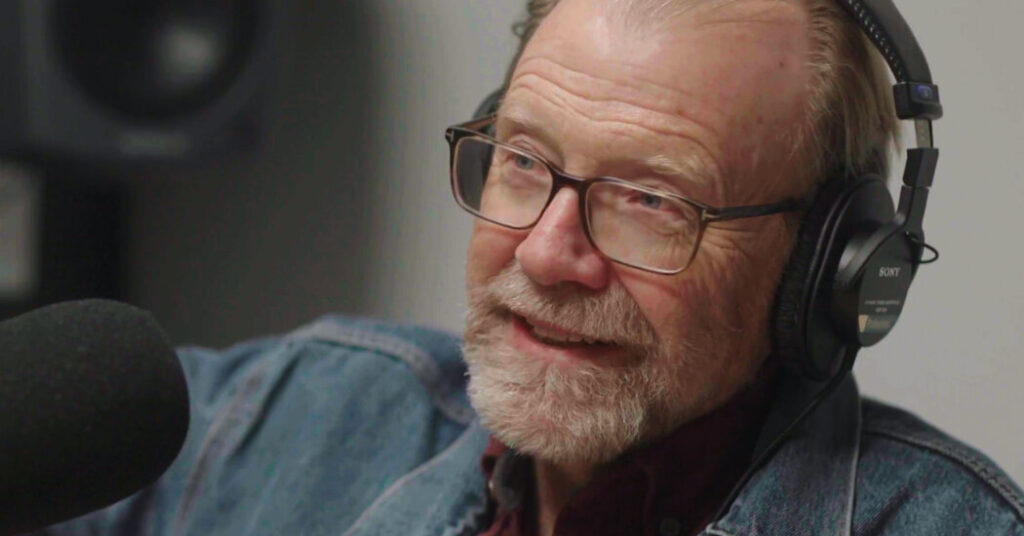
This is an edited transcript of “The Ezra Klein Show.” You can listen to the episode wherever you get your podcasts.
There tend to be two ways one might be familiar with the novelist George Saunders. One is through his amazing short story collections and novels — “Lincoln in the Bardo” is one of my favorite books of all time. The other is through his role as one of America’s leading prophets and proselytizers of kindness, which largely stems from the virality of this beautiful commencement speech he gave some years ago:
Archival clip of George Saunders: What I regret most in my life are failures of kindness. Those moments when another human being was right there, in front of me, suffering, and I responded sensibly, reservedly, mildly. Or, to look at it from the other end of the telescope: Who, in your life, do you remember most fondly?
I’ve talked to Saunders about that speech. He was on the show in 2021 in an episode that many people tell me is their favorite.
Archival clip of Saunders: I think one of the things that the left has to do is recognize that we really are, at a very basic level, defending virtues like kindness and decency and equality. To me, that’s the thing we have to concentrate on, that actually we’re the true defenders of the constitutional ideas, that say we really are hopeful that we’ll have a beautiful country where everybody is equal. That’s actually what we’re working for. And don’t get too distracted by the small storms.
I’ve always thought of Saunders in that mode — as the kindness guy. But reading his new novel, “Vigil,” which is about an oil tycoon on his deathbed being visited by angels and people from his past trying to get him to reassess his own life, I began to realize that Saunders is more interested in something else now — not kindness, but the question of judgment. Not just the question of how we treat others, but how we understand our own lives.
In this book, you can feel Saunders searching for bigger, darker game. This is a book about sin and judgment. It’s about free will, and whether or not we have it.
And in it there’s a very fundamental tension between the side of Saunders that does not want to judge — that wants to explain who we are in terms of the conditions we came from, which is a stance of very deep compassion — and the side of him that thinks judgment is necessary, that sin needs to be recognized and that you cannot have truth if you are not willing to open up to ideas of fundamental wrongdoing.
So I wanted to explore some of these questions with Saunders. I wanted to see for him, in this moment, what lies beyond kindness.
Ezra Klein: George Saunders, welcome back to the show.
George Saunders: It’s so nice to be here. Thanks for having me.
There’s a moment in your new book, “Vigil,” where one of the main characters is on his deathbed, and he offers this prayer: “Thank you, Lord, thank you for making me who I was and not some little squirming powerless nincompoop. Thank you for making me unique, one of a kind, incomparable, victorious.”
Tell me about that prayer.
He’s a guy who has been driven by ambition his whole life, and it has served him pretty well. He’s a really powerful oil executive. He had, as I imagined him, some early insecurity instillers. So his whole life he was working against that to try to assert himself and give himself enough power so that he’d never feel that again. And he did it.
I think he’s just turning to God and saying: I’m correct, aren’t I? Like: I did it right? That’s why you gave me all this power?
And he hears God saying: Yes, you did great.
From my perspective, it’s a moment of extreme delusion, where he’s getting exactly the wrong message from the moment he’s in. But from my own experience of being a person, you develop a certain approach to life to keep anxiety at bay, to solidify your view of yourself, to make it easier to get through life.
Then it’s really hard to peel that away. He has an opportunity to maybe have a different perspective on his life — and he just passes.
Do you think there’s a question inside of that?
A question that feels very culturally relevant to me right now — which is whether the greatness that the world rewards, the power that the world offers, is something to be lauded or is something to be feared and ashamed of?
I think it’s something to look askance at. I think everybody, to a greater or lesser extent, is involved in trying to get over in some way, trying to push back on the natural fear that we have of being out of control.
But I think what should be becoming clear to us is that if you say power is everything — that if I get that power, I’m safe — that’s completely B.S. There’s not a world where one person could have so much power as to be above suffering. There just isn’t.
I think our culture is in a particular moment where we have forgotten that for various reasons. So it’s easy politically and maybe personally to think: If I just get enough of this power, then I’m safe.
But that’s clearly delusional.
And: If I just get enough of this validation.
I was thinking about how you have a safer form of social acclaim. You’re a novelist and a writer and very beloved. People quote your work on kindness. You’ve received a lot of social praise.
I have my own version of this. And it can be pretty easy, if you’re having a moment of self-doubt, to fall back on the things the world has told you about yourself. And I wondered when I read this whether any part of you identified with that prayer or the feelings within it.
Oh, 100 percent. When you write a book like this, everybody is you. You both believe in them, and you think they’re full of it.
That’s the whole game of being a novelist. I remember thinking: OK, George, if you were on your deathbed and some evidence was presented that you’d wasted your life, what would your response be?
And, of course, you want to think it would be: Oh, I am corrected. But, in fact, you double down. You say: But I wrote books! So that’s a big, big danger, I think, for anybody — and certainly for me.
The praise comes in, and you accept it very happily, and it inflates you. The blame comes in, and you don’t accept it quite so easily, and you deflect it.
I find it to be the opposite, actually.
[Klein and Saunders laugh.]
Right. That’s right. That’s a good point.
The praise goes off the back like water off a duck, and then you get one mean comment and you’re thinking about it for two weeks.
For sure. And one of the cool things about getting older, actually, is that you realize that everything in the universe is giving you the memo that you’re temporary and that you’re on the way out. Your hairline, your body, the way you feel.
But then in a moment when you get praised, that information contradicts that somehow, and the ego goes: Oh, we are important. We are permanent. I’m still growing in import.
I was actually thinking about a different moment in your life as I was reading the book, which is about K.J. Boone, an oil company C.E.O. You had worked early in your life as a geophysical prospector.
What is a geophysical prospector?
I was trained at the Colorado School of Mines in Golden, Colorado.
We’d go into an area where there might be oil, and then we’d plant a dynamite charge, 10 or 15 feet underground, blow it off, and then with a sophisticated system of sensors, we would record the sound waves as they came back up. Then that could be used to predict the three-dimensional topography underground, which then in turn could be used to locate wells.
How did you get into that?
I trained for it. I was a geophysics major.
I figured. [Laughs.] They don’t just send you out with dynamite and a map.
At that time in the 1980s, that was kind of what they were teaching at the School of Mines in geophysics — highly mathematical and technical.
One of the things that happened that was kind of life informing was: When I was a trainee, I was in a room, and they were having a meeting in the next room with the higher-ups. And it became clear — I could overhear it — that the grid that we were using to submit our drilling recommendations and the grid that the national oil company of Indonesia was using were different.
So we would say: Drill here. And they would take it onto their map and drill in a completely randomized location.
So as the conversation unfolded, everybody was getting awkwardly quiet in there. And then there was a kind of a group agreement that this was unfortunate, but it could be overlooked, and it wouldn’t go any further up the line.
So for 10 years they had been spending millions of dollars on this information and then randomizing it and drilling anyway. And they just decided to keep it quiet.
So it was Kafkaesque.
That does sound very Kafkaesque.
So what was and what is your relationship to oil, to energy, to this fundamental engine of human existence and progress and destruction?
I use it. At that time, it was very simple — it was just an adventure. People weren’t really talking climate change much.
There was some sense, which I saw firsthand, that we were running roughshod over the environment in that area and also over the culture. We were just sort of imperialists, you know?
But mostly, for me, it was just thrilling. We would go into these rainforests where no one had ever set foot, and we’d have the local guys cut a very narrow path, and we’d go in, and there were tigers. For a 22-year-old, it was a thrill.
I used that in the book just to get a way into his mind, like somebody who feels positively about this endeavor. I could see if I had been a little more talented at it, I might have become an executive, and those early feelings of tribal pride would probably have just grown and grown and grown.
So K.J. Boone is an oil company C.E.O. Did you research him? Is he based on anyone for you? How did you put yourself in the mind of a robber baron of sorts?
I researched a bunch for a month. I just read everything I could find, took notes, and then I just put it away.
The purpose of that is not to ever give someone’s biography or to have a real-life basis, but just so that the invention is within the realm of the plausible. For the voice and the attitude — in fiction, I’m always trying to find a corollary to that person in my mind and then trying to build out that corollary.
With him, taking that early oil experience and also superimposing my writing life, the pride I feel in that and the investment I have in that, and then just sort of growing that out line by line.
The game is to make sure that with each one of those you’ve done them the service of really listening and really trying to inhabit the world through their point of view.
What are the years you’re writing this book?
The last three years.
So the last three years, specifically, have been a fight over what we should think about the “great men of history.” And this goes back before the last few years, but the last decade, let’s call it, which is certainly in your head — what should you think about the founding fathers of this country?
What should you think about somebody with the personality of Donald Trump? Clearly a man who has bent the river of history himself. Elon Musk, Mark Zuckerberg.
I was just at the Frick Collection — and, I mean, what a beautiful gallery. Then you read a little bit about Henry Frick. It’s built on some blood, that incredible museum.
So there’s both the critique of the great men of history and then also in the period in which you’re writing, specifically, the backlash to that critique. The backlash to the idea that we have swept away the need for these conquerors, these human beings who are engines of a certain kind of progress.
You may not like what that progress requires, but that is how we have America. That is how we’ll one day go to Mars. That is how we got to the moon. It’s not all nice.
Five years ago, 10 years ago, it felt like the critique was winning. Now it feels like a very joined battle. And I’m curious how all this was sitting in your mind during it.
Watch me evade this question. Because for me, that kind of question puts my head in a spin. Your question is very good, and it is in my heart, but for me, the way to work it out is on the page.
I think a person can access more truth as he seeks greater specificity. The specificity has to be in a locale. So when I think about the great men of history in general, I don’t come up with much that any drunk uncle at a party couldn’t come up with.
But if I locate it in the person of K.J. Boone, then I can kind of work through it.
Well, let’s talk about the way you work it out on the page, because I think we’re not saying something different. I just see you working out what actually feels to me like a very live social argument on the page.
Much of the book is an argument between Boone and his critics in the form of angels and visitations at the time of his death. I want to have you read this section from “Vigil” on Page 18.
[Saunders reads.]
There was a story often told. Perhaps you’ve heard this one. Don’t stop me if you have, though, ha-ha (I dearly love to tell it): Little boy’s grousing: doesn’t like cars. Because of “the pollution.” You know where this one’s going, I bet. The father pulls the car over to the side of the road. “Then I suppose you’ll want to walk.”
End of objections from el kiddo.
Your choice, Jacques.
Dying in the back of a horse cart stuck in the mud? Or zinging toward help, air con blasting?
Anyone with a lick of sense would choose the latter.
We had.
The world had.
That was what was so damn stupid about it. People forgot the empty larder. Forgot drought, forgot famine. Forgot what it was like to be at the mercy of the world.
“Forgot what it was like to be at the mercy of the world.” This is part of his self-conception. He is one of those people who have removed, to some degree, humanity from the mercy of the world.
Tell me about the feelings, the argument, the life experience you’re channeling there.
There was a time when I was in my 20s, that my dad had a restaurant, and it burned down. So things were rough. We were living in Texas, and I just got that first sense that in our country, if things got tough below a certain level, nobody was coming except your friends and family.
That landed on me. At that time, I was an upbeat, optimistic, Ayn Rand kind of guy. But still, it landed.
And then many years later, when we had our family, we didn’t have any money saved. We were just going paycheck to paycheck. That feeling came back almost like a flashback, like: Oh, God. For all of the surface glitter of the culture, if you drop below a certain level, you’re an embarrassment. The cavalry isn’t coming.
I’ll add a third thing. When I first got out of college, I went to visit a friend of mine from high school. He was living in his mom’s basement. He had a good job. He was a very attractive, intelligent guy.
The question hovered: Why are you still at your mom’s?
And he said that he had certain experiences when he was young and they were very poor that were quite humiliating for him. He had internalized them, and he said: I’m not moving out of this basement until I’m a millionaire.
It really struck me because he was not somebody who was at all off-center or deficient in any way. He was a high-achieving guy. But that early pain had stung him.
I think that’s what this guy is tapping into. Maybe in a more general sense, I think that’s what capitalism is about, really. It’s beautiful if you’re above the line. And if you’re below the line — what’s that line from Terry Eagleton? “Capitalism plunders the sensuality of the body.”
So I thought: Well, if I want to have a motivation for him that isn’t easily dismissed, that’s a pretty good one. And I could just really feel it.
Let me actually try to argue that even more strongly than you did.
I agree that capitalism can plunder the sensuality of the body. If you’re working in lithium mining in unsafe conditions to feed the world’s desire for various electronics, the sensuality of your body is being pretty plundered.
On the other hand, you know what plunders the sensuality of the body? For most of human history, half of all human beings died before they were 15 years old and a quarter of them before they were 1 year old.
It was interesting to me that in that answer, you went toward the question of money and the social safety net. I even understood in the way you wrote this that you’re talking about something much more fundamental, which is: To what degree do we live insulated from nature by technology versus to what degree are we at the mercy of nature?
To what degree do we control the world — which is what we’re always trying to do as human beings, for better and for worse — versus to what degree does the world control us?
The lines are: “Dying in the back of a horse cart stuck in the mud? Or zinging toward help, air con blasting?”
Your book talks a lot about the deaths from natural disasters that are worsened by climate change, but I think the numbers are something like we have one-fifth as many deaths from natural disasters as we did in 1960. That’s partially because we are so much better at building and getting emergency response to places and telling people where to go.
So there’s this really deep Janus-faced nature to this modernity we’ve built, and yet I think we also look around at it and think something has gone terribly wrong.
Yes. In the local sense, I think about when our kids were little and I was working. It was a great job — tech writer. And this is maybe a factor of contemporary life, but for 10 hours a day, I was doing something that had no relation to anything that I cared about — except providing for.
So within that work space, I would do whatever — I was photocopying, I was mopping up spills, writing technical reports.
So when I think about that plundering of the body, I think of that. Now, again, it’s part of this huge system that you’re alluding to. But I think for the individual, the journey through capitalism — especially in my lifetime — has become one of increasingly handing over everything to sustenance.
As corporations become so powerful, the feeling that one should naturally give up more of one’s private space, more of one’s peace of mind, in order to live within the system — I feel that’s something that has really happened in my lifetime.
I want to have you read one more part — actually, from that same page — that I think also gets at an interesting way in which you make this argument through his voice.
[Saunders reads.]
Whereas nowadays folks padded past climate-controlled cases of out-of-season vegetables and fish from faraway seas and meat from animals who fed in meadows under mountain ranges whose names a person could hardly pronounce, thinking: Yap, yap, yap, big deal, pork from Denmark, salmon from the Bering Strait, loaves of woven bread from Ferrara, all of this is my right.
When what it was, was a goddamn miracle.
How had that bounty made its way here?
Did it walk?
Just magically appear?
Go waltz on someone else’s feet, Henri.
I was so struck by that phrase, “All of this is my right.”
I feel like the thing you do really effectively when you’re inhabiting Boone’s voice is get at the idea: It’s not a right, it’s not a miracle. We want it to be a miracle. What it is is a supply chain. And nobody wants a supply chain.
Right. I was thinking, when our kids were little, we lived in Syracuse, and there was this incredible store called Wegmans. You’d go in there, and it was just like a Bosch painting of bounty.
I mean, I’m big into contradictions. So the idea that all of that doesn’t just magically appear — I agree with him.
The part of me that I summoned there was the part that says: Well, OK, let’s get rid of oil. Let’s see what happens.
The real-life corollaries of these guys, they made a lot of hay out of the idea that if we eliminate oil — which, I don’t think anyone is really calling for that — but if you do that, you end up with punishment of the poor, primarily.
That was one of the big lines in the ’90s. Who suffers the most? The poor. If you disrupt the supply chains, disrupt things as they are, the rich people are going to be OK, but the poor are going to suffer. That was the line, anyway.
I struggle with these questions. My book “Abundance” is all about technological prosperity, but also about, in some ways, the ways it can go wrong. If you have an abundance of the wrong thing — an abundance of fossil fuel, you’ll choke on the air.
One of the things that makes my stomach turn is you’re usually not getting animals feeding in meadows under mountain ranges. You’re getting animals in a hellish industrial factory that you cannot even imagine, and that we often make it illegal to look into, because if people knew what we were doing to the animals we kill for food, they would stop eating that meat.
But I thought that a thing you were playing with was: It’s not just complicity — I think that’s too small. It’s desire.
We talk about the great men of history. But at least under capitalism, you have the great wants of society. There needs to be a match between what is provided and what is desired.
As somebody who thinks about some of those questions, you’re so often dealing with the power of what we want, even if we don’t really want to know how we get it.
Yes. I think we have different approaches based on our abilities. My ability to think larger and more abstract is not so good. I agree with what you say about wants, and so what I think is within the individual person, as personified in a character or just the individual person.
When I say “I want,” there are a lot of errors in that already. What’s the “I”?
If you look deeply into it from any of the great traditions, the self is a temporary illusion that appears maybe at birth or maybe a little after birth. So from the very beginning, if you define “I” the way we conventionally do — from the minute we open our eyes in the world — there’s a problem. Because my wanting means, at some level, I’m taking from you. Or it could mean we’re cooperating. But mostly it means I’m protecting that perimeter that makes “I,” that makes me.
There’s a great error in that from the very beginning — that, of course, is Darwinian, and we can’t get around it. But when you start from that point of view, all the problems come from that.
Wait, but hold on. I want to know what the error was.
The error is that, in fact, when you go looking for what that “I” consists of, there’s nothing there. It’s an illusion that we create with philosophers and Buddhists who thought you reify Ezra by thinking: I have to put a sweater on. And: I like this one. And: I’m going to do my show. You think that, and it’s totally natural, and you can’t get around it.
But from the minute you have that construction, you are making it a fundamental error because you’re not the center, you’re not permanent. But also the construction of the “I” is a neurological thing that is very fraught with illusion. It tells us that we’re perceiving correctly, but we’re constructing in every instant.
It sounds very woo-woo, but the truth is that’s where a lot of the big problems come from. Because that central delusion gets multiplied.
So when we think about power: What would power look like if we had the correct understanding of our being? Well it would have a lot to do with cooperation because the idea that you and I are separate is actually demonstrably false. If you look on a cellular level, it’s just a bunch of molecules.
So I think the big struggle of the human race is: Can we figure out a way to make an accommodation with the essential truth that, actually, this illusion of self isn’t true? What would that community look like?
So when I’m thinking about characters, I’m thinking about that, really. This person has certain desires. How do those desires square with metaphysical reality? And then how do that character’s actions get him into trouble? Because he is acting on that delusion of a central self.
How do you think about that? I’m not going to let us get too deep into the Buddhism here, because I love talking with you about the Buddhism —
I don’t really know that much about it.
But I’m going to take it in another direction in a second.
Good luck. [Laughs.]
But, as you were saying, when the empty self that is Ezra puts on a sweater —
And he looks good in it, by the way.
It’s OK. I need some new sweaters.
I am cold. You’re not cold. The other people in this room aren’t cold.
My self might be empty, but it is me that wants not to be cold. I am having an experience that the other selves are not. And as interdependent and connected to everything as I may be, I do want things. I want them all the time.
Of course. That’s really what the book is about. There’s a relative truth: We want what we want, and it’s beautiful to want what we want to a certain extent.
But in the absolute sense, it isn’t true.
So the extent that we go through life embracing that illusion wholeheartedly, I think we cause suffering. And, of course, there’s a position where you can go: Yeah, I want to wear my sweater. But also: I recognize that this self is something that my mind is creating.
I think that’s where we get into spiritual ideas.
Well, let’s do that.
OK.
You were talking about the great traditions a moment ago, and in past conversations, you and I have talked a lot about meditation and Buddhism.
But there was a deep Catholicism in this book. You grew up Catholic, but you said that the central problem of the book is what to do with the sinner in the bed. You say in the book that Boone’s sins were “grievous.”
So I want to start with the word “sin.” How do you understand sin, and what is your relationship to the idea of sin?
I think sin is what we were just talking about. This is not the Catholic understanding. But my understanding is sin just means you’re out of step with truth, whatever it might be.
The world has a way of — either internally or from the outside — punishing sin in that way. Again, if I think I’m a really tough guy, and I’m still me, and I go out and challenge somebody, and I get my [expletive] kicked, I’ve committed a sin — the sin of misunderstanding who I am. And then there’s a punishment.
For me, in the book, that sin is just being out of touch with the way things actually are. That’s it.
In Buddhism, it’s karma, but what that really means is cause and effect. Basically, the view is cause and effect is absolutely undeniable. When you do something, there’s a reaction.
Now, the comic tragedy part of it is that we aren’t very good at predicting causes from effects. We think this action will cause this reaction, but we’re often so wrong.
So cause and effect is God, basically. God acts by cause and effect. And in every moment, if we’re out of alignment with cause and effect, we suffer some. It may not be overt, but we suffer. That’s what my idea of sin is now.
I’m thinking about your idea of truth. I’m processing what you just said.
Cause and effect is God. Cause and effect, in this vision of the world, is also a form of truth. There’s a truth to cause and effect, and if you’re out of alignment with it ——
Yes. Truth would be just what is. So whatever you do, whatever your action is, the universe reacts to it however it likes. And to the extent that we can posit what that is, we’re in alignment with truth, and if we’re not, then we’re out of alignment with truth.
It’s interesting because it did feel to me that there was a tension in the book between a much more traditional idea of sin — and choices made and repentance needed, in fact, particularly repentance needed through good works — and then what I would call a more Buddhist concept of everything as cause and effect. Everything is karmic and conditioned and must be looked at nonjudgmentally and compassionately.
The other big idea, alongside sin, that keeps coming up in the book: You use the phrase “an inevitable occurrence” seven times. There’s this one in which the angel, Jill, describes looking at the soul and the life of the man who murdered her.
She says:
[Klein reads.]
He came to seem, if I may say it this way, inevitable.
An inevitable occurrence, upon which, therefore, it would be impossible, even ludicrous, to pass judgment.
Who else could he have been, but who he was?
I feel like there is this tension between: There is sin, and we should pass judgment on it, and people should be judged, and they must repent — and who could we be, but who we are? How can you ask somebody to be anybody but the person they’ve become?
Yes, that’s exactly the tension of the book. Thank you.
Jill had an experience at her own death, and the experience was that she spontaneously inhabited the mind of the person responsible for her death. This was kind of like she’s had on the costume of her Jill self her whole life — and, of course, like we do, she mistook that for the universe. Her qualia were the universe.
Then, in that split second, she took off that costume and put on the costume of this repellent person who, in real life, would have been quite disgusting to her. And from that point of view, she’s like: Oh, OK. I understand him. I am him.
This leads to this idea that, from his point of view and given that time only goes in one direction, how could he be any different than he is? It’s an absurd thing to say. He’s done, you know? So if he could have been more understanding, why wasn’t he?
Again, time is going in one direction. He’s finished. He was what he was. And that complexity is what she feels.
We understand that height, for example, is not negotiable. You didn’t choose to be the height you are. I think we also understand intelligence that way.
But then we get into some murky areas when people say: Well, you could work harder. You could work at it. And there’s freedom of choice, which is true. But even there, there’s a limit to it.
I would say, if you think of it in calculus terms, if I want to improve my physical shape, for example, which would be a good idea ——
You look great. Don’t say that about yourself.
Oh, thank you. It’s layers. But if you want to do that, you have to go to the gym. You’re going to find out that you have certain built-in limitations — your body and your muscle type, all that kind of thing. But also your willpower, your interest.
My thought is that even those things are pregiven to you at birth. Now I think people sometimes struggle with this, and I struggle with it. But the idea is this: Imagine somebody that you cared about. Maybe you had a fraught relationship with that person. Imagine they just died, and they’re lying there in front of you, and you say: Oh, I wish he had been more understanding.
If he should have been more articulate, why wasn’t he? I think if we dig deeply enough into it in this absolute sense, you’ll find that there is a kind of inevitability to that.
That’s Jill’s point of view. What she’s doing is saying: It’s fine. Whatever you did is fine. Just leave the self and all is forgiven.
It’s kind of my point of view, but as I wrote the book, I got more and more skeptical about it as I examined it.
There’s a guy in the book called the Frenchman. His point of view is: [Expletive.] Don’t give me that. When that guy was alive, somebody could have kicked his butt enough to get him to be more of quantity X.
So he’s urging her to get after Boone and do whatever is necessary to get him in relation to truth. The Frenchman is saying he’s still breathing, so you have a chance — if you approach it skillfully — to put him in alignment with truth.
That’s where the salvation would come from. Even though he can’t move, and he’s never going to move again, if his mind could be correctly aligned, you saved him.
Do you believe in free will?
Depends where you put the point of view.
Do you believe in free will? [Laughs.]
At this moment, in terms of: I don’t know what I’m going to do when I leave here — that feels like free will.
I think if you could run the whole clock of reality from the beginning, you’d see that the decision I made was, of course, pre-encoded by everything that came before.
The book was me looking at that question. I don’t know, except: Move the point of view around. That’s the book. Some people I’ve talked to, they’re reading the book, and they think I’m endorsing Jill’s position — which I’m 100 percent not.
I’m going to stand on free will for a moment.
[Both laugh.]
It’s your choice.
If you had asked me seven years ago — my older son is about to turn seven — I would have told you that I believe that the space of decision making that can truly be called free will is not absent, but it is incredibly more narrow than we like to think it is.
Now having had two kids and seeing how much they were themselves from the first moment, I believe it is even more narrow than that.
It’s not that we don’t make choices, but when you were saying that if you want to change your shape, you go to the gym, and you’re limited by things like willpower — willpower does not seem, to me, to be something that we choose to generate.
Right.
Again, I feel like I make a lot of decisions in a day that I could make better or worse, but the me who makes them is much more conditioned.
Yes. And I think when you love somebody like you love your kids, it becomes beautifully true.
It becomes beautiful, yes.
If the person you love has this tendency, the judgment kind of goes away. It’s just something to accommodate and even be fond of.
That’s Jill’s thing. She came to it in a moment of trauma and inspiration. You know how sometimes you have such a peak experience that you attempt to re-create it, or you think: Well, that felt so deep to me, it must be true? That’s how I understand her.
She’s had that experience, and now in her horror to find that, at 22, she’s dead, she’s clinging to that idea. She’s, in a sense, hiding behind it.
That’s what I loved about her — she’s in a real fix. But I see her as primarily fearful to come out of that position.
Jill’s fundamental purpose is comfort. The mission she’s been given, or the salvation she’s been given, is to comfort. What does comfort mean to you?
Truth. If you and I are in a cabin and we can hear there are wolves outside, and I say: It’s cool — they’re probably dogs — that’s not comfort.
But if you look at each other and go: [Expletive], there are wolves — that’s comfort.
But she doesn’t have the capability to communicate that to him.
I’m very skeptical of this. I’m trying to think about this — that comfort is truth.
I don’t want to say I’ve never been comforted by the truth. I think that I have more often been comforted ——
But you seek comfort for it in your work every day. You come into work, and you try to get to the bottom of complicated things, and you’re seeking comfort.
I don’t find it comfortable.
But you’re seeking, in biological terms, homeostasis.
That might be right.
You want to calm yourself, comfort yourself, by getting in closer relation to the truth, so the world doesn’t seem so anarchic.
I’m just thinking about this now. I’m interested in this topic.
I was going to ask you in a moment about the idea of grace and your relationship to grace. But I think about comforting my children. I think about being comforted by my mother. That comfort seems closer to grace to me. And what Jill seems to define ——
Define grace.
I’m not Christian, I’m not Catholic — and grace is one of these ideas that I find very beautiful without feeling like I have a deep understanding of it. So I want to be honest about where I’m coming from here.
But I understand grace as, at its core, that there is a love that God or the universe has for you that has nothing to do with what you’ve done, that does not judge you, that exists despite all the reasons you may not have earned it, and it will always be there for you.
That’s the inverse or the shadow side of this elevation idea. Jill believes in that.
Why don’t you describe the elevation idea then? I’d like to hear your description of it.
“Elevation” is how Jill refers to this luminous event that she had in her death, where she understands people as inevitable occurrences.
But that is another way, I think, of saying grace — that everything is OK, that ultimately you’re not to blame and you’re not to praise. You’re just an embodiment of God’s will. Something like that.
I guess I took elevation, as if it almost had a coldness to it — that “you’re an inevitable occurrence” is very different than “you are loved.”
I’m not sure. Because if you think of — now, this is getting a little deep, but I think if you say —
It’s my hope.
Here’s a question: Have you ever been comforted by a falsehood?
Yes.
Which one?
When I was young, I had a terrible fear of vomiting. And night after night, I would ask my parents to promise me before I went to sleep that I wouldn’t throw up. And in that time I was comforted by that.
And did it work?
I did not throw up in those years.
So they were telling you the truth?
I never even made this connection until this second, but one of my sons asked me to do like a little spell every night to keep away bad dreams.
Hmm.
And it has not always worked. It’s just a little like a rhyme I do. But he’s comforted — he asks me for it every night.
Because you’re working on it together. In a sense, what you’re saying is all will be well. That’s the form of you extending grace to him, which isn’t exactly truthful. The spell isn’t exactly truthful, but the substrate or the foundation of the spell is true.
To bring it back to comfort — which, again, I think is related to grace for me — but here’s how I describe comfort: The fundamental exchange of comfort, when I offer it to my children or when it has been offered to me, is somebody sitting there with you, no matter what is happening, and saying: I am here, and I love you.
Yes.
That’s it. That is what comforts another human being. And I think of Jill doing that in this book. You are dying, and I am here, and on some level, I love you. The love has to be true, or it’s better if it’s true, I think. But it’s not so much about being in a space of truth or a space of falsehood so much as a sense of there is presence here.
There is. But where she gets into trouble, and I discovered this about halfway through, if you are beating the [expletive] out of another human being, and I say to you: Ezra, I’m here, and I love you — that’s [expletive]. That’s false. I think in her situation, she says: I’m here, and I love you, and I don’t care what you did.
Now, from his point of view, I’d say K.J. Boone knows what he did, and he cares. As the book goes on, he’s increasingly tormented by this denial.
So I think certainly saying: I love you, I’m here — is 100 percent beautiful in the right conditions. But her problem is she’s got a bit of denial built into herself, too.
For example, the end condition — let’s say that he was a murdering rapist and she came down to his bed and said: I’m here. That somehow doesn’t seem sufficient — although by her definition, it is. This is where the book really exploded into being interesting to me because I don’t really know the answer to these things.
Is that murdering rapist an inevitable occurrence and so cannot be judged?
Right, right. I think, in her peak elevation, she’d say yes. But readers have talked to me about the middle section in the book, like: God, Jill, you’re pissing me off.
That’s a result of the fact that she isn’t really giving comfort. She’s doing what in Buddhism we call idiot compassion — where somebody drives a spike to your head and you say: Thanks for the coat rack. That thing. She’s not really doing what she claims to be doing.
That’s her sin. Her tragedy is that I think she had a genuine insight. But when you go to apply it, it’s going to take a little less autopilot than she’s on.
This is such a weird thing to say to a person sitting in front of you. You wrote something a while back in a Substack conversation discussing to what degree we should judge people who write books and to what degree their moral failings should change the way we read the book. I wish I had the quote in front of me because I love the quote, but you said something along the lines of: The person who wrote the book doesn’t exist. Whoever that person was in the moment they were writing that book is gone when they look up from channeling that moment of inspiration.
Yes.
Who George Saunders is right now is different than who George Saunders was when he was writing Page 112 of “Vigil.” It’s interesting because I’m hearing you talk about sin and talking about it as being out of alignment with truth and just what is.
The book, as I read it, certainly had a much more traditional view of sin. The question of what is truth and what isn’t — I mean, who among us is capable of understanding what is actually unfolding in time?
But in the book there is Jill, who has this elevation and this belief that everybody is exactly who they are. And then there is this idea of sin that is: You chose, you did horrible things, you denied what you knew, you fooled other people, and you justified it to yourself.
Yes, that’s the hinge.
But it feels like more than being out of alignment with truth. I feel like the world as it is could be all kinds of different ways. But it feels like you believe in morality here.
Yes.
There’s good and bad and evil.
In any specific situation there is. In the specific situation of the book, this guy spent many, many years knowing the truth and denying it. The mechanism by which he did that, or the rationale, is interesting.
But he knew that climate change was a thing, and he consciously or unconsciously denied it. That’s where he was out of sync with truth.
One of the books I had in mind while I was writing this was “The Death of Ivan Ilyich” by Tolstoy. In that book, it’s a much more modest sinner. His sin is just that he lived his life by the credo: I just want to do what everybody else is doing. I want to be normal.
At the end of his life, he got stomach cancer. It was based on a real thing. Tolstoy’s neighbor supposedly screamed for four straight days at the end of his life. Tolstoy heard this story and was like: Wow, what would make you do that?
In the book, the guy has this intense physical pain, of course. But Tolstoy has layered in this idea that Ivan is starting to realize that he wasted his life by this idea of being normal. There’s a beautiful moment, where after many, many days of saying: Why am I suffering so much when I lived the perfect life? when he finally says to God: All right, maybe I didn’t. Maybe I lived out of alignment with truth.
And at that point, he begins this rapid transformation. Salvation in that moment is to align yourself with what is actually true. The truth is you lived your life in the wrong way.
At some point he says: All right, I can’t go back in time, but I can start now, essentially. I can start being in alignment. I didn’t live in the right way.
You can feel the pain start to go out of him. So the idea that there’s physical suffering, and then there’s the suffering of denial on top of it.
We all know that if your leg hurts, but you can’t let it hurt, it kind of hurts more. I think that’s what, in the book, the Frenchman correctly posits, that if they could just get Boone to say: Yes, I lied. I really did. I’m sorry — that would represent a better state of being for him than the one in which he actually dies, in which he continues to deny it.
So that’s the truth.
So before there’s repentance, there has to be acceptance.
I think there has to be. You have to be in relation to what you actually did.
“Sin” is a word I brought from my Catholic childhood, but now I understand it can be so infinitesimal.
You’re feeling X, and you say you’re feeling X prime. Hmm. That’s going to cause you a little pain. That’s the idea. That’s sin.
Now, the characters will use that word — the Frenchman died in 1890 or something. So he’s using it in a traditional sense. But I think it’s compatible with this other sense.
I feel like the Frenchman was too hard on himself in his character. He is somebody who helped invent the engine.
Right.
Now he’s haunting the world, trying to make everybody aware of how much damage the engine has done.
No, you’re exactly right.
I think the engine is pretty great.
Well, so does Jill. But one of the fun things about writing a book for me — and this method I use has a lot of iteration. Early in the book, I thought Jill was right. And then, as I kept revising it, the Frenchmen seemed to be right. And then I started to see: Oh, they’re both kind of out of their minds. They’re dead.
The Frenchman, he’s very much neurotic in that way. They’re these manic spirits who have got some truth in them, but they’re expressing it inefficiently and poor K.J. Boone — these are his two guardian angels, and they’re both kind of mess-ups.
I think that in the final analysis of the book, I went: Oh, this is so sad. He does need some help, but neither of these people is willing to give it to him. The Frenchman comes in so hot and so angry that anybody would resist him. And Jill assuages in such a cozy way that nobody could take correction from her, either. So Boone floats through, and in a sense he’s not saved, actually.
I was thinking about this tension in the book because I think it is one that we exist, in a very intense way, right now — both in our own lives, people around us, but also politically, internationally.
What is the path of truth, of kindness? Is it to be judgmental or is it to be understanding? Is it to look at JD Vance and his cruelties?
I’m not necessarily asking you to comment on JD Vance and think: Well, I’ve read your book, and I see how much trauma you went through as a child, and I understand that on some level that all made you who you are today, and the cruelty you are inflicting on others comes from an insecurity and a fear. Or is it to say,: You’re an adult man imbued with enormous power who claims to be a Catholic. Shape up, be who you claim to be.
That’s the book.
That’s the book. But it’s also the life.
Yes, it is. And I think the answer is: Yes, you do have to do both there. There’s a beautiful Buddhist teacher named Francesca Fremantle, and she has a talk, it’s on “The Tibetan Book of the Dead.” She has the most mind-blowing answer because what she says is: There’s no difference.
If you have compassion for the victims of this cruelty, that’s important, of course. Protect them. But if you run around on the other side of the table, the way she puts it is: When you think about the karmic consequences of the sins they’re committing, the harm that they’re doing, she says: I wouldn’t wish that on my worst enemy.
So if you want to help them, if you have any bandwidth for that, then what you would do is stop them — within your principles, within your nonviolence — you stop them. Then you save the victims, and you save the perpetrators. In a high realm, it’s an identical act.
It’s also true, as you said, that these people aren’t doing these horribly cruel things out of nowhere. But again, we’d want to avoid that idiot compassion somehow in our attempt to understand, because then we enable them. That’s also a dangerous narrative.
Or we excuse them.
Or we excuse them. Yes.
You have a line, and forgive me because I don’t have it in front of me. It’s something like: Specificity and judgment are opposed to each other.
I get this from writing workshops and then from writing. If you move toward specificity, facile judgment goes away. So in a workshop, for example, somebody will say: Oh, I think your story is boring. You can’t work with that. You ask them to be more specific — where is it boring, and what do you mean by boring? And as you go through that process, it becomes diagnostic: Oh, actually, there’s a thought that’s repeated three times in the paragraph on Page 6. Could you choose one of those repetitions?
And a writer can hear that and eliminate one repetition. That’s all good. Whereas “You’re boring” is less appealing.
The example I’ve thought of before is if you had five Republicans and five Democrats on the town board. If you asked them to discuss immigration, you’re going to get a fight because they’re all preprogrammed with their media inputs — just turn on MSNBC and Fox and everybody can go out and have lunch and the TVs can fight.
But if you said: We’ve got $10,000 to fix potholes in our little town, and we’ve got $20,000 worth of potholes, what do we do? Suddenly, the politics is gone. We should probably fix the one in front of the E.R. Then, as you start talking about individual potholes, it’s just science, you know? So I think that’s what I mean by specificity squeezes out facile judgment.
You don’t want to squeeze out judgment, but you want to squeeze out that quality of empty, agitated, abstract opining that seems to be prevalent right now — and which I don’t think really produces much except angst.
It’s one of the reasons I loved the central tension of the book, because I feel this tension every day right now, that there is wisdom and grace and a path at times to a higher version of myself.
In trying to understand — and I took the specificity point differently — the specificity of other people, how they became who they are, how they’re doing things or supporting things that I cannot imagine — forget the people doing them, who I think bear much more culpability — the people who are voting for it.
Yes.
I am angry at some of them, and I love them. Some of them individually and then also as my neighbors and my countrymen. But if you go too far down that path of just trying to explain how everything becomes an inevitable occurrence, I do think your ability to make judgments and to work for a different world can become compromised.
Buddhism, Catholicism, all of them — in addition to having practices of: How do I make it possible to love my enemy? How do I understand that everything has interdependent arising? — also all have very tight moral codes about what is right and what is wrong.
Sure. But I think all those things are compatible.
I come from a scientific background. So to say: Can you understand a geological problem? Of course, there’s no problem. There’s no limit to the lengths you can go to understand that problem. It doesn’t incriminate you. It doesn’t involve you.
Likewise, if the goal was to try to understand your enemies, I think the point of that is kind of strategic. If you’re a football coach, if you could inhabit the mind of the other coach for five minutes, that would be unbelievably great.
I deeply agree with this.
But the problem is, I think, in that process of trying to understand, there’s something — I certainly have it — whereas I try to understand, I think I’m trying to empathize.
That’s where it gets a little mushy, for me, personally, because then you start to feel an overinvestment that then interferes with the judgment that you have to have. Like this guy in the book. He is a pretty good father. Pretty good. Maybe we don’t really know, but at least he would say he is.
Well, his daughter loves him. We can say that.
Yes. Yes, she does. And she’s disappointed in him, and he seems to love her. If I had said: He’s evil. He’s going to be a terrible father — that’s a less convincing portrait of him.
For me, the empathy thing, both in a book and when we’re imagining our political enemies, it has to be scientific, it has to be objective. Then you can get to where you need to be emotionally.
But I think that the feeling — maybe on the left, especially — is: I’m going to understand the Trump supporters, and then I won’t have this anxiety about disliking them.
But you can understand somebody deeply and dislike them or, let’s say, oppose them. At the highest level, you can oppose somebody in this way we’re talking about, which is lacking facile judgment but very firm.
I think one of the strangest political delusions that I see that does not seem to go away is the idea that people who do bad things will present as bad people.
Right. It’s the Cruella de Vil falsity.
Yes, the Cruella de Vil falsity.
One of the things that affected me a lot over the last year was a book by Philippe Sands called “East West Street.” He was on the show. It’s a book about the development of the concept of genocide and war crimes, and it’s a book about the Holocaust.
He’s writing at great length about, among other people, the man Hitler puts in charge of governing Poland. This person has an incredible artistic sensitivity. He truly loves art and music, and he’s a beautiful player of the piano.
You read so much about — I mean, you’ve made arguments like this — the way art is supposed to enlarge your soul. The Nazis really cared about aesthetics. Say what you will about them, they really cared about aesthetics.
Yes. I don’t think I’ve ever made the argument that art enlarges everyone’s soul and will therefore solve everything. Like if somebody went into a gym and said: This doesn’t work — there are still chubby people in here.
It’s just from my own experience.
I’m not accusing you of that claim. What I’m saying more is that I’ve seen so many people go to meet with Donald Trump who say: Oh, he is really charming and personable. And I’m like: Of course he’s charming and personable. What were you expecting?
Right. But this is where the science comes in, because if you go in and you say: He’s charming and personable — you just add it to your data set. Noted. He’s doing these incoherent things. He seems to be largely incoherent in his views and in his plans. He seems to have a terrific mean streak. And when I talked to him, he’s so nice.
OK. So now we have a new portrait of the man. I think that would totally enable one to oppose him better — better than if you had a character of him that didn’t comply with truth. To me, as a scientist, of course you’d want all the information you could have. And if it’s hard to process or it’s complicated, that’s OK. That’s just part of the game, you know?
There’s so much emotion right now, so much agitation and fear that somehow, for some reason, makes people crave autopilot — a set of beliefs that’s very simple and is sturdy in every circumstance — and that’s not really what human beings are good at.
I mean, we like it. We like it, but out of that comes violence and extremity. And I would say that’s what the right is doing right now. They know they’re looting the house, and they know the time is limited, so they’re agitated, and they’re on autopilot, and anybody who opposes them is a leftist lunatic.
You have the evidence of your senses saying: This is a murder in Minneapolis. They fictionalized the fact that he was “brandishing” a gun.
That’s panic. But it’s also autopilot, because a person not on autopilot would watch the [expletive] video and would adjust their viewpoint accordingly. That’s what intelligent people do.
I wonder if it’s autopilot or ——
Well, one of the things it is is autopilot.
Is it an attempt to impose the domination that power can have over other people on reality itself?
Yes.
When I see that, when I am lied to in that way, I understand it as an act of domination. They do not expect me to believe it.
Right. You know what it’s like? It’s like if you went into a really nice restaurant and the waiter brought you three turds on a tray and put it down: Enjoy.
There’s a disbelief that he just did that. If you don’t stand up and say: Get these turds out of here! Bring me my lasagna! — then he has won. And if he keeps bringing the turds and you don’t call him on it, then your belief in truth erodes, and you start to shrink. Pretty soon, all bets are off.
Now what amazes me is that they want that, and they know how to do it. If I was going to write a book about this time, that’s the part I would really want to understand — because as you said, I don’t think anyone gets up in the morning and goes: Ha-ha-ha, time to be evil.
There are probably some sociopaths and so on, but mostly I think JD Vance wakes up in the morning, and he feels like a good Catholic. And that’s fascinating to me.
Despite being repeatedly rebuked by popes just a couple of years after you turned Catholic.
Yes. It is interesting.
As a writer, that’s such rich stuff to go toward that which you don’t understand and vow not to falsify it in either direction. Just look at it, look at it, look at it. That’s rich.
For a long time you’ve been known as the kindness guy. You gave us a famous speech.
[Growls. Laughs.]
See, there it is. And I can see you in interviews recently pushing back on it.
Yes.
I can see the way you’ve become very uncomfortable with it. I was thinking as we were talking that compared to other times when I’ve spoken to you, it feels like the concept of the virtue, the practice you are circling, has changed.
Its truth — you’ve developed a view about truth that is lying at the core of what you’re doing, certainly in this conversation.
I think so. Yes. I mean, the kindness thing — I made that one speech, and I stand behind it, but it was a simple rule.
It’s your fault for making it good, man.
The speech says: I suck at kindness, and it’s too bad. Then, of course, the way that things work is if we had a talk about squirrels, and I said I really love squirrels, that’s going to show up in the next seven interviews: Let’s talk about your relationship to squirrels.
It replicates. I’m certainly for kindness, and I try to be nice, and I try to have good public manners, but in truth, it starts to work into people’s interpretation of your work as if that’s what I’m trying to do is model kindness in my work — which is so far from the truth of what I’m doing.
Your work always had a bite. What’s your relationship to anger?
I have it all the time. I’ve had a rough couple of years. We had a lot of illness in the family, and the dog is sick and all kinds of weird things. And most days, I’m just a little agitated and entitled and pissed off. A lot of days I’m struggling with that.
In the Buddhist tradition, that’s a course. You have negative emotions — who doesn’t? And the whole thing is to try to work with those somehow, maybe, and in some traditions you could take a negative emotion and convert it to a positive emotion.
So this is a thing about this kindness shtick that bugs me. I can be struggling through a day with, say, our sick dog. What I’m doing all day is just trying to do the right thing for her and interrupt narratives of anxiety that I’m having about what I should be doing. How long do I have to do this before I have to rush off? That’s a whole day. And then you get on a call and someone says: Tell me about your approach to kindness.
It seems so hypocritical, and it seems so partial — because of course kindness and empathy and all that stuff — but if you are an adult, that stuff has to take place on a much higher level than just intending to be kind.
I’ve been in my own period of change and growth and rupture, and part of that has been actually developing a closer relationship to anger. There are many ways in which I have found trying to be kind sort of cut me off from my own — anger was so much more frightening an emotion to me, certainly to say nothing of an action, than kindness.
But there were things I wasn’t seeing because I wasn’t allowing that in. And part of what I’ve been going through personally is letting myself feel, if not act on, more of my own negative emotions because there is truth in them, too.
One hundred percent.
So tell me about the relationship for you between anger, between fury, between judgment and truth.
First of all, I had — maybe still have — a misunderstanding of kindness being niceness. Kindness is a deep concept, and it’s not about being nice. It’s about being beneficial in the moment you’re in. Kindness wouldn’t have to be tidy and mincing. It’s something else.
I almost feel like striking that word from my personal vocabulary because it’s confusing. But if you have anger, then I would say the primary thing is — like if you had hunger, what would it be like to go: Oh no, I’m not hungry?
Because that’s not virtuous. You’re hungry. That’s all right.
Then, if you’re angry, I think the idea would be to think about controlling it. I mean that it’s OK to control your anger and then also to think about the source of it and so on. All those things we all do that could be construed as ultimately a form of kindness because you’re dealing with what is truth.
I had a young woman come up at this event and she said: I can’t write because I’m so anxious. She was so sweet and so heartfelt about it, and you could see she was really struggling.
If I weren’t so anxious, I couldn’t write.
That’s what I said. I said: Actually, your anxiety — let’s just not call it that. Let’s turn a little bit and call it beautiful high standards. Can you think of it that way? And she goes: Well, maybe. I said: You’re anxious because you love this form so much, you don’t want to mess it up. That’s good.
So anyway, that whole process of taking anger and going: Yes, of course, I’m pissed off. And in my work, that’s exactly what I’m doing. I think I’m taking darkness and neurosis and O.C.D. and anger and all that stuff, and then putting it on the page and trying to work with it.
I find anxiety a lot easier to feel than anger.
Yes.
And a lot easier to talk about than anger, because anxiety elicits sympathy as opposed to anger.
It’s a little glamorous in a way.
Well, it has also become trendy — I agree with that.
But what you just made me think of with that conversation you had with that woman is, over the years, I’ve looked very deeply into my own anxiety. What I always noticed to be at its very bottom is energy.
Yes.
A large amount of my work is the energy in me that becomes anxiety just harnessed to productivity.
Yes.
I don’t remember who said it, but maybe Tina Fey had said that you could say: I’m nervous. Or you could say: I’m excited. And they’re similar.
The writers I work with at Syracuse, you can’t truncate them. You can’t say: Don’t be what you are. But you can say: Can we together reconceptualize that thing that you’re naming in a negative way?
Just turn it slightly and see if it’s not a virtue — because it has to be. For a person to write a book, that’s powerful. They have to take everything that they have, and even the stuff that they’ve habitually labeled as negative can be turned.
So anger, really, in some situations, anger is just an appropriate reaction to injustice or to misalignment. But for me, writing, that’s what you’re doing in every second. You’re taking a sentence that’s a little messed up and you’re putting it on the table and going: Oh, OK, let’s make that more specific.
Let’s just turn it a little bit, and suddenly it pops into something that’s more truthful.
Something in you is changing or something in the way you’re presenting yourself is changing. I can feel your discomfort. We’ve talked about truth so much here, I don’t have any questions here on truth. It’s not a word that is coming up constantly in the book. You haven’t done a big speech on it.
And it’s lowercase truth. It is just truth.
But what is it? It’s the way things are? The way they’re supposed to be? The Tao? The way?
I don’t know enough about it. It’s the way things are.
But you can be out of alignment with the way things are.
Of course. Yes, that’s sin. As we have said.
You said it’s sin, but then what do you mean by “the way things are”? Because somebody out of alignment with the way things are is part of the way things are.
Yes. Truth just means, from my point of view, what’s happening right now. But also with a dose of skepticism about the way my mind answered that question.
I read a beautiful quote by Chögyam Trungpa. He said: Everything that you feel and enjoy and hate and crave, it’s all memory. A certain loose relation to appearances that says this is all a dream or it’s all a form of memory that’s happening. So let’s not get too attached to the way things appear, and in our actions, let’s factor that in.
Let’s say what’s not truth. What’s not truth is your mind stream in a given situation. You walk into a party, and you feel judged. Are people actually judging you? Maybe. Now you go into the party, and you can sort of see.
Honestly, man, nowadays, if you were me, they kind of are. [Laughs.]
But, I mean, truth is not anything lofty. I think it’s just saying in a given moment: Can I sort through the various scale models that my mind is presenting to a quieter place? And in the quieter place, you’re processing more data. So if you go to that party and your mind is quiet and you see somebody smiling at you, you go: Oh, OK. Noted. Or if you see somebody giving the side eye, you just note it more honestly.
It’s very simple. This is weird, and I can’t really defend this in a piece of writing. Truth is what works. And, of course, it’s all by your standards as the writer, but if a certain part of the prose comes alive, there’s truth in it.
I’m not a Taoist, either, and I don’t know that much about the Tao, but what you were describing to me sounds a little bit more like the idea that there is a flow to the world.
It’s a facet of my life that I’ve been privileged to know some people who I think are fundamentally mystics, and they’re a little more in touch with something. They are a little more in touch with something than I am, and they move with less resistance than I do. They feel currents that I don’t.
Yes.
And to maybe make the argument for K.J. Boone here for a moment, they are not the people trying to master nature to make it possible to fly from Brazil to Japan or wipe out certain forms of childhood illnesses.
There’s something that is a fascinating tension. I do believe there is something that — you keep calling it truth, I think of it as a current in life. And I think people who are at a higher level of spiritual attainment than I am can sometimes sense it.
Yes. I know people like that, too. I’ve heard it described as basic sanity, like are you in relation to what actually is.
And then there is something beautifully human and amazing about the struggle with the world — as is the effort to change it. Not to master it, but to alter it.
The way K.J. Boone is a villain in this book, the villainy to him is that he was an oil executive. He knew that climate change was happening, and he lied, and he sowed doubt about it.
If you took that out, though, if you separately imagine somebody who is the K.J. Boone of clean energy, the K.J. Boone of solar panels, that person might have all of his ambition and his energy and his ferocity and his aggression and his cruelty. They may have paneled over huge amounts of forest.
You can be trying to remake this world and be not obviously villainous about it, but it’s going to have villainy in it. There’s going to be a cost.
I think there’s something interesting in this — being close to truth and then also trying to act upon the world and make it fundamentally different than the way it is.
Yes, I’m not sure I feel that question.
It doesn’t feel true to you.
No, it doesn’t. It has got a concept thing that I don’t — you could put anybody in this book in that bed, but I think the reason it’s him is because he’s almost cartoonishly sinful.
Back in maybe 2022, there was a string of weather disasters, and I was watching it: What would a climate change denier make of this? Could they still say nothing is happening? It’s really just an attempt to put somebody exaggeratedly “evil” into the book and let the world work on him.
But you don’t feel any recognition of this other thing I’m saying, which is that you’re circling this idea of truth and the idea of truth to you is the world as it is ——
A person’s ability in a given moment to be open to what’s actually happening.
And you don’t feel that there is, to some degree, a tension between that and the better side of K.J. Boone, which is a person’s ability to look at the world and say: It should be radically different than it is.
Oh, I think that’s beautiful. There’s no problem. The thing that makes him problematic is that he did that with something under his cloak. He was both in and out of relation with what was real. He knew in some way that he was shilling a falsehood.
So he wasn’t in relation to things as they were, except in this false way. I don’t see it. In other words, from a novelistic standpoint, everything is sacred. Everything is interesting, in other words.
Ideally, you’re just, like in the ’60s parlance, digging it. Like: Oh, wow, look at that. A hustler, a con man, a criminal, a saint. It all occurs, and therefore it’s worthy of your attention.
The best book would be one that I have not written yet, which lets all of that in with very minimal judgment — and even a feeling of, if we define it correctly, celebration — like: Look at this universe. It’s amazing.
Has anyone written that book?
Yes, Shakespeare. Every great book has a little hint of that in there, you know?
It resonates with what we talked about earlier about specificity. In the best of Shakespeare, what you feel is a god’s eye view of someone going: Whoa, this is amazing — without tilting the board based on your own viewpoint. The vastness that you feel in him.
With this book, I worried a lot because of the point of view. We’re mostly in his point of view as mediated by Jill. I didn’t have a chance to tell you my political beliefs, my beliefs about climate change.
I could only signal over the character’s head to you — and I could feel that as an act of tension and a sign of my immaturity as a writer. I want you to know that I know he’s a bad guy. I think a more mature writer would be somewhat more open about that, wouldn’t be quite so fearful that his political agenda and his shtick were being hidden.
How old are you now?
Three hundred. [Both laugh.]
Somebody asked me how old I feel the other day, and the number that came into my mind before I had thought of an answer was 58. I was like: Oh, my God. Wow.
Oh, that’s good.
I’m 41.
That’s very specific. Yeah. I’m 67.
Do you surprise yourself more now than you did when you were 40 or less?
Hmm, probably less, I think — not in a negative sense, but the places where I expect surprise, that has narrowed. So I expect surprise when I’m writing. That comes more, more surprises there.
As a person, I would say less. Things are a little more patterned.
I ask for my own personal reasons.
How do you feel about it?
I find I’m surprising myself, particularly recently, more than I did when I was in my 20s.
In what flavor? Professionally? Personally?
No. I mean, professionally, a lot of things are surprising, but that’s not what I mean here.
I think, in some ways, because I’m more settled in myself, I have noticed myself allowing myself to change more than I did at other times. I think I was more afraid of being out of control, of parts of me cracking or having to open. And now I’ve been through that process of internal rupture a few times.
Yes. And you can survive it.
So I think I’m more open to the idea that in different periods I will have to change.
I think at this point, one of the things that gets a little scary is that the blind spots get bigger. There are things when you’re younger — the world hits you in ways that make you aware of the blind spots. And I think as you get older, and especially as you get — I have a teaching life, and most of the areas in my life allow me to think I’m all right. So then your blind spots sit there very happily, and they just expand. That can be scary.
But for me, writing is one way where a lot of that gets overturned. But then also, I guess, in terms of repetition, the number of things that you’ve done and seen and thought — just the sheer volume over the years — it starts to put you into a better relation with truth.
For example, I remember when I turned 40, I was walking to teach at Syracuse, and I was having a certain thought stream, a certain preteaching nervous mind fart, basically. And I thought: Oh, my God, I’ve been having this since I was 8 years old. That little pep talk you give yourself when you’re feeling nervous.
And at that point, I thought: I wonder if I’ll be doing this when I’m 90? And a little voice said: Yes, of course you will. That stuff happens more and more, and you start to see yourself as a kind of patterned, repetitive being, for better or worse. And that kind of makes for a certain relaxation.
Like: Oh, I’m just trapped. I’m trapped inside this guy. I can work with him a little more. Maybe something like that.
That’s a lovely place to end. Always our final question: What are three books you would recommend to the audience?
I’m sure you’ve read this, but “I Will Bear Witness” by Victor Klemperer.
I just bought this recently, but I have not read it yet.
It’s incredible.
Can you describe what it is?
Somebody described it as the first book that shows the Holocaust in color as opposed to black and white. He’s a professor. I think he’s in Dresden, Germany. There’s this unforgettable scene where he goes into the butcher, whom he’s known for years, and the butcher says: Hi Professor, I’m so sorry, it’s not me, it’s Berlin. And he can’t sell him meat anymore.
Klemperer’s world gets constricted. He loses his office, and he loses his job, then he loses his house. But it happens over about a five-year period. So reading that now, it’s kind of amazing how relatively slowly it’s happening. Then every so often, something seeps in. It’s a really interesting read for right now.
Then the other one I would recommend — I may have recommended it before because I love it so much — but it’s “Red Cavalry” by Isaac Babel, the Jewish Russian writer. I think what speaks to me about that book right now is it’s so chaotic, and it’s written from different points of view, and it doesn’t really underscore who’s speaking to you.
The very, very understated through line of the book is this Jewish kid throws him at the revolution, and they go back and forth over Poland, mistreating Jews and mistreating everybody. His heart slowly starts to turn against the revolution.
It speaks to me of the way I feel about the country right now. As soon as you sit on a truth, it gets knocked out from under you — that kind of kaleidoscopic feeling.
And then the third one would be maybe more of an antidote. It’s a beautiful book called “The Place of Tides” by James Rebanks. Nonfiction.
He goes to an island, I think it’s off Iceland, and he lives with this woman whose job is to collect eiderdown. There’s an elaborate process where you lure the ducks in by being very quiet and setting up little environments that they’ll like. And then they come in, and they leave eiderdown, which is then collected and sold.
But it’s such a quiet, beautiful, meditative book. It’s got true rising action, but it’s so subtle, and it just made me think a lot about how much we miss with the speed of our lives and technology. This book works that way. You start reading it, and it really announces that it’s going to take its time, and then slowly it just builds into this beautiful crescendo at the end.
George Saunders, thank you very much.
Thank you so much for having me.
You can listen to this conversation by following “The Ezra Klein Show” on the NYTimes app, Apple, Spotify, Amazon Music, YouTube, iHeartRadio or wherever you get your podcasts. View a list of book recommendations from our guests here.
This episode of “The Ezra Klein Show” was produced by Annie Galvin. Fact-checking by Michelle Harris. Our senior engineer is Jeff Geld, with additional mixing by Aman Sahota, Efim Shapiro and Isaac Jones. Our executive producer is Claire Gordon. The show’s production team also includes Marie Cascione, Rollin Hu, Kristin Lin, Emma Kehlbeck, Jack McCordick, Marina King and Jan Kobal. Original music by Aman Sahota and Pat McCusker. Audience strategy by Kristina Samulewski and Shannon Busta. The director of New York Times Opinion Audio is Annie-Rose Strasser. Transcript editing by Sarah Murphy and Marlaine Glicksman.
The Times is committed to publishing a diversity of letters to the editor. We’d like to hear what you think about this or any of our articles. Here are some tips. And here’s our email: [email protected].
Follow the New York Times Opinion section on Facebook, Instagram, TikTok, Bluesky, WhatsApp and Threads.
The post George Saunders on Anger, Ambition and Sin appeared first on New York Times.