When President Trump declared a “national emergency” last month, accusing Cuba of harboring Russian spies and “welcoming” enemies like Iran and Hamas, it came with a warning: Countries that sell or provide oil to the Caribbean nation could be subject to high tariffs.
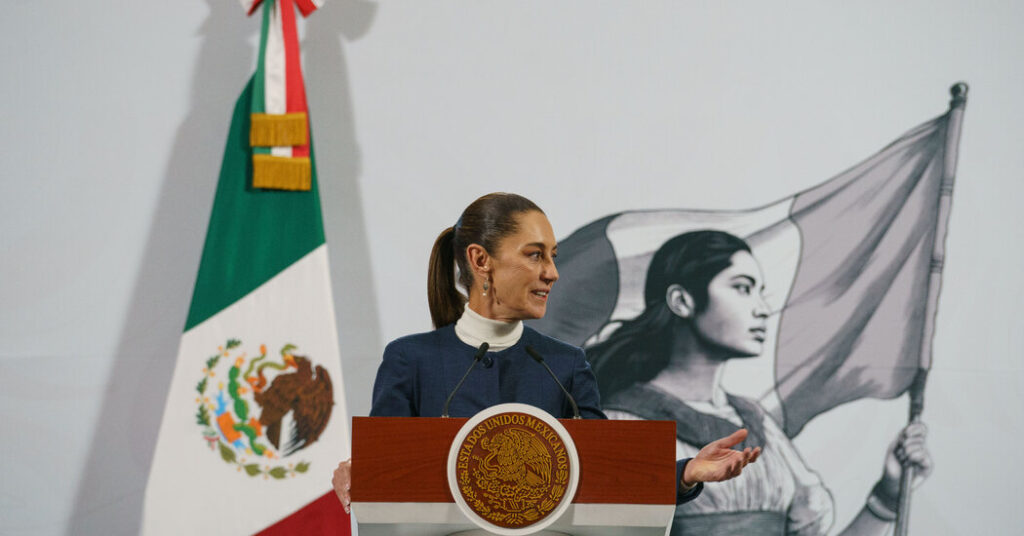
The threat seemed to be directed at Mexico, one of the few countries still delivering oil to Cuba. Earlier this month, he even said that he had specifically asked President Claudia Sheinbaum of Mexico to cut off its supply.
Mexico and Cuba’s long alliance — rooted in economic and cultural cooperation and a shared wariness of U.S. intervention — survived and even deepened after the Cuban Revolution, when Mexico preserved ties with Havana even as much of the region aligned with Washington.
Ms. Sheinbaum now faces a fraught balancing act: upholding her country’s historical alliance with Havana, while managing its vital yet increasingly tense relationship with the United States.
The Sheinbaum administration has been careful not to provoke Mr. Trump, who has strained Mexico’s economy with tariffs and threats of military action to stop fentanyl from crossing the border. He has also threatened to withdraw from the free trade deal with Canada and Mexico, the U.S.’s largest trading partner.
Ms. Sheinbaum has largely held to her country’s commitment to Cuba, a Communist country, where people are struggling with surging food costs, constant blackouts, a lack of critical medicine and dwindling fuel. But Mexico has not sent any oil to Cuba since early last month.
“No one can ignore the situation that the Cuban people are currently experiencing because of the sanctions that the United States is imposing in a very unfair manner,” she said during a news conference on Monday. She added that Mexico had deployed two Navy ships carrying more than 814 tons of humanitarian aid — mostly staple foods and hygiene supplies — to Cuba.
Cuba, whose main oil provider was Venezuela, has faced chronic fuel shortages for years, but the situation has become far more severe since last month, when President Trump took control of Venezuela’s oil supply. He halted deliveries to Cuba, which now only has a fraction of the oil it needs.
Mexico had been sending about 22,000 barrels a day, but that figure dropped to about 7,000 toward the end of 2025 — which was still far less than Venezuela was sending, according to Jorge Piñon, a University of Texas oil expert who tracks the shipments closely. The last delivery from Mexico arrived in early January, he said, days after President Nicolas Maduro of Venezuela was captured by U.S. forces.
To navigate the crisis, Ms. Sheinbaum has tried to distinguish between commercial contracts between Mexico’s state-owned oil company Pemex and the Cuban government, and humanitarian aid, which she insists must continue. She has also called for a diplomatic talks between Mexico and the United States, and has offered her country as a mediator for discussions between Washington and Havana.
President Miguel Díaz-Canel of Cuba said on Thursday that his government was open to negotiations with the United States. Mr. Trump has warned that Cuba should strike a deal, which he has not elaborated on, “before it is too late.”
With the taps effectively running dry, Ms. Sheinbaum seems focused on keeping Mexico’s historical loyalty alive.
Hers is the only Latin American country that has consistently opposed the U.S. economic embargo of Cuba since it began more than 60 years ago, even as the tenor of the relationship between Mexico and Cuba has varied under different presidents.
Fidel Castro and Che Guevara, two key figures of the Cuban Revolution, first met while in exile in Mexico City in 1955, and began planning a guerrilla war that would sweep the island and change the course of Latin American history. They followed in the footsteps of José Martí, a Cuban national hero who lived in Mexico before returning to his land, where he died in 1895 fighting for independence from Spain.
The Cuban Revolution was also an inspiration for anti-government movements in Mexico in the 1960s, said Rafael Rojas, a Cuban historian at the College of Mexico.
He said that Morena, the leftist governing party of Ms. Sheinbaum, has “a nostalgic, very sentimental view of Cuba.” To a significant part of the party’s leadership and base, he added, “Cuba appears as a victim of the empire and must be helped.”
Mexico has long been a refuge and transit point for Cubans, especially since the United States ended its policy in 2017 of allowing Cubans who arrived without visas to stay, and as the island’s economic crisis has deepened in recent years.
After Cuban leftists planned their revolution in Mexico in the 1950s, Manuel Antonio de Varona, founded an anti-Castro movement in Mexico City in 1960. Generations earlier, during the Mexican Revolution, Mexican figures fled to Cuba.
Since the revolutionaries took control of Cuba in 1959, Mexico has proved useful as a negotiator between the United States and Cuba, said Ricardo Pascoe, the former Mexican ambassador to Cuba under the conservative president Vicente Fox in the early 2000s.
During parts of the Cold War, Mr. Pascoe said, Washington kept tabs on Cubans through intelligence shared by Mexico, but Mexico also was Cuba’s gateway to the rest of the world. And though past right-wing Mexican presidents did not share Cuba’s political or economic policies, Mexico maintained friendly diplomatic ties and trade partnerships.
Under the Morena party — founded by Ms. Sheinbaum’s predecessor, Andrés Manuel López Obrador, who built closer ties with Mr. Díaz-Canel of Cuba — Mr. Pascoe said that the Mexican government has become more ideologically aligned with Cuba.
“That has placed Mexico and the president of Mexico in a very complicated position,” he said. “Because Mexico’s economy continues to depend on its relationship with the United States yet it wants to have a privileged political relationship with a recognized adversary of the United States.”
Ricardo Monreal, who leads the Morena legislators in the lower house of congress, said there is a conservative sentiment in Mexico that does not agree with the country’s current relationship with Cuba. But he insisted that Mexico “cannot accept” a policy that affects essentials such as food and energy.
“I feel that this is the worst crisis in Cuba’s modern history because of the pressure of the blockade and the strangulation it is suffering at the hands of the United States,” he said. “We cannot assume a position of contempt or indifference toward what Cuba is suffering.”
Miriam Castillo, Frances Robles and Emiliano Rodríguez Mega contributed reporting.
James Wagner covers news and culture in Latin America for The Times. He is based in Mexico City.
The post Trump’s Threats to Cuba’s Oil Suppliers Put Mexico in a Bind appeared first on New York Times.