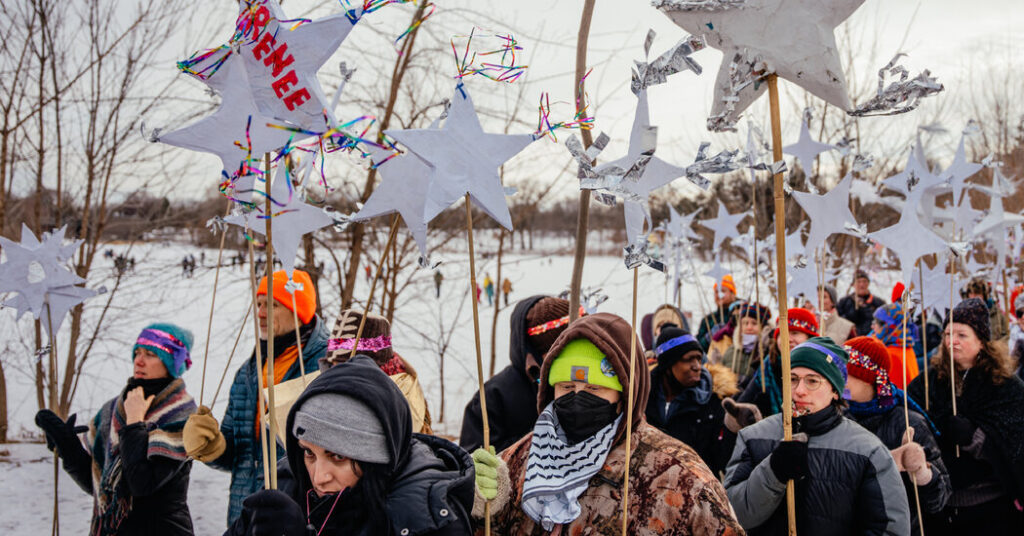
In the month since Renee Good was shot and killed on Portland Avenue, life at the impromptu street-side memorial to her memory has taken on a gentle rhythm. Well-wishers walk quietly around its circumference, reading the signs, looking at the artwork and laying down bouquets. Caretakers come too, chipping away ice with hammers and sweeping up old flowers to make room for the new.
On Saturday, Sandy Zaic, a 59-year-old teacher, came with two friends to pay her respects.
“It’s very overwhelming,” she said, looking at a blue painting of Ms. Good and holding a bouquet of yellow flowers.
In four days of interviews in Minneapolis and St. Paul, people reflected on the two months since the federal immigration operation began. Almost everybody interviewed in the heavily Democratic region opposed the federal presence. Some also worried that protesters would destroy property; many had not attended any of the protests.
But almost all of those interviewed said they had learned a lot about each other in the past two months, as the Twin Cities have been confronted by an immigration sweep that, by the government’s own account, has been the largest in the nation. Along the way, not only was Ms. Good killed, but a nurse, Alex Pretti, was too. Federal agents also arrested a 5-year-old boy, Liam Ramos, whose picture in a bunny hat became a symbol for many of all that had gone wrong.
They learned that they are willing to be outdoors for hours on one of the coldest days of the past 25 years to march in protest. They learned they will deliver food to complete strangers after long days at work, so families who need meals don’t have to risk a trip to the store, where immigration agents may be waiting.
And they learned that these efforts bring a new sense of their own power, that they have come together, made themselves heard and, if they have not prevailed against what they see as unjust federal action in their cities, then at least they have held their ground.
“I’m super proud to be a Minnesotan,” said Ms. Zaic, who lives in the suburbs and delivers food to families in the Columbia Heights neighborhood, where Liam Ramos went to school. “I’m proud to watch all these people stand up for what they know is right.”
Not all Minnesotans disagree with the deportations. Republicans nationally still tell pollsters they support President Trump’s actions on immigration, and Republicans in Minnesota do not appear to be any different. But a small but growing minority of Republicans nationwide say the enforcement tactics have gone too far.
Minnesota has experienced mass protests before, most notably in 2020 when George Floyd was killed by a Minneapolis police officer less than a mile from where Ms. Good was shot. But the two situations are not alike, multiple people said in interviews. The Floyd killing was an argument that the state was having with itself over the nature of policing. It divided people, while the killings of Ms. Good and Mr. Pretti have had a unifying effect.
“This is something different,” said Craig Wilson, 54, a landscape architect who helped organize a candlelight vigil for Ms. Good on Saturday evening, and was standing in the cold with his two dogs, Harper and Huck, both whippets in jackets. “This is the federal government. This is an invasion.”
He added: “We feel like we have a common purpose.”
The federal sweeps began almost two months ago, but since Mr. Pretti’s death on Jan. 24, the dynamic appears to be shifting.
The Department of Homeland Security has pulled 700 of its 3,000 agents from the streets, and Tom Homan, Mr. Trump’s border czar, was sent to Minnesota to strike a more conciliatory tone. In an interview on Friday with KSTP, a television station in the Twin Cities, Mr. Homan said one of the first things he did after arriving was to have more oversight of federal agents and “to hold anybody who acts out of policy, hold them accountable.” He said that several agents are under investigation and no longer part of the operation in Minnesota.
Immigration agents have continued to circle neighborhoods, driving their vehicles in the south and the north ends of the city, and residents who have taken it upon themselves to watch them continued to follow them. Photographers from The Times who spent the past week monitoring the streets said they still saw many ICE vehicles, but fewer arrests and confrontations.
“It feels like an ebb, but at any moment someone else could get killed and it will just pick up again,” said Jeremy Stadelman, 42, a local government worker who was out walking his dog on Thursday. “We are on pins and needles. But we are also very resilient people.”
He said the people opposing ICE may have “won the propaganda battle, but the changes are pretty superficial.”
Many people interviewed said they did not believe the government had changed its tactics. But as the government continued to defend its actions in a federal courtroom in Minneapolis on Friday, it found a Trump-appointed judge pushing back.
A legal group called Democracy Forward was arguing that detainees were not given access to lawyers inside the Whipple Federal Building, where many of those arrested are being taken.
“OK, so I weigh this, against this,” said U.S. District Judge Nancy E. Brasel, picking up a stack of papers filed by the plaintiffs and then the slim government response, and looking at the government lawyer. “And that’s a tough sell, right?”
Judge Brasel said she would rule on Thursday.
Saturday marked one month since Ms. Good was killed. Her partner, Becca Good, spoke for the first time, through a spokeswoman, at a memorial that began with a Native American ceremony in snowy Powderhorn Park. A large crowd stood in the cold for several hours, many wearing an item of sparkly clothing as the invitation had instructed. One man wore a crown of green tinsel. A little girl wore a pink armband with sequins.
Some people interviewed compared the last few weeks in the Twin Cities with the first few weeks after 9/11.
“There’s something really heartwarming about looking a complete stranger in the eye and saying, ‘I’m here for you,’” said Nebiyu Meseret, 28, a business administrator.
Lindsey Gruttadaurio, 62, an insurance claims adjuster, had never been to a protest before. A centrist democrat, she grew up in a military family, and often disagrees with progressives. But watching the ICE raids on the news motivated her, so on Jan. 23, she bundled up and went.
She immediately felt comfortable.
“It’s like a Lutheran potluck — just go and you’ll be fine,” she said.
“It was thrilling. There was a lot of cussing. It was fantastic, actually.”
The thrill, she said, came from being together with all those people and the power in that.
“We’ve found our voice and it’s never going away now.”
Owen Deneen, a nurse who was walking downtown in hospital scrubs at lunchtime on Friday, said it was as if “a natural disaster happened and it’s neighbor helping neighbor.”
He and his wife also went to the Jan. 23 protest, also his first. He said he felt “a mix of anger and resolution” during the demonstration.
When the couple broke away from the crowd to walk back toward their car, he said the temperature felt like it dropped by 15 degrees. They looked at each other and realized that it was because they had left “the closeness” of the crowd.
“It’s much colder when you’re alone,” he said.
David Guttenfelder Jamie Kelter Davis
Sabrina Tavernise is a writer-at-large for The Times, focused on political life in America and how Americans see the changes in Washington.
The post Tempered by Turmoil, Many in Twin Cities Now Feel Empowered appeared first on New York Times.