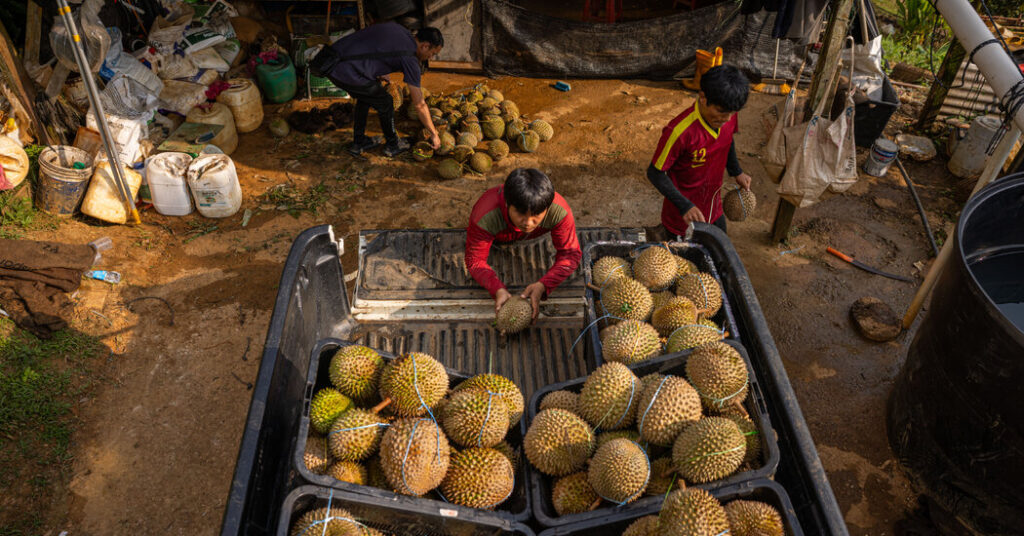
Soaring Chinese demand for durian, a Southeast Asian fruit famous for its intense smell and rich taste, brought Liew Jia Soon home to Malaysia in 2018. He had been living abroad, but his father’s durian farm, in the hills north of Kuala Lumpur, was poised to make more money than ever.
Eight years later, the farm has grown to cover twice as much land as it did a decade ago. But the spectacular earnings that brought Mr. Liew back have evaporated.
“We farmers have seen a 60 percent drop in profits during this season,” he said on a recent Sunday, as he looked over hundreds of unsold durians last month at a collection point near his farm in Raub.
The problem is not that Chinese buyers have lost interest in durian. In fact, the country’s seemingly insatiable appetite for the fruit has continued despite a downturn in the economy late last year. But China’s standards have shifted over the last year or so: No longer do most buyers want the frozen shipments that are Malaysia’s stock-in-trade. They want their fruit fresh.
The change has thrown Malaysia’s durian industry into turmoil.
“We need to get the supply chain to cater for this change in exporting fresh durians,” said Eric Chan, president of the Durian Manufacturer Association, an organization that represents Malaysian durian farmers and distributors. There are a limited number of flights from Malaysia to China that can support the shipment of fresh produce, Mr. Chan said.
“I am worried,” he added.
The market shift has left Malaysia’s durian farmers with a glut of produce. Some in the country are calling the crisis a “durian tsunami.” Prices sank in December to a decade low of 10 ringgit per kilogram, or about $1 a pound and a tenth of what sellers could previously ask.
The crisis has been exacerbated by the unpredictability inherent in durian farming. It can take between five and 10 years for a newly planted durian tree to reach maturity and produce fruit. That leaves farmers with the tricky proposition of predicting future demand up to 10 years in advance.
In 2017, Malaysian exports of frozen durian pulp and paste were winning a greater share of the Chinese market. Growers planted aggressively, betting that demand would rise.
When frozen whole durians were approved for export to China in 2019, it seemed the bet had paid off. Prices soared, and farmers further expanded their crop.
By 2024, durian plantations covered more than 227,000 acres in Malaysia, up from just over 163,000 acres in 2016, and nationwide production had nearly doubled in that time to more than 568,000 tons, according to government data.
That expansion is now feeding into today’s glut.
Lim Chin Khee, an adviser to the Durian Academy, an organization that trains growers in Malaysia, said the recent slowdown in China’s economy had also made buyers more particular and tougher in price negotiations.
And competition from other durian exporters in Southeast Asia, including Thailand, Vietnam, and Indonesia, has dealt another blow to Malaysian farmers.
Ken Tan, whose family owns Durianhill Plantation in the state of Penang, said its exports to China had fallen by 40 percent this season compared with last year’s.
Malaysia’s competitors are likely to experience a similar contraction soon, said Sam Tan, president of the Malaysia Durian Exporters Association, an industry trade group.
“Thailand will also face these low prices soon during their peak season in April,” Mr. Tan said.
But for many Malaysian consumers the crash is a welcome change. Chinese demand, many had complained until recently, had priced them out. Now they are buying durians at pennies on the dollar.
At a night market last month, just outside Kuala Lumpur, the fruit’s pungent smell hung in the air. Dozens of pop-up stalls lined the streets, their tables piled high with durians the size of rugby balls. Customers stood around eating the fruit’s thick, creamy flesh.
The government has also intervened, buying some of the excess fruit in a bid to help keep farmers afloatir. The agriculture ministry has said that it hopes the industry can recover in part by marketing Malaysian durian as a premium product instead of chasing high-volume sales.
The country’s minister of agriculture, Mohamad Sabu, described the glut as “temporary,” adding that the next peak season, in June, would be a clearer test
“I still believe that durians will be the economic boom for Malaysia,” he said in an interview.
Regional producers are skeptical. They are watching closely as China pushes to grow its own durians to achieve what Chinese agriculture experts have called “durian freedom.”
As official figures suggest that production in Malaysia will rise further to 590,000 tons this year, exporters are targeting new markets like Taiwan and Peru.
But they are nowhere near as big as China.
Stephen Chow, who runs a durian plantation called Chow Kai Pheng Enterprise, said supply was likely to outstrip demand over the next three to five years as thousands of durian trees planted years ago begin to bear fruit.
What Malaysia is experiencing now “is just a preview,” he said.
The post Farmers Made a Fortune on This Fruit. Now It Is Piling Up. appeared first on New York Times.