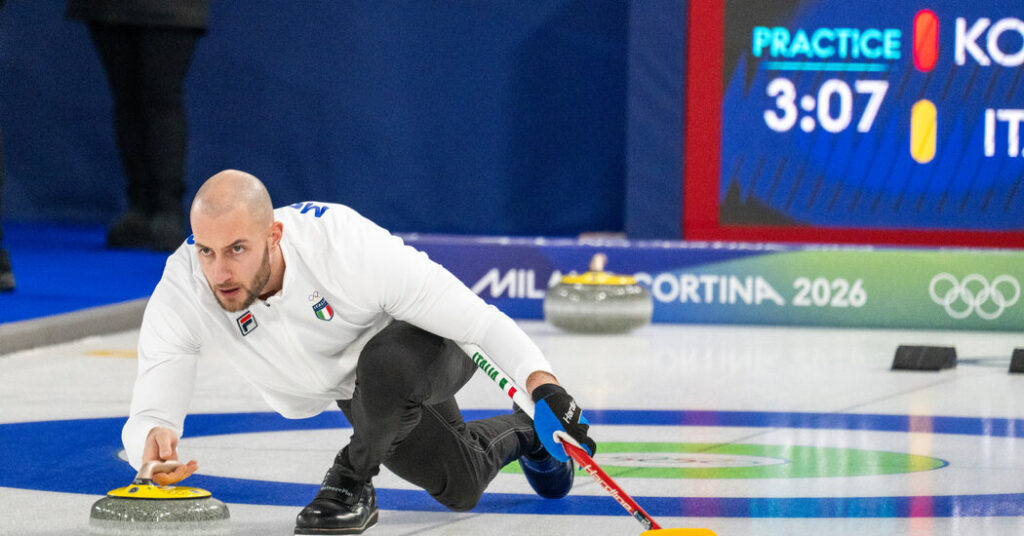
The Italian curler Amos Mosaner returned home from the Beijing Winter Games in 2022 as a gold medal winner and the pride of the Italian Air Force, which had recruited him as a soldier-athlete and subsidized his training for years.
But then the Italian police came sniffing around.
They had a strong pitch. Their training center was closer to where Mr. Mosaner, now 30, lived in the Trentino valley in northern Italy. His mixed-doubles teammate, Stefania Constantini, already a cop on the job, talked up joining the force. “It made the choice easier,” he said.
For the Air Force, Mr. Mosaner’s subsequent defection to the police was “a wound,” said Lt. Col. Andrea Colotti, the commander of its sports department. The police offered a higher salary and “more benefits, more discounts, a lot of things,” Colonel Colotti said, adding that “normally we try to compete fairly. Sometimes they don’t, but it’s the game.”
The competition for Italian athletes — the game behind the 2026 Winter Games — reveals a little-known feature of sporting life in Italy: Most Olympic athletes are also soldiers in the Army, Navy or Air Force, police officers, firefighters or even prison guards. As in other countries that lack big-time national sports budgets and deep-pocketed university athletic programs, Italy over the decades has developed a military and policing farm system that officials say accounts for a majority of its Olympians.
The different agencies provide a salary, stability and access to top coaches and training facilities. Some athletes climb in rank if they bring back medals, a valuable recruiting tool.
Once they retire from competitive sport, some stay on as coaches, soldiers or officials at ministry headquarters in Rome, where they can be seen walking the corridors with career servicemen. Athletes in the police, who fall under the Ministry of the Interior, and those with the rival paramilitary Carabinieri, who fall under the Ministry of Defense, are armed with guns, handcuffs and badges. Off the field, athletes are encouraged to wear uniforms, or at least gear branded with their force’s logo.
But their main duty is to run track, navigate the slalom or throw curling stones.
“Their job is to be athletes,” said Lt. Col. Luigi Usai, an official in the Defense Ministry’s sports department.
Some historians have traced the tradition to before Italy’s unification in 1861, when the royal family in Turin founded a military gymnastics school to boost fencing, horse-riding and shooting, among other aristocratic sports. At the Summer Games in 1900, a cavalry officer competing in the equestrian events, won one of Italy’s first golds. Things became more formalized after World War II, when Italy decided that untethering athletes from distracting desk jobs would bring glory to the country and prestige to their armed forces.
In the 1950s, compulsory military service funneled more promising athletes into the system, and in the 1960 Olympics, the gold medalist Livio Berruti ran track with the nickname “world’s fastest policeman.” The end of military service in the early 2000s, Colonel Colotti said, forced the armed forces to more proactively seek out civilian athletes to enlist.
Like top colleges enticing top athletic talent, the sport sections of the different forces search for athletes to fill spots on their roster, whether it be in skiing, speedskating, bobsledding or other disciplines. Public competitions are held and recruiters also look for personal connections.
Mara Navarria, a soldier-fencer who won gold at the 2024 Paris Olympics, proudly described herself as the granddaughter of a military medic in a coffee-table book titled “Insignia of the Five Rings,” published by Italy’s Defense Department.
Some recruiters pitch parents about opportunities for steady careers while the Carabinieri carries itself like a blue chip school, dropping the names of top coaches and esteemed gold-medalist alumni: the great alpine racer Alberto Tomba; the legendary luger Armin Zöggeler, aka “The Cannibal”; or Federica Brignone, the downhill skier who carried the flag for Italy during these Games’ opening ceremonies. All three were promoted, because of their exploits, to the rank of Marshal.
“I say look at these names and make your choice,” said Lt. Davide Carrara, an alpine skier and commander of the winter sports group for the Carabinieri. He said he was honest to potential recruits about the hard training and great expectations. “Maybe it’s easier to go elsewhere where you don’t have to train and they give you your windbreaker and you’re good,” he said, “but we are proud to be how we are.”
Colonel Colotti, the Air Force official and a former equestrian, said that when it came to catching the attention of a potential recruit, he had more than a uniform to offer. “We try to get them up in some aircraft,” he said, adding the branch had recently flown top gymnasts in a Eurofighter jet.
“We are lucky for recruitment because flying is, I think, cooler than being in the mud on the ground,” the colonel said.
The different outfits agreed that nothing aided recruiting like a winning athlete.
The Italian sprinter, Marcell Jacobs, who returned from the 2020 Tokyo Olympics with a gold medal in his book bag and his badge in his wallet, was a running advertisement for the “Gold Flames,” as the police sports unit is known.“You’re a police officer in all effects, because I have a gun and handcuffs and a badge,” the world’s fastest man at the time explained. Though he still hadn’t had to chase any criminals, he said, “If you wanted to, you could.”
The Air Force’s medal-winning rhythmic gymnastics team, known as the “Blue Butterflies,” travel the country and are featured on the official website in sequins doing splits in front of propeller planes. After the speedskater Francesca Lollobrigida on Saturday won Italy’s first gold medal of the 2026 Winter Games, the Air Force’s Instagram page, and the Italian minister of defense, immediately congratulated one of their own.
On Monday in Cortina d’Ampezzo, a host city of the Games, the Carabinieri set up an inflatable stand on the main drag to promote their athletic program, though its arguably biggest star no longer wears the uniform.
Mr. Tomba famously wore his Carabinieri uniform as he joined Sophia Loren during the 1992 Columbus Day parade down Fifth Avenue in New York. But in 1996, after some scandals including using a police siren to get out of a Cortina traffic jam, he quit his day job, putting the blame on media scrutiny.
“I was with Miss Italia, I had a Ferrari, they couldn’t understand that I was a Carabinieri,” Mr. Tomba said of the Italian press.
Other athletes competing in this year’s Milan-Cortina games envisioned long-term careers in their respective forces. Ms. Constantini, Mr. Mosaner’s curling teammate, had worked in a clothing store until winning a public competition to enter the police, just weeks before winning gold in Beijing. She said she was considering staying on the force as a coach when her competitive days were over. “I’m lucky to have a steady job, that’s important,” she said, though she lamented that she still got parking tickets.
For Colonel Usai, the Defense Ministry sports official, Ms. Constantini remained the prime suspect in Mr. Mosaner going AWOL.
“She pulled him in,” the colonel said, adding that the police, in poaching Mr. Mosaner, “haven’t behaved correctly.”
Colonel Colotti, of the aggrieved Air Force, instead evinced a more Olympic spirit when it came to Mr. Mosaner, who with Ms. Constantini will compete for the bronze on Tuesday. “I hope he can win,” he said, “to bring Italy another medal.”
Jason Horowitz is the Madrid bureau chief for The Times, covering Spain, Portugal and the way people live throughout Europe.
The post The Games Before the Games: How Italy’s Security Forces Compete for Olympic Stars appeared first on New York Times.